TITLE 9. ENVIRONMENT
TITLE 9. ENVIRONMENT
STATE WATER CONTROL BOARD
Proposed Regulation
Title of Regulation: 9VAC25-260. Water Quality Standards (amending 9VAC25-260-10, 9VAC25-260-140, 9VAC25-260-185, 9VAC25-260-187, 9VAC25-260-280, 9VAC25-260-310, 9VAC25-260-370, 9VAC25-260-390, 9VAC25-260-400, 9VAC25-260-410, 9VAC25-260-450, 9VAC25-260-520, 9VAC25-260-540).
Statutory Authority: § 62.1-44.15 of the Code of Virginia; Clean Water Act (33 USC § 1251 et seq.); 40 CFR Part 131.
Public Hearing Information:
August 31, 2026 - 1 p.m. - Department of Environmental Quality, Bank of America Building, Third Floor Conference Room, 1111 East Main Street, Richmond, VA 23219.
Public Comment Deadline: September 11, 2026.
Agency Contact: Jeanette Ruiz, Department of Environmental Quality, P.O. Box 1105, Richmond, VA 23218, telephone (804) 494-9636, or email jeanette.ruiz@deq.virginia.gov.
Basis: Section 62.1-44.15 of the Code of Virginia requires the State Water Control Board to (i) establish standards of quality and (ii) hold public hearings from time to time to review the water quality standards and, as appropriate, adopt, modify, or cancel such standards. The Clean Water Act (33 USC § 1251 et seq.) authorizes restoration and maintenance of the chemical, physical, and biological integrity of the nation's waters. 40 CFR 131 authorizes requirements and procedures for developing, reviewing, revising, and approving water quality standards by the states as authorized by § 303(c) of the Clean Water Act. 40 CFR 131 specifically requires the states to adopt criteria to protect designated uses.
Purpose: This action is essential to the protection of the public health, safety, and welfare because proper water quality standards protect water quality and living resources of Virginia's waters for the designated uses of aquatic life, wildlife, recreation, public water supply, shellfish consumption, and fish consumption. The intent of the action is to protect designated and beneficial uses of state waters by ensuring the regulation is technically correct, necessary, and reasonable.
Substance: The proposed amendments (i) expand the Virginia portion of the Chesapeake Bay that is designated for Deep Water Aquatic Life Designated Use; (ii) add aquatic life criteria for Perfluorooctanoic Acid (PFOA) and Perfluorooctane sulfonate (PFOS); (iii) allow the use of the Biotic Ligand Model (BLM) without promulgating every BLM-derived copper criterion and clarifying that BLM-based criteria supersede hardness-based criteria; (iv) add a decimal place to the five dissolved oxygen (DO) criteria that are currently whole numbers; (v) allow the use of Department of Environmental Quality (DEQ)-approved methods in addition to the cumulative frequency distribution to assess attainment of Chesapeake Bay DO criteria; (vi) add special DO criteria for the tidal Chickahominy and Pocomoke Rivers; (vii) add a document incorporated by reference, Boundary of the Deep Water Designated Use in Virginia's Chesapeake Bay Mainstem; (viii) correct a Chemical Abstracts Service (CAS) number for tributyltin and a pH special standard for stockable trout waters in Turkey Run; and (ix) make other technical corrections, including updating the names of certain waters and of the Department of Wildlife Resources.
Issues: The primary advantage to the public is that the updated water quality standards amendments are based on better scientific information to protect aquatic life and human health. The disadvantage is that criteria that become more stringent may result in increased costs to the regulated community. However, the goal is to set realistic, protective goals in water quality management and to maintain the most scientifically defensible criteria in the Water Quality Standards regulation. The U.S. Environmental Protection Agency (EPA) has also provided guidance that these criteria are "approvable" under the federal Clean Water Act. The advantage to the agency and the Commonwealth is more accurate and scientifically defensible permit limits, assessments, and clean-up plans (TMDLs). The regulated community may find that some of the amendments pertinent to their operations provide greater flexibility and may be economically advantageous. Other amendments may require additional capital or operating costs by the regulated community to control their discharges, particularly where the numerical criteria are more stringent. Individual members of the regulated community may view some cases as disadvantageous. There are no disadvantages to the agency or the Commonwealth.
Department of Planning and Budget Economic Impact Analysis:
The Department of Planning and Budget (DPB) has analyzed the economic impact of this proposed regulation in accordance with § 2.2-4007.04 of the Code of Virginia and Executive Order 19. The analysis presented represents DPB's best estimate of the potential economic impacts as of the date of this analysis.1
Summary of the Proposed Amendments to Regulation. The State Water Control Board (board) proposes to: (i) expand the Virginia portion of the Chesapeake Bay that is designated for Deep Water Aquatic Life Designated Use, (ii) add the U.S. Environmental Protection Agency's (EPA) aquatic life criteria for Perfluorooctanoic Acid (PFOA) and Perfluorooctane sulfonate (PFOS), which are designed to safeguard aquatic life by reducing exposure to these contaminants, (iii) amend the Biotic Ligand Model (BLM) for copper criteria language to allow for use of the BLM without promulgating every BLM-derived copper criterion, and clarifying that BLM-based criteria supersede hardness-based criteria, (iv) add a decimal place to the five dissolved oxygen (DO) criteria that are currently whole numbers, (v) allow use of Department of Environmental Quality (DEQ)-approved methods in addition to the cumulative frequency distribution to assess attainment of Chesapeake Bay DO criteria, (vi) add special DO criteria for the tidal Chickahominy and Pocomoke Rivers, and (vii) make other less substantive changes.
Background. The Water Quality Standards are used in setting Virginia Pollutant Discharge Elimination System (VPDES) Permit limits and for evaluating the waters of the Commonwealth for inclusion in the federal Clean Water Act 305(b) report and on the 303(d) list. Waters not meeting standards may require development of a Total Maximum Daily Load (TMDL), effluent limitations, or further analysis of use removal or modification under the Clean Water Act at 303(e) and § 62.1-44.19:7 of the Code of Virginia. The Code of Virginia states that the board shall develop and implement a plan to achieve fully supporting status for impaired waters, except when the impairment is established as naturally occurring.
Expanding the Deep Water Aquatic Life Designated Use Area in the Virginia Portion of the Chesapeake Bay. The minimum DO level required by the regulation varies based upon the time of year, the location in the Chesapeake Bay (Bay), and the water depth. From October 1 through May 31 of each year, DO must be at least 5 milligrams per liter (mg/l) throughout the entire Virginia portion of the bay, regardless of water depth.2 In contrast, from June 1 to September 30, certain designated areas of the Bay have less stringent DO criteria (at least 3 mg/l.3) that apply to the deeper portions. This less stringent criteria reflects the fact that in those warmer months, the naturally occurring DO level at greater depths tends to be lower owing to persistent stratification. However, this less stringent criteria only applies to the northern portion of the bay, although deeper waters also occur in the southern portion. To reflect this, the board proposes to expand the portion of the bay where the less stringent DO criteria apply to their deeper portions from the beginning of June through the end of September. In the map below titled "Current Deep Water Boundary,"4 the lightest shaded area (marked 5 mg/L) is where the DO criterion is a minimum of 5 mg/l at all depths year-round. The medium shaded area (marked 3 mg/L) is where the minimum criterion at deeper levels is only 3 mg/l from the beginning of June through the end of September (it remains at 5 mg/L at shallower depths throughout the bay). In the darkest shaded area (marked 1 mg/L) there is even less stringent criteria at the greatest depth during the warmer months. The board is not proposing to change the border for this area.
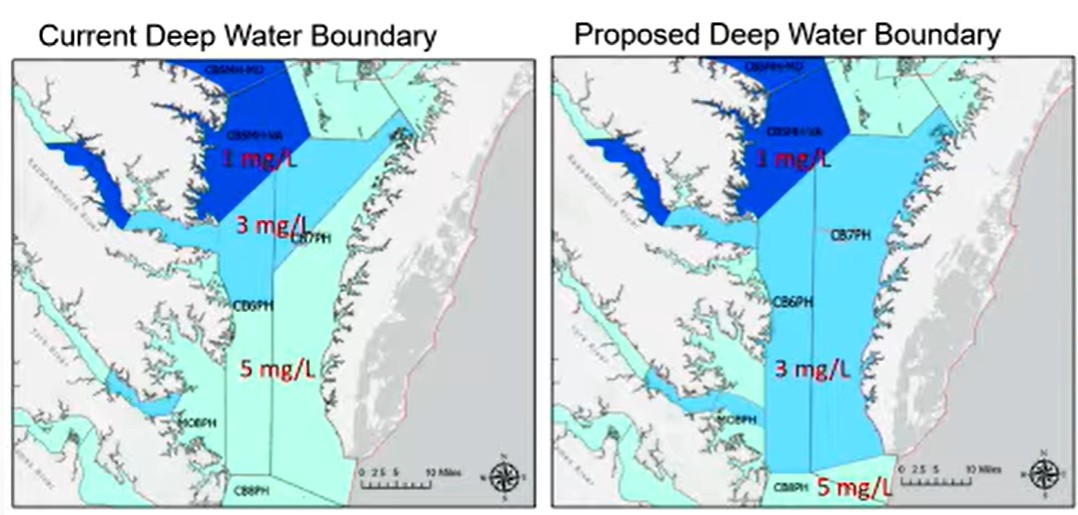
As can be seen in the map above titled "Proposed Deep Water Boundary," the board proposes to substantially expand the portion of the bay where the less stringent criteria applies during the warmer months to extend southward toward the bay's mouth. According to DEQ, when EPA established the current boundaries in 2004 there was an assumption that due to the proximity to the Atlantic Ocean there would be constant recharging of the bottom waters in the areas closest to the mouth; as a result, that the naturally occurring DO levels would not deviate substantially at different depths during the summer. DEQ staff have found that this assumption is not matching up with their monitoring data. There is some recharge and replenishment, but not enough to disturb the stratification that results in the low DO at greater depths. Thus, the board proposes to extend the area where the less stringent criteria applies from June 1 through September 30.
Dissolved Oxygen Criteria and Tenths' Placeholders. In the current regulation there are five DO criteria for the Bay and its tidal tributaries that are whole numbers. The board proposes to add ".0" after these whole numbers. For example, where there are migratory fish spawning, the current regulation requires that the instantaneous DO be at least 5 mg/L. The board proposes to amend the minimum to be 5.0 mg/L.
Assessment of Attainment of Dissolved Oxygen Criteria. The current regulation restricts the assessment of bay DO criteria to the cumulative frequency distribution method. The board proposes to allow for the use of other DEQ-approved methods.
Dissolved Oxygen Criteria for Tidal Chickahominy and Pocomoke Rivers. DEQ staff have recently determined that the water quality in the tidal Chickahominy is significantly influenced by surrounding wetlands. Wetlands have a depressing effect on DO5 and the agency has been recording low DO in this system. According to DEQ, EPA has developed a special DO criterion for situations like this. Thus, the board proposes that special less stringent DO criterion be applied to the tidal Chickahominy. DEQ staff have observed a similar situation on the Eastern Shore with the oligohaline portion of the tidal Pocomoke River, which is shared between Maryland and Virginia. It sits right on the state boundary and Maryland has adopted that special EPA DO criterion for wetland influence water bodies whereas Virginia has been using the default DO criterion of 5 milligrams per liter. Thus, the board proposes that the special DO criterion be applied to Virginia's portion of the Pocomoke River as well.
Perfluorooctanoic Acid and Perfluorooctane Sulfonate Criteria. The current regulation does not have aquatic life criteria for PFOA and PFOS. These are two chemicals in the class of chemicals known as per- and polyfluoroalkyl substances (PFAS), also known as forever chemicals. According to the EPA, peer-reviewed scientific studies have shown that exposure to certain levels of PFAS may lead to:6
- Reproductive effects such as decreased fertility or increased high blood pressure in pregnant women;
- Developmental effects or delays in children, including low birth weight, accelerated puberty, bone variations, or behavioral changes;
- Increased risk of some cancers, including prostate, kidney, and testicular cancers;
- Reduced ability of the body's immune system to fight infections, including reduced vaccine response;
- Interference with the body's natural hormones; and
- Increased cholesterol levels and/or risk of obesity.
The federal agency points out that eating fish and other seafood and drinking water that contain PFAS are among the ways people may be exposed to PFAS. Aquatic organisms are also negatively affected by PFAS.7 To address these negative effects, the board proposes to set EPA's aquatic life criteria for PFOA and PFOS, which are designed to safeguard aquatic life by reducing exposure to these contaminants.
Copper Biotic Ligand Model. Both the current and proposed regulations allow for the use of either the standard hardness-based freshwater copper criteria or the alternative BLM copper criteria. Under the current regulation, BLM-derived criteria for each specific site would have to be promulgated through the regulatory process, which can take two or more years. Consequently, BLM has not been used in practice. Under the proposed regulation, the regulatory process would not be needed to effectively implement the BLM criteria. The proposed regulation also makes clear that the BLM criteria would be used instead of the hardness-based criteria if both are available.
Estimated Benefits and Costs. Expanding the Deep Water Aquatic Life Designated Use Area in the Virginia Portion of the Chesapeake Bay. The proposed expansion in the Bay of where the less stringent DO criteria applies from June 1 through September 30 could potentially affect facilities with a dissolved oxygen permit limit that discharge in the newly less stringent area. Such facilities could potentially benefit by saving on costs or increasing production with a more permissive TMDL or effluent limitations. In practice, DEQ does not expect substantial changes in point source permitting.
Dissolved Oxygen Criteria and Tenths' Placeholders. According to DEQ, where the criteria are whole numbers, the data is rounded up. For example, for the migratory fish spawning areas an instantaneous DO reading of 4.6 mg/L would be rounded up to 5 and would be assessed as meeting the minimum of 5 mg/L. Under the board proposed minimum of 5.0 mg/L, the reading 4.6 mg/L would not be assessed as meeting the minimum of 5.0 mg/L. Though it is possible that this could cause a permittee to take action where there would be no need under the current regulation, DEQ believes that this would be unlikely in practice.
Assessment of Attainment of Dissolved Oxygen Criteria. According to DEQ, the cumulative frequency distribution method does not allow for the assessment of all bay DO criteria using all existing data sets. The proposal to allow for the use of other DEQ approved methods would enable DEQ to conduct more complete assessments of the DO criteria, improving accuracy.
Dissolved Oxygen Criteria for Tidal Chickahominy and Pocomoke Rivers. Similar to the proposed expansion in the bay of where the less stringent DO criteria applies, the proposed reduction in stringency of DO criteria for the tidal Chickahominy and Pocomoke Rivers could potentially affect facilities with a dissolved oxygen permit limit that discharge in these tidal rivers. Such facilities could potentially benefit by saving on costs or increasing production with a more permissive TMDL or effluent limitations. In practice though, DEQ does not expect substantial changes in point source permitting.
Perfluorooctanoic Acid and Perfluorooctane Sulfonate Criteria. Facilities that are found to discharge PFOS and PFOA contaminants at levels that exceed the proposed aquatic life criteria may incur costs. Such facilities may need to increase monitoring and conduct treatment activities or reduce discharge. To the extent that the proposed aquatic life criteria result in reduced discharge of PFOS and PFOA into the bay, there may be some reduction in the occurrences of the negative health outcomes described above for people as well as aquatic life. In practice, DEQ expects that a few facilities may be required to do increased monitoring but believe it is unlikely that any facilities will have to take any other action to maintain their permit. If there are some facilities that need to take action beyond monitoring, they would be given a compliance schedule (up to five years) to meet the criteria.
Copper Biotic Ligand Model. The proposal allows the use of the BLM copper criteria without promulgating each individual BLM-derived copper criterion. This would save staff time for both DEQ and the facility owner applying for a permit. It could also enable the facility to operate sooner.
Businesses and Other Entities Affected. Entities that operate facilities subject to VPDES permitting may potentially be affected by the proposed amendments as related to discharge permits. In particular, DEQ estimates that there are 268 industrial dischargers that may be subject to additional monitoring requirements due to the potential for manufacturing sources of PFAS. Additionally, permittees that discharge into the tidal Chickahominy and Pocomoke Rivers and the portion of the Bay where the less stringent DO criteria would newly apply during warmer months may also be particularly affected. According to the agency, 146 permittees currently have copper limits and may be affected by the modified language for the copper BLM. Municipally-owned wastewater treatment plants comprise 36 percent of these permittees, while industrial facilities make up the rest. There are other permittees that currently do not have copper limits but may be required to have them when their permits are renewed. The Code of Virginia requires DPB to assess whether an adverse impact may result from the proposed regulation.8 An adverse impact is indicated if there is any increase in net cost or reduction in net benefit for any entity, even if the benefits exceed the costs for all entities combined.9 As noted above, some industrial dischargers may encounter additional costs through the proposed PFAS criteria. Thus, an adverse impact is indicated.
Small Businesses10 Affected.11
Types and Estimated Number of Small Businesses Affected. The proposal to incorporate PFAS criteria may moderately increase costs for manufacturers that discharge PFAS. DEQ does not have an estimate of the number that qualify as small businesses.
Costs and Other Effects. The costs would most likely occur from increased monitoring.
Alternative Method that Minimizes Adverse Impact. There are no clear alternative methods that both reduce adverse impact and meet the intended policy goals.
Localities12 Affected.13 Localities throughout the Commonwealth may be affected, but localities adjacent to the Chesapeake Bay or the Chickahominy and Pocomoke Rivers may be particularly affected. The proposed amendments are unlikely to introduce costs for local governments.
Projected Impact on Employment. The proposed amendments are unlikely to substantively affect total employment.
Effects on the Use and Value of Private Property. As discussed above, for the most part DEQ does not expect that the proposed amendments would require substantive new actions or reductions in actions. The proposed PFAS criteria would likely require some additional monitoring, which would impose a small new cost, but would not likely substantively affect the value of firms required to do such additional monitoring. The proposed amendments are unlikely to substantively affect real estate development costs.
_____________________________
1 Section 2.2-4007.04 of the Code of Virginia requires that such economic impact analyses determine the public benefits and costs of the proposed amendments. Further the analysis should include but not be limited to: (1) the projected number of businesses or other entities to whom the proposed regulatory action would apply, (2) the identity of any localities and types of businesses or other entities particularly affected, (3) the projected number of persons and employment positions to be affected, (4) the projected costs to affected businesses or entities to implement or comply with the regulation, and (5) the impact on the use and value of private property.
2 More specifically: (a) 30-day mean ≥ 5.5 mg/l (tidal habitats with 0-0.5 ppt salinity), (b) 30-day mean ≥ 5.0 mg/l (tidal habitats with > 0.5 ppt salinity), (c) 7-day mean ≥ 4.0 mg/l, (d) instantaneous minimum ≥ 3.2 mg/l at temperatures < 29°C, and (e) instantaneous minimum ≥ 4.3 mg/l at temperatures ≥ 29°C.
3 More specifically: (a) 30-day mean ≥ 3 mg/l, (b) 1-day mean ≥ 2.3 mg/l, and (c) instantaneous minimum ≥ 1.7 mg/l.
4 The maps are courtesy of the Department of Environmental Quality.
5 Source: DEQ.
6 See https://www.epa.gov/pfas/our-current-understanding-human-health-and-environmental-risks-pfas.
7 See https://www.sciencedirect.com/science/article/abs/pii/S0025326X25001535.
8 Pursuant to § 2.2-4007.04 D: In the event this economic impact analysis reveals that the proposed regulation would have an adverse economic impact on businesses or would impose a significant adverse economic impact on a locality, business, or entity particularly affected, the Department of Planning and Budget shall advise the Joint Commission on Administrative Rules, the House Committee on Appropriations, and the Senate Committee on Finance. Statute does not define "adverse impact," state whether only Virginia entities should be considered, nor indicate whether an adverse impact results from regulatory requirements mandated by legislation.
9 Statute does not define "adverse impact," state whether only Virginia entities should be considered, nor indicate whether an adverse impact results from regulatory requirements mandated by legislation. As a result, DPB has adopted a definition of adverse impact that assesses changes in net costs and benefits for each affected Virginia entity that directly results from discretionary changes to the regulation.
10 Pursuant to § 2.2-4007.04, small business is defined as "a business entity, including its affiliates, that (i) is independently owned and operated and (ii) employs fewer than 500 full-time employees or has gross annual sales of less than $6 million."
11 If the proposed regulatory action may have an adverse effect on small businesses, § 2.2-4007.04 requires that such economic impact analyses include: (1) an identification and estimate of the number of small businesses subject to the proposed regulation, (2) the projected reporting, recordkeeping, and other administrative costs required for small businesses to comply with the proposed regulation, including the type of professional skills necessary for preparing required reports and other documents, (3) a statement of the probable effect of the proposed regulation on affected small businesses, and (4) a description of any less intrusive or less costly alternative methods of achieving the purpose of the proposed regulation. Additionally, pursuant to § 2.2-4007.1 of the Code of Virginia, if there is a finding that a proposed regulation may have an adverse impact on small business, the Joint Commission on Administrative Rules shall be notified.
12 "Locality" can refer to either local governments or the locations in the Commonwealth where the activities relevant to the regulatory change are most likely to occur.
13 Section 2.2-4007.04 defines "particularly affected" as bearing disproportionate material impact.
Agency Response to Economic Impact Analysis: The State Water Control Board has reviewed the economic impact analysis prepared by the Department of Planning and Budget and has no comment.
Summary:
The proposed amendments update numerical and narrative criteria, use designations, and other requirements based on current scientific information. The changes include (i) expanding the Virginia portion of the Chesapeake Bay that is designated for Deep Water Aquatic Life Designated Use; (ii) adding the U.S. Environmental Protection Agency's (EPA) aquatic life criteria for perfluorooctanoic acid (PFOA) and perfluorooctane sulfonate (PFOS); (iii) updating the Biotic Ligand Model option for copper criteria; (iv) adding a decimal place to the five dissolved oxygen (DO) criteria that are currently whole numbers; (v) allowing use of Department of Environmental Quality-approved methods in addition to the cumulative frequency distribution to assess attainment of Chesapeake Bay DO criteria; (vi) adding special DO criteria for the tidal Chickahominy and Pocomoke Rivers; and (vii) incorporating by reference the document, Boundary of the Deep Water Designated Use in Virginia's Chesapeake Bay Mainstem.
9VAC25-260-10. Designation of uses.
A. All state waters, including wetlands, are designated for the following uses: recreational uses, e.g., swimming and boating; the propagation and growth of a balanced, indigenous population of aquatic life, including game fish, which might reasonably be expected to inhabit them; wildlife; and the production of edible and marketable natural resources, e.g., fish and shellfish.
B. Subcategories of the propagation and growth of a balanced indigenous population of aquatic life, including game fish designated use for waters in the Chesapeake Bay and its tidal tributaries are listed in this subsection.
1. Migratory Fish Spawning and Nursery Designated Use: waters in the Chesapeake Bay and its tidal tributaries that protect the survival, growth, and propagation of the early life stages of a balanced, indigenous population of anadromous, semi-anadromous, catadromous, and tidal-fresh resident fish species inhabiting spawning and nursery grounds. This designated use extends from the end of tidal waters to the downriver end of spawning and nursery habitats that have been determined through a composite of all targeted anadromous and semi-anadromous fish species' spawning and nursery habitats (see boundaries in U.S. Environmental Protection Agency, 2004, Technical Support Document for Identification of Chesapeake Bay Designated Uses and Attainability 2004 Addendum, Chesapeake Bay Program Office, Annapolis, Maryland). This designated use extends horizontally from the shoreline of the body of water to the adjacent shoreline, and extends down through the water column to the bottom water-sediment interface. This use applies February 1 through May 31 and applies in addition to the open-water use described in this subsection.
2. Shallow-water Submerged Aquatic Vegetation Designated Use: waters in the Chesapeake Bay and its tidal tributaries that support the survival, growth, and propagation of submerged aquatic vegetation (rooted, underwater bay grasses). This use applies April 1 through October 31 in tidal-fresh, oligohaline, and mesohaline Chesapeake Bay Program segments, and March 1 through November 30 in polyhaline Chesapeake Bay Program segments and applies in addition to the open-water use described in this subsection.
3. Open Water Aquatic Life Designated Use: waters in the Chesapeake Bay and its tidal tributaries that protect the survival, growth, and propagation of a balanced, indigenous population of aquatic life inhabiting open-water habitats. This designated use applies year-round but the vertical boundaries change seasonally. October 1 through May 31, the open water aquatic life use extends horizontally from the shoreline at mean low water, to the adjacent shoreline, and extending through the water column to the bottom water-sediment interface. June 1 through September 30, if a pycnocline is present and, in combination with bottom bathymetry and water column circulation patterns, presents a barrier to oxygen replenishment of deeper waters, this designated use extends down into the water column only as far as the upper boundary of the pycnocline. June 1 through September 30, if a pycnocline is present but other physical circulation patterns (such as influx of oxygen rich oceanic bottom waters) provide for oxygen replenishment of deeper waters, the open-water aquatic life designated use extends down into the bottom water-sediment interface (see boundaries in U.S. Environmental Protection Agency, 2004 Technical Support Document for Identification of Chesapeake Bay Designated Uses and Attainability 2004 Addendum, Chesapeake Bay Program Office, Annapolis, Maryland). This designated use includes the migratory fish spawning and nursery and shallow-water submerged aquatic vegetation uses.
4. Deep Water Aquatic Life Designated Use: waters in the Chesapeake Bay and its tidal tributaries that protect the survival and growth of a balanced, indigenous population of aquatic life inhabiting deep-water habitats. This designated use extends to the tidally influenced waters located between the upper and lower boundaries of the pycnocline where, in combination with bottom bathymetry and water circulation patterns, a pycnocline is present and presents a barrier to oxygen replenishment of deeper waters. In some areas, the deep-water designated use extends from the upper boundary of the pycnocline down to the bottom water-sediment interface (see boundaries in U.S. Environmental Protection Agency, 2004 Technical Support Document for Identification of Chesapeake Bay Designated Uses and Attainability 2004 Addendum, Chesapeake Bay Program Office, Annapolis, Maryland) and the updated boundaries in the Chesapeake Bay mainstem and Mobjack Bay as described in the DEQ 2025 technical support document titled "Boundary of the Deep Water Designated Use in Virginia's Chesapeake Bay Mainstem." This use applies June 1 through September 30.
5. Deep Channel Seasonal Refuge Designated Use: waters in the Chesapeake Bay and its tidal tributaries that protect the survival of a balanced, indigenous population of benthic infauna and epifauna inhabiting deep-channel habitats. This designated use extends to the tidally influenced waters at depths greater than the lower boundary of the pycnocline in areas where, in combination with bottom bathymetry and water circulation patterns, the pycnocline presents a barrier to oxygen replenishment of deeper waters (see boundaries in U.S. Environmental Protection Agency, 2004 Technical Support Document for Identification of Chesapeake Bay Designated Uses and Attainability 2004 Addendum, Chesapeake Bay Program Office, Annapolis, Maryland). This use applies June 1 through September 30.
C. In designating uses of a water body and the appropriate criteria for those uses, the board shall take into consideration the water quality standards of downstream waters and shall ensure that its water quality standards provide for the attainment and maintenance of the water quality standards of downstream waters.
D. The board may adopt subcategories of a use and set the appropriate criteria to reflect varying needs of such subcategories of uses, for instance, to differentiate between cold water (trout streams) and warm water fisheries.
E. At a minimum, uses are deemed attainable if they can be achieved by the imposition of effluent limits required under §§ 301(b)(1)(A) and (B) and 306 of the Clean Water Act and cost-effective and reasonable best management practices for nonpoint source control.
F. Prior to adding or removing any use, or establishing subcategories of a use, the board shall provide notice and an opportunity for a public hearing under the Administrative Process Act (§ 2.2-4000 et seq. of the Code of Virginia).
G. The board may adopt seasonal uses as an alternative to reclassifying a water body or segment thereof to uses requiring less stringent water quality criteria. If seasonal uses are adopted, water quality criteria should be adjusted to reflect the seasonal uses; however, such criteria shall not preclude the attainment and maintenance of a more protective use in another season.
H. The board may remove a designated use which that is not an existing use, or establish subcategories of a use, if the board can demonstrate that attaining the designated use is not feasible because:
1. Naturally occurring pollutant concentrations prevent the attainment of the use;
2. Natural, ephemeral, intermittent, or low flow conditions or water levels prevent the attainment of the use unless these conditions may be compensated for by the discharge of sufficient volume of effluent discharges without violating state water conservation requirements to enable uses to be met;
3. Human caused conditions or sources of pollution prevent the attainment of the use and cannot be remedied or would cause more environmental damage to correct than to leave in place;
4. Dams, diversions, or other types of hydrologic modifications preclude the attainment of the use, and it is not feasible to restore the water body to its original condition or to operate such modification in a way that would result in the attainment of the use;
5. Physical conditions related to the natural features of the water body, such as the lack of a proper substrate, cover, flow, depth, pools, riffles, and the like, unrelated to water quality, preclude attainment of aquatic life protection uses; or
6. Controls more stringent than those required by §§ 301(b) and 306 of the Clean Water Act would result in substantial and widespread economic and social impact.
I. The board may not remove designated uses if:
1. They The designated uses are existing uses, unless a use requiring more stringent criteria is added; or
2. Such uses will be attained by implementing effluent limits required under §§ 301(b)(1)(A) and (B) and 306 of the Clean Water Act and by implementing cost-effective and reasonable best management practices for nonpoint source control.
J. Where existing water quality standards specify designated uses less than those which that are presently being attained, the board shall revise its standards to reflect the uses actually being attained.
K. The board must conduct a use attainability analysis whenever:
1. The board designates or has designated uses that do not include the uses specified in § 101(a)(2) of the Clean Water Act; or
2. The board wishes to remove a designated use that is specified in § 101(a)(2) of the Clean Water Act or to adopt subcategories of uses specified in § 101(a)(2) of the Clean Water Act which require less stringent criteria.
L. The board is not required to conduct a use attainability analysis under this chapter whenever designating uses which that include those specified in subsection A of this section.
9VAC25-260-140. Criteria for surface water.
A. Instream water quality conditions shall not be acutely1 or chronically2 toxic except as allowed in 9VAC25-260-20 B (mixing zones). The following are definitions of acute and chronic toxicity conditions:
"Acute toxicity" means an adverse effect that usually occurs shortly after exposure to a pollutant. Lethality to an organism is the usual measure of acute toxicity. Where death is not easily detected, immobilization is considered equivalent to death.
"Chronic toxicity" means an adverse effect that is irreversible or progressive or occurs because the rate of injury is greater than the rate of repair during prolonged exposure to a pollutant. This includes low level, long-term effects such as reduction in growth or reproduction.
B. The following table is a list of numerical water quality criteria for specific parameters.
|
Table of Parameters6, 7
|
|
PARAMETER
CAS Number
|
USE DESIGNATION
|
|
AQUATIC LIFE
|
HUMAN HEALTH
|
|
FRESHWATER
|
SALTWATER
|
Public Water Supply3
|
All Other Surface Waters4
|
|
Acute1
|
Chronic2
|
Acute1
|
Chronic2
|
|
EDITOR'S NOTE: Rows Acenapthene through Pentachlorophenol of 9VAC25-260-140 B are not amended; therefore, the text of those rows is not set out.
|
|
Perfluorooctanoic acid (PFOA) (µg/l)
45285516; 335671; 3825261
|
3,100
|
100
See footnote 9 for tissue values
|
|
|
|
|
|
Perfluorooctane sulfonate (PFOS) (µg/l)
45298906; 1763231; 2795393; 56773423; 4021470; 29457725
|
71
|
0.25
See footnote 10 for tissue values
|
|
|
|
|
|
EDITOR'S NOTE: Rows pH through Toxaphene of 9VAC25-260-140 B are not amended; therefore, the text of those rows is not set out.
|
|
Tributyltin (µg/l)
E1790678 E1790679
|
0.46
|
0.072
|
0.42
|
0.0074
|
|
|
|
EDITOR'S NOTE: Rows 1, 2, 4 Trichlorobenzene through Zinc of 9VAC25-260-140 B are not amended; therefore, the text of those rows is not set out.
|
|
1One hour average concentration not to be exceeded more than once every 3 three years on the average, unless otherwise noted.
2Four-day average concentration not to be exceeded more than once every 3 three years on the average, unless otherwise noted.
3Criteria have been calculated to protect human health from toxic effects through drinking water and fish consumption, unless otherwise noted and apply in segments designated as PWS in 9VAC25-260-390 through 9VAC25-260-540. Human health criteria are based on the assumption of average amount of exposure on a long-term basis.
4Criteria have been calculated to protect human health from toxic effects through fish consumption, unless otherwise noted and apply in all other surface waters not designated as PWS in 9VAC25-260-390 through 9VAC25-260-540. Human health criteria are based on the assumption of average amount of exposure on a long-term basis.
5Acute and chronic saltwater and freshwater aquatic life criteria apply to the biologically available form of the metal and apply as a function of the pollutant's water effect ratio (WER) as defined in 9VAC25-260-140 F (WER X criterion). Metals measured as dissolved shall be considered to be biologically available, or, because local receiving water characteristics may otherwise affect the biological availability of the metal, the biologically available equivalent measurement of the metal can be further defined by determining a water effect ratio (WER) and multiplying the numerical value shown in 9VAC25-260-140 B by the WER. Refer to 9VAC25-260-140 F. Values displayed above in the table are examples and correspond to a WER of 1.0. Metals criteria have been adjusted to convert the total recoverable fraction to dissolved fraction using a conversion factor. Criteria that change with hardness have the conversion factor listed in the table above Table of Parameters6, 7.
6The flows listed below in the Aquatic Life table are default design flows for calculating steady state wasteload allocations unless statistically valid methods are employed which that demonstrate compliance with the duration and return frequency of the water quality criteria.
|
Aquatic Life:
|
|
Acute criteria
|
1Q10
|
|
Chronic criteria
|
7Q10
|
|
Chronic criteria (ammonia)
|
30Q10
|
|
Human Health:
|
|
Noncarcinogens
|
30Q5
|
|
Carcinogens
|
Harmonic mean
|
The following are defined for this section:
"1Q10" means the lowest flow averaged over a period of 1 one day which on a statistical basis can be expected to occur once every 10 climatic years.
"7Q10" means the lowest flow averaged over a period of 7 seven consecutive days that can be statistically expected to occur once every 10 climatic years.
"30Q5" means the lowest flow averaged over a period of 30 consecutive days that can be statistically expected to occur once every 5 five climatic years.
"30Q10" means the lowest flow averaged over a period of 30 consecutive days that can be statistically expected to occur once every 10 climatic years.
"Averaged" means an arithmetic mean.
"Climatic year" means a year beginning on April 1 and ending on March 31.
7The criteria listed in this table are two significant digits with the exception of criteria values for the animal tissue concentrations for perfluorooctanoic acid (PFOA) and perfluorooctane sulfonate (PFOS). In footnote 8, all digits for these criteria values are significant. For other criteria that are referenced to other sections of this regulation in this table, all numbers listed as criteria values are significant.
8The fish tissue criterion for methylmercury applies to a concentration of 0.30 mg/kg as wet weight in edible tissue for species of fish and shellfish resident in a waterbody that are commonly eaten in the area and have commercial, recreational, or subsistence value.
9 Perfluorooctanoic acid (PFOA) - Duration for invertebrate/fish tissue is instantaneous and not to be exceeded.
1.18 mg/kg wet weight in invertebrate whole-body tissue.
6.49 mg/kg wet weight fish whole-body tissue.
0.133 mg/kg wet weight fish muscle tissue.
10 Perfluorooctane sulfonate (PFOS) - Duration for invertebrate/fish tissue is instantaneous and not to be exceeded.
0.028 mg/kg wet weight in invertebrate whole-body tissue.
0.201 mg/kg wet weight fish whole-body tissue.
0.087 mg/kg wet weight fish muscle tissue.
|
C. Application of freshwater and saltwater numerical criteria. The numerical water quality criteria listed in subsection B of this section (excluding dissolved oxygen, pH, temperature) shall be applied according to the following classes of waters (see 9VAC25-260-50) and boundary designations:
|
CLASS OF WATERS
|
NUMERICAL CRITERIA
|
|
I and II (Estuarine Waters)
|
Saltwater criteria apply
|
|
II (Transition Zone)
|
More stringent of either the freshwater or saltwater criteria apply
|
|
II (Tidal Freshwater), III, IV, V, VI and VII
|
Freshwater criteria apply
|
The following describes the boundary designations for Class II, (estuarine, transition zone, and tidal freshwater waters) by river basin:
1. Rappahannock Basin. Tidal freshwater is from the fall line of the Rappahannock River to the upstream boundary of the transition zone including all tidal tributaries that enter the tidal freshwater Rappahannock River.
Transition zone upstream boundary – N38° 4' 56.59"/W76° 58' 47.93" (430 feet east of Hutchinson Swamp) to N38° 5' 23.33"/W76° 58' 24.39" (0.7 miles upstream of Peedee Creek).
Transition zone downstream boundary – N37° 58' 45.80"/W76° 55' 28.75" (1,000 feet downstream of Jenkins Landing) to N37° 59' 20.07/W76° 53' 45.09" (0.33 miles upstream of Mulberry Point). All tidal waters that enter the transition zone are themselves transition zone waters.
Estuarine waters are from the downstream boundary of the transition zone to the mouth of the Rappahannock River (Buoy 6), including all tidal tributaries that enter the estuarine waters of the Rappahannock River.
2. York Basin. Tidal freshwater is from the fall line of the Mattaponi River at N37° 47' 20.03"/W77° 6' 15.16" (800 feet upstream of the Route 360 bridge in Aylett) to the upstream boundary of the Mattaponi River transition zone, and from the fall line of the Pamunkey River at N37° 41' 22.64"/W77° 12' 50.83" (2,000 feet upstream of Totopotomy Creek) to the upstream boundary of the Pamunkey River transition zone, including all tidal tributaries that enter the tidal freshwaters of the Mattaponi and Pamunkey Rivers.
Mattaponi River transition zone upstream boundary – N37° 39' 29.65"/W76° 52' 53.29" (1,000 feet upstream of Mitchell Hill Creek) to N37° 39' 24.20"/W76° 52' 55.87" (across from Courthouse Landing).
Mattaponi River transition zone downstream boundary – N37° 32' 19.76"/W76° 47' 29.41" (old Lord Delaware Bridge, west side) to N37° 32' 13.25"/W76° 47' 10.30" (old Lord Delaware Bridge, east side).
Pamunkey River transition zone upstream boundary – N37° 32' 36.63"/W76° 58' 29.88" (Cohoke Marsh, 0.9 miles upstream of Turkey Creek) to N37° 32' 36.51"/W76° 58' 36.48" (0.75 miles upstream of creek at Cook Landing).
Pamunkey River transition zone downstream boundary – N37° 31' 57.90"/W76° 48' 38.22" (old Eltham Bridge, west side) to N37° 32' 6.25"/W76° 48' 18.82" (old Eltham Bridge, east side).
All tidal tributaries that enter the transition zones of the Mattaponi and Pamunkey Rivers are themselves in the transition zone.
Estuarine waters are from the downstream boundary of the transition zones of the Mattaponi and Pamunkey Rivers to the mouth of the York River (Tue Marsh Light) including all tidal tributaries that enter the estuarine waters of the York River.
3. James Basin. Tidal freshwater is from the fall line of the James River in the City of Richmond upstream of Mayo Bridge to the upstream boundary of the transition zone, including all tidal tributaries that enter the tidal freshwater James River.
James River transition zone upstream boundary – N37° 14' 28.25"/W76° 56' 44.47" (at Tettington) to N37° 13' 38.56"/W76° 56' 47.13" (0.3 miles downstream of Sloop Point).
Chickahominy River transition zone upstream boundary – N37° 25' 44.79"/W77° 1' 41.76" (Holly Landing) N37° 24' 25"/W76° 56' 16" (Walker's Dam).
Transition zone downstream boundary – N37° 12' 7.23"/W76° 37' 34.70" (near Carters Grove Home, 1.25 miles downstream of Grove Creek) to N37° 9' 17.23"/W76° 40' 13.45" (0.7 miles upstream of Hunnicutt Creek). All tidal waters that enter the transition zone are themselves transition zone waters.
Estuarine waters are from the downstream transition zone boundary to the mouth of the James River (Buoy 25) including all tidal tributaries that enter the estuarine waters of the James River.
4. Potomac Basin. Tidal freshwater includes all tidal tributaries that enter the Potomac River from its fall line at the Chain Bridge (N38° 55' 46.28"/W77° 6' 59.23") to the upstream transition zone boundary near Quantico, Virginia.
Transition zone includes all tidal tributaries that enter the Potomac River from N38° 31' 27.05"/W77° 17' 7.06" (midway between Shipping Point and Quantico Pier) to N38° 23' 22.78"/W77° 1' 45.50" (one mile southeast of Mathias Point).
Estuarine waters includes all tidal tributaries that enter the Potomac River from the downstream transition zone boundary to the mouth of the Potomac River (Buoy 44B).
5. Chesapeake Bay, Atlantic Ocean, and small coastal basins. Estuarine waters include the Atlantic Ocean tidal tributaries, and the Chesapeake Bay and its small coastal basins from the Virginia state line to the mouth of the bay (a line from Cape Henry drawn through Buoys 3 and 8 to Fishermans Island), and its tidal tributaries, excluding the Potomac tributaries and those tributaries listed in subdivisions 1 through 4 of this subsection.
6. Chowan River Basin. Tidal freshwater includes the Northwest River and its tidal tributaries from the Virginia-North Carolina state line to the free flowing portion, the Blackwater River and its tidal tributaries from the Virginia-North Carolina state line to the end of tidal waters at approximately state route 611 at river mile 20.90, the Nottoway River and its tidal tributaries from the Virginia-North Carolina state line to the end of tidal waters at approximately Route 674, and the North Landing River and its tidal tributaries from the Virginia-North Carolina state line to the Great Bridge Lock.
Transition zone includes Back Bay and its tributaries in the City of Virginia Beach to the Virginia-North Carolina state line.
D. Site-specific modifications to numerical water quality criteria.
1. The board may consider site-specific modifications to numerical water quality criteria in subsection B of this section where the applicant or permittee demonstrates that the alternate numerical water quality criteria are sufficient to protect all designated uses (see 9VAC25-260-10) of that particular surface water segment or body.
2. Any demonstration for site-specific human health criteria shall be restricted to a reevaluation of the bioconcentration or bioaccumulation properties of the pollutant. The exceptions to this restriction are for site-specific criteria for taste, odor, and aesthetic compounds noted by double asterisks in subsection B of this section and nitrates.
3. Procedures for promulgation and review of site-specific modifications to numerical water quality criteria resulting from subdivisions 1 and 2 of this subsection.
a. Proposals describing the details of the site-specific study shall be submitted to the board's staff for approval prior to commencing the study.
b. Any site-specific modification shall be promulgated as a regulation in accordance with the Administrative Process Act (§ 2.2-4000 et seq. of the Code of Virginia). All site-specific modifications shall be listed in 9VAC25-260-310 (Special standards and requirements).
E. Variances to water quality standards.
1. A variance from numeric criteria may be granted to a discharger if it can be demonstrated that one or more of the conditions in 9VAC25-260-10 H limit the attainment of one or more specific designated uses.
a. Variances shall apply only to the discharger to whom they the variances are granted and shall be reevaluated and either continued, modified, or revoked at the time of permit issuance. At that time the permittee shall make a showing that the conditions for granting the variance still apply.
b. Variances shall be described in the public notice published for the permit. The decision to approve a variance shall be subject to the public participation requirements of the Virginia Pollutant Discharge Elimination System (VPDES) Permit Regulation, 9VAC25-31.
c. Variances shall not prevent the maintenance and protection of existing uses or exempt the discharger or regulated activity from compliance with other appropriate technology or water quality-based limits or best management practices.
d. Variances granted under this section shall not apply to new discharges.
e. Variances shall be submitted by the department's Division of Scientific Research or its successors to the U.S. Environmental Protection Agency for review and approval or disapproval.
f. A list of variances granted shall be maintained by the department's Division of Scientific Research or its successors.
2. None of the variances in this subsection shall apply to the halogen ban section (9VAC25-260-110) or temperature criteria in 9VAC25-260-50 if superseded by § 316(a) of the Clean Water Act requirements. No variances in this subsection shall apply to the criteria that are designed to protect human health from carcinogenic and noncarcinogenic toxic effects (subsection B of this section) with the exception of the metals, and the taste, odor, and aesthetic compounds noted by double asterisks and nitrates, listed in subsection B of this section.
F. Water effect ratio.
1. A water effects ratio (WER) shall be determined by measuring the effect of receiving water (as it is or will be affected by any discharges) on the bioavailability or toxicity of a metal by using standard test organisms and a metal to conduct toxicity tests simultaneously in receiving water and laboratory water. The ratio of toxicities of the metals in the two waters is the WER (toxicity in receiving water divided by toxicity in laboratory water equals WER). Once an acceptable WER for a metal is established, the numerical value for the metal in subsection B of this section is multiplied by the WER to produce an instream concentration that will protect designated uses. This instream concentration shall be utilized in permitting decisions.
2. The WER shall be assigned a value of 1.0 unless the applicant or permittee demonstrates to the department's satisfaction in a permit proceeding that another value is appropriate, or unless available data allow the department to compute a WER for the receiving waters. The applicant or permittee is responsible for proposing and conducting the study to develop a WER. The study may require multiple testing over several seasons. The applicant or permittee shall obtain the department's Division of Scientific Research or its successor approval of the study protocol and the final WER.
3. 9VAC25-31-230 C requires that permit limits for metals be expressed as total recoverable measurements. To that end, the study used to establish the WER may be based on total recoverable measurements of the metals.
4. The WER is established in a permit proceeding, shall be described in the public notice associated with the permit proceeding, and applies only to the applicant or permittee in that proceeding. The department's action to approve or disapprove a WER is a case decision, not an amendment to the present regulation.
The decision to approve or disapprove a WER shall be subject to the public participation requirements of Virginia Pollutant Discharge Elimination System (VPDES) Regulation, Part IV (9VAC25-31-260 et seq.). A list of final WERs will be maintained by the department's Division of Scientific Research or its successor.
5. A WER shall not be used for the freshwater and saltwater chronic mercury criteria or the freshwater acute and chronic selenium criteria.
G. Biotic Ligand Model for copper. On a case-by-case basis, EPA's 2007 The copper criteria (EPA-822-F-07-001) biotic ligand model Biotic Ligand Model (BLM) for copper may be used as an alternative to determine alternate the hardness-based freshwater copper criteria in 9VAC25-260-140 B. The copper BLM is described in the document "Aquatic Life Ambient Freshwater Quality Criteria for Copper" (EPA-822-R-07-001). Site-specific BLM-derived criteria, where established, will supersede hardness-based criteria for freshwater sites copper. The BLM is a bioavailability model that uses receiving water characteristics to develop site-specific criteria.
1. Site-specific data for 10 parameters are needed to use the BLM. These parameters are temperature, pH, dissolved organic carbon, calcium, magnesium, sodium, potassium, sulfate, chloride, and alkalinity.
If sufficient 2. Any data for these parameters are available, the BLM can be set used to calculate alternate develop BLM-based criteria values for the copper criteria shall be collected in accordance with a study plan approved by DEQ. The BLM criteria would be used instead of the hardness-based criteria and takes take the place of the hardness adjustment and the WER. A WER will not be applicable with the BLM.
9VAC25-260-185. Criteria to protect designated uses from the impacts of nutrients and suspended sediment in the Chesapeake Bay and its tidal tributaries.
A. Dissolved oxygen. The dissolved oxygen criteria in the following table apply to all Chesapeake Bay waters according to their specified designated use and supersede the dissolved oxygen criteria in 9VAC25-260-50.
|
Designated Use
|
Criteria Concentration/Duration
|
Temporal Application
|
|
Migratory fish spawning and nursery
|
7-day mean ≥ 6 greater than or equal to 6.0 mg/l (tidal habitats with 0-0.5 ppt salinity)
|
February 1 - May 31
|
|
Instantaneous minimum ≥ 5 greater than or equal to 5.0 mg/l
|
|
Open water1
|
30-day mean ≥ greater than or equal to 5.5 mg/l (tidal habitats with 0-0.5 ppt salinity)
|
year-round2
|
|
30-day mean ≥ 5 greater than or equal to 5.0 mg/l (tidal habitats with > greater than 0.5 ppt salinity)
|
|
7-day mean ≥ 4 greater than or equal to 4.0 mg/l
|
|
Instantaneous minimum ≥ greater than or equal to 3.2 mg/l at temperatures < less than 29°C
Instantaneous minimum ≥ greater than or equal to 4.3 mg/l at temperatures ≥ greater than or equal to 29°C
|
|
Deep water
|
30-day mean ≥ 3 greater than or equal to 3.0 mg/l
|
June 1 - September 30
|
|
1-day mean ≥ greater than or equal to 2.3 mg/l
|
|
Instantaneous minimum ≥ greater than or equal to 1.7 mg/l
|
|
Deep channel
|
Instantaneous minimum ≥ greater than or equal to 1 mg/l
|
June 1 - September 30
|
|
1In applying this open water instantaneous criterion to the Chesapeake Bay and its tidal tributaries where the existing water quality for dissolved oxygen exceeds an instantaneous minimum of 3.2 mg/l, that higher water quality for dissolved oxygen shall be provided antidegradation protection in accordance with 9VAC25-260-30 A 2.
2Open-water dissolved oxygen criteria attainment is assessed separately over two time periods: summer (June 1- September 30) and nonsummer (October 1-May 31) months.
|
EDITOR'S NOTE: Subsections B and C of 9VAC25-260-185 are not amended; therefore, the text of those subsections is not set out.
D. Implementation.
EDITOR'S NOTE: Subdivisions D 1 and D 2 of 9VAC25-260-185 are not amended; therefore, the text of those subsections is not set out.
3. Attainment of these criteria shall be assessed through comparison of the generated The cumulative frequency distribution of the monitoring data to the method, where applicable criteria reference curve for each designated use. If the monitoring data cumulative frequency curve is completely contained inside the reference curve, then the segment is in attainment of the designated use. The reference curves, and procedures to be followed are other published in methods approved by DEQ, shall be used to assess attainment of these criteria. These methods include procedures described in the USEPA, Ambient Water Quality Criteria for Dissolved Oxygen, Water Clarity and Chlorophyll a for the Chesapeake Bay and Its Tidal Tributaries, EPA 903-R-03-002, April 2003 and the 2004 (EPA 903-R-03-002 October 2004), 2007 (CBP/TRS 285/07, EPA 903-R-07-003), 2007 (CBP/TRS 288/07, EPA 903-R-07-005), 2008 (CBP/TRS 290-08, EPA 903-R-08-001), 2010 (CBP/TRS 301-10, EPA 903-R-10-002), and 2017 (CBP/TRS 320-17, EPA 903-R-17-002) addenda. An exception to this requirement is in measuring attainment of the SAV and water clarity acres, which are compared directly to the criteria.
9VAC25-260-187. Criteria for man-made lakes and reservoirs to protect aquatic life and recreational designated uses from the impacts of nutrients.
A. The criteria in subsection B of this section apply to the man-made lakes and reservoirs listed in this section. Additional man-made lakes and reservoirs may be added as new reservoirs are constructed or monitoring data become available from outside groups or future agency monitoring.
B. Whether or not algicide treatments are used, the chlorophyll a criteria apply to all waters on the list. The total phosphorus criteria apply only if a specific man-made lake or reservoir received algicide treatment during the monitoring and assessment period of April 1 through October 31.
The 90th percentile of the chlorophyll a data collected at one meter or less within the lacustrine portion of the man-made lake or reservoir between April 1 and October 31 shall not exceed the chlorophyll a criterion for that waterbody in each of the two most recent monitoring years that chlorophyll a data are available. For a waterbody that received algicide treatment, the median of the total phosphorus data collected at one meter or less within the lacustrine portion of the man-made lake or reservoir between April 1 and October 31 shall not exceed the total phosphorus criterion in each of the two most recent monitoring years that total phosphorus data are available.
Monitoring data used for assessment shall be from sampling locations within the lacustrine portion where observations are evenly distributed over the seven months from April 1 through October 31 and are in locations that are representative, either individually or collectively, of the condition of the man-made lake or reservoir.
|
Man-made Lake or Reservoir Name
|
Location
|
Chlorophyll a (μg/L)
|
Total Phosphorus (μg/L)
|
|
EDITOR'S NOTE: Rows Able Lake through Lake Connor of 9VAC25-260-187 B are not amended; therefore, the text of those rows is not set out.
|
|
Lake Culpeper
|
Culpeper County
|
35
|
40
|
|
EDITOR'S NOTE: Rows Lake Frederick through Lake Orange of 9VAC25-260-187 B are not amended; therefore, the text of those rows is not set out.
|
|
Lake Pelham
|
Culpeper County
|
35
|
40
|
|
EDITOR'S NOTE: Rows Lake Prince through Wise Reservoir of 9VAC25-260-187 B are not amended; therefore, the text of those rows is not set out.
|
C. When the board determines that the applicable criteria in subsection B of this section for a specific man-made lake or reservoir are exceeded, the board shall consult with the Department of Wildlife Resources regarding the status of the fishery in determining whether or not the designated use for that waterbody is being attained. If the designated use of the subject waterbody is not being attained, the board shall assess the waterbody as impaired in accordance with § 62.1-44.19:5 of the Code of Virginia. If the designated use is being attained, the board shall assess the waterbody as impaired in accordance with § 62.1-44.19:5 of the Code of Virginia until site-specific criteria are adopted and become effective for that waterbody.
D. If the nutrient criteria specified for a man-made lake or reservoir in subsection B of this section do not provide for the attainment and maintenance of the water quality standards of downstream waters as required in 9VAC25-260-10 C, the nutrient criteria herein may be modified on a site-specific basis to protect the water quality standards of downstream waters.
9VAC25-260-280. Analytical procedures.
Analytical testing should be done in accordance with accepted procedures in 40 CFR 136, as amended published in the 40 CFR July 1, 2024, update or other board/EPA recognized department or U.S. Environmental Protection Agency-recognized and approved methods.
9VAC25-260-310. Special standards and requirements.
The special standards are shown in small letters to correspond to lettering in the basin tables. The special standards are as follows:
a. Shellfish waters. In all open ocean or estuarine waters capable of propagating shellfish or in specific areas where public or leased private shellfish beds are present, including those waters on which condemnation classifications are established by the Virginia Department of Health, the following criteria for fecal coliform bacteria will apply:
The geometric mean fecal coliform value for a sampling station shall not exceed an MPN (most probable number) or MF (membrane filtration using mTEC culture media) of 14 per 100 milliliters (ml) of sample and the estimated 90th percentile shall not exceed an MPN of 43 per 100 ml for a 5-tube decimal dilution test or an MPN of 49 per 100 ml for a 3-tube decimal dilution test or MF test of 31 CFU (colony forming units) per 100 ml.
The shellfish area is not to be so contaminated by radionuclides, pesticides, herbicides, or fecal material that the consumption of shellfish might be hazardous.
b. Policy for the Potomac Embayments. At its meeting on September 12, 1996, the board adopted a policy (9VAC25-415., Policy for the Potomac Embayments) to control point source discharges of conventional pollutants into the Virginia embayment waters of the Potomac River, and their tributaries, from the fall line at Chain Bridge in Arlington County to the Route 301 bridge in King George County. The policy sets effluent limits for BOD5, total suspended solids, phosphorus, and ammonia, to protect the water quality of these high profile waterbodies.
c. Canceled.
d. Canceled.
e. Canceled.
f. Canceled.
g. Occoquan watershed policy. At its meeting on July 26, 1971 (Minute 10), the board adopted a comprehensive pollution abatement and water quality management policy for the Occoquan watershed. The policy set stringent treatment and discharge requirements in order to improve and protect water quality, particularly since the waters are an important water supply for Northern Virginia. Following a public hearing on November 20, 1980, the board, at its December 10-12, 1980, meeting, adopted as of February 1, 1981, revisions to this policy (Minute 20). These revisions became effective March 4, 1981. Additional amendments were made following a public hearing on August 22, 1990, and adopted by the board at its September 24, 1990, meeting (Minute 24) and became effective on December 5, 1990. Copies are available upon request from the Department of Environmental Quality.
h. Canceled.
i. Canceled.
j. Canceled.
k. Canceled.
l. Canceled.
m. The following effluent limitations apply to wastewater treatment facilities treating an organic nutrient source in the entire Chickahominy watershed above Walker's Dam (this excludes discharges consisting solely of stormwater):
|
CONSTITUENT
|
CONCENTRATION
|
|
1. Biochemical oxygen demand 5-day
|
6 mg/l monthly average, with not more than 5% 5.0% of individual samples to exceed 8 mg/l.
|
|
2. Settleable solids
|
Not to exceed 0.1 ml/l monthly average.
|
|
3. Suspended solids
|
5.0 mg/l monthly average, with not more than 5% 5.0% of individual samples to exceed 7.5 mg/l.
|
|
4. Ammonia nitrogen
|
Not to exceed 2.0 mg/l monthly average as N.
|
|
5. Total phosphorus
|
Not to exceed 0.10 mg/l monthly average for all discharges with the exception of Tyson Foods, Inc., which shall meet 0.30 mg/l monthly average and 0.50 mg/l daily maximum.
|
|
6. Other physical and chemical constituents
|
Other physical or chemical constituents not specifically mentioned will be covered by additional specifications as conditions detrimental to the stream arise. The specific mention of items 1 through 5 does not necessarily mean that the addition of other physical or chemical constituents will be condoned.
|
n. No sewage discharges, regardless of degree of treatment, should be allowed into the James River between Bosher and Williams Island Dams.
o. The concentration and total amount of impurities in Tuckahoe Creek and its tributaries of sewage origin shall be limited to those amounts from sewage, industrial wastes, and other wastes that are now present in the stream from natural sources and from existing discharges in the watershed.
p. Canceled.
q. Canceled.
r. Canceled.
s. Canceled.
t. Canceled.
u. Maximum temperature for the New River Basin from the Virginia-West Virginia state line upstream to the Giles-Montgomery County line:
The maximum temperature shall be 27°C (81°F) unless caused by natural conditions; the maximum rise above natural temperatures shall not exceed 2.8°C (5°F).
This maximum temperature limit of 81°F was established in the 1970 water quality standards amendments so that Virginia temperature criteria for the New River would be consistent with those of West Virginia, since the stream flows into that state.
v. The maximum temperature of the New River and its tributaries (except trout waters) from the Montgomery-Giles County line upstream to the Virginia-North Carolina state line shall be 29°C (84°F).
w. Canceled.
x. Clinch River from the confluence of Dumps Creek at river mile 268 at Carbo downstream to river mile 255.4. The special water quality criteria for copper (measured as total recoverable) in this section of the Clinch River are 12.4 μg/l for protection from chronic effects and 19.5 μg/l for protection from acute effects. These site-specific criteria are needed to provide protection to several endangered species of freshwater mussels.
y. Canceled.
z. A site specific dissolved copper aquatic life criterion of 16.3 μg/l for protection from acute effects and 10.5 μg/l for protection from chronic effects applies in the following area:
Little Creek to the Route 60 (Shore Drive) bridge including Little Channel, Desert Cove, Fishermans Cove, and Little Creek Cove.
Hampton Roads Harbor including the waters within the boundary lines formed by I-664 (Monitor-Merrimac Memorial Bridge Tunnel) and I-64 (Hampton Roads Bridge Tunnel), Willoughby Bay, and the Elizabeth River and its tidal tributaries.
This criterion reflects the acute and chronic copper aquatic life criterion for saltwater in 9VAC25-260-140 B X a water effect ratio. The water effect ratio was derived in accordance with 9VAC25-260-140 F.
aa. The following site-specific dissolved oxygen criteria apply to the tidal Mattaponi and Pamunkey Rivers and their tidal tributaries because of seasonal lower dissolved oxygen concentration due to the natural oxygen depleting processes present in the extensive surrounding tidal wetlands. These criteria apply June 1 through September 30 to Chesapeake Bay segments MPNTF, MPNOH, PMKTF, PMKOH and are implemented in accordance with subsection D of 9VAC25-260-185 D. These criteria supersede the open water criteria listed in subsection A of 9VAC25-260-185 A.
|
Designated use
|
Criteria Concentration/Duration
|
Temporal Application
|
|
Open water
|
30 day mean is greater than or equal to 4.0 mg/l
|
June 1 - September 30
|
|
Instantaneous minimum is greater than or equal to 3.2 mg/l at temperatures less than 29°C
Instantaneous minimum is greater than or equal to 4.3 mg/l at temperatures greater than or equal to 29°C
|
A site-specific pH criterion of 5.0-8.0 applies to the tidal freshwater Mattaponi Chesapeake Bay segment MPNTF to reflect natural conditions.
bb. The following site-specific seasonal mean criteria should not be exceeded in the specified tidal James River segment more than twice in six years. Should consecutive exceedances of the same seasonal mean criterion occur in a waterbody segment after the effective date, January 9, 2020, of these chlorophyll a criteria, the department will examine additional lines of evidence, including the occurrence of harmful algae blooms, physicochemical monitoring and phytoplankton datasets, and fish kill reports in the evaluation of the appropriate assessment category for the waterbody segment. The department will develop guidance for inclusion in the Water Quality Assessment Guidance Manual to address evaluating the appropriate assessment category when consecutive exceedances of the same seasonal mean criterion occur. The department will determine if additional monitoring for harmful algal blooms is warranted.
|
Designated Use
|
Chlorophyll a µ/l
|
Chesapeake Bay Program Segment
|
Temporal Application
|
|
Open water
|
8
|
JMSTF2
|
March 1 - May 31
(spring)
|
|
10
|
JMSTF1
|
|
13
|
JMSOH
|
|
7
|
JMSMH
|
|
8
|
JMSPH
|
|
21
|
JMSTF2
|
July 1 - September 30
(summer)
|
|
24
|
JMSTF1
|
|
11
|
JMSOH
|
|
7
|
JMSMH
|
|
7
|
JMSPH
|
The following site-specific chlorophyll a concentrations at the specified duration should not be exceeded more than 10% of the time over six summer seasons in the specified area of the tidal James River. These criteria protect against aquatic life effects due to harmful algal blooms. Such effects have not been documented in the upper portion of JMSTF2 or in JMSOH.
|
Chlorophyll a µg/l
|
Chesapeake Bay Program Segment
|
Spatial Application
|
Duration
|
|
--
|
JMSTF2
|
Upstream boundary of JMSTF2 to river mile 95
|
--
|
|
52
|
JMSTF2
|
River mile 95 to downstream boundary of JMSTF2
|
1-month median
|
|
52
|
JMSTF1
|
Upstream boundary of JMSTF1 to river mile 67
|
1-month median
|
|
34
|
JMSTF1
|
River mile 67 to downstream boundary of JMSTF1
|
1-month median
|
|
--
|
JMSOH
|
Entire segment
|
--
|
|
59
|
JMSMH
|
Entire segment
|
1-day median
|
|
20
|
JMSPH
|
Entire segment
|
1-day median
|
(1) The site-specific numerical chlorophyll a criteria apply to the tidal James River segments (excludes tributaries) JMSTF2, JMSTF1, JMSOH, JMSMH, and JMSPH, the boundaries of which are described in EPA 903-R-05-004.
(2) For segments JMSOH, JMSMH, and JMSPH, the median of same-day samples collected one meter or less in a segment should be calculated to represent the chlorophyll a expression of a segment over that day, and the median of same-month chlorophyll a values should be calculated to represent the chlorophyll a expression of a segment over that month. The seasonal geometric mean shall be calculated from the monthly chlorophyll a values for a segment.
(3) For segment JMSTF2, chlorophyll a data collected in the "upper zone" (from the upstream boundary at the fall line to approximately river mile 95 (N37° 23' 15.27" / W77° 18' 45.05" to N37° 23' 19.31" / W77° 18' 54.03")) should be pooled, in the manner described in subdivision bb (2) of this section, separately from chlorophyll a data collected in the "lower zone" (from river mile 95 to the downstream boundary of JMSTF2). The seasonal geometric mean for each of these zones should be calculated from their respective monthly chlorophyll a values. To calculate the seasonal segment-wide geometric mean, an area-weighted average of the zonal geometric means should be calculated using the following equation:
Upper Zone Geometric Mean x 0.41 + Lower Zone Geometric Mean x 0.59
(4) For segment JMSTF1, chlorophyll a data collected in the "upper zone" (from the upstream boundary of JMSTF1 to approximately river mile 67 (N37° 17' 46.21" / W77° 7' 9.55" to N37° 18' 58.94" / W77° 6' 57.14")) should be pooled, in the manner described in subdivision bb (2) of this section, separately from chlorophyll a data collected in the "lower zone" (between river mile 67 to the downstream boundary of JMSTF1). The seasonal geometric mean for each of these zones should be calculated from their respective monthly chlorophyll a values. To calculate the seasonal segment-wide geometric mean, an area-weighted average of the zonal geometric means should be calculated using the following equation:
Upper Zone Geometric Mean x 0.49 + Lower Zone Geometric Mean x 0.51
cc. For Mountain Lake in Giles County, chlorophyll a shall not exceed 6 µg/L at a depth of six meters and orthophosphate-P shall not exceed 8 µg/L at a depth of one meter or less.
dd. For Lake Drummond, located within the boundaries of Chesapeake and Suffolk in the Great Dismal Swamp, chlorophyll a shall not exceed 35 µg/L and total phosphorus shall not exceed 40 µg/L at a depth of one meter or less.
ee. Maximum temperature for these seasonally stockable trout waters is 26°C and applies May 1 through October 31.
ff. Maximum temperature for these seasonally stockable trout waters is 28°C and applies May 1 through October 31.
gg. Little Calfpasture River from the Goshen Dam to 0.76 miles above its confluence with the Calfpasture River has a stream condition index (A Stream Condition Index for Virginia Non-Coastal Streams, September 2003, Tetra Tech, Inc.) of at least 20.5 to protect the subcategory of aquatic life that exists in this river section as a result of the hydrologic modification. From 0.76 miles to 0.02 miles above its confluence with the Calfpasture River, aquatic life conditions are expected to gradually recover and meet the general aquatic life uses at 0.02 miles above its confluence with the Calfpasture River.
hh. Maximum temperature for these seasonally stockable trout waters is 31°C and applies May 1 through October 31.
ii. In the wadeable portions of the mainstem sections of the Shenandoah River, North Fork Shenandoah River, and South Fork Shenandoah River listed in the table in this subdivision, a determination of persistent nuisance filamentous algae impeding the recreation use should be made when exceedances of either of the specified benthic chlorophyll-a concentration thresholds occur in more than one recreation season (May 1 to October 31) in three years. "Wadeable" constitutes a stream that can be crossed and sampled safely during a given sampling event occurring within the recreation season.
|
Segment
|
Two-Month Median (mg/m2)
|
Seasonal Median (mg/m2)
|
|
Shenandoah River from its confluence of the North Fork and South Fork Shenandoah Rivers downstream to the Virginia-West Virginia state line
|
150
|
100
|
|
North Fork Shenandoah River from its confluence with Fort Run downstream to its confluence with the South Fork Shenandoah River
|
150
|
100
|
|
South Fork Shenandoah River from its confluence with the North and South Rivers downstream to its confluence with the North Fork Shenandoah River
|
150
|
100
|
jj. The selenium chronic criteria for the protection of freshwater aquatic life apply in the following waters:
Knox Creek watershed in Buchanan County:
(1) Race Fork and tributaries.
(2) Pounding Mill Creek and tributaries.
(3) Right Fork of Lester Fork and tributaries.
(4) Abners Fork and tributaries.
|
Media Type
|
Fish Tissue1
|
Water Column4
|
|
Criterion Element
|
Egg-ovary2
|
Fish Whole-body or Muscle3
|
Monthly Average Exposure
|
Intermittent Exposure5
|
|
Magnitude
|
15.1 mg/kg dw
|
8.5 mg/kg dw whole-body
or
11.3 mg/kg dw muscle (skinless, boneless filet)
|
1.5 µg/L in lentic aquatic systems
3.1 µg/L in lotic aquatic systems
|
WQCint = (WQC30-day - Cbkgrnd(1-fint))/ fint
|
|
Duration
|
Instantaneous measurement6
|
Instantaneous measurement6
|
30 days
|
Number of days/month with an elevated concentration
|
|
Frequency
|
Not to be exceeded
|
Not to be
exceeded
|
Not more than once in three years on average
|
Not more than once in three years on average
|
|
mg/kg dw = milligrams per kilogram dry weight
|
|
1. Fish tissue elements are expressed as steady state.
2. Egg-ovary supersedes any whole-body, muscle, or water column element when fish egg-ovary concentrations are measured , except as noted in footnote 4.
3. Fish whole-body or muscle tissue supersedes water column element when both fish tissue and water concentrations are measured , except as noted in footnote 4.
4. Water column values are based on dissolved total selenium in water and are derived from fish tissue values via bioaccumulation modeling. When selenium inputs are increasing, water column values are the applicable criterion element in the absence of steady-state condition fish tissue data. In fishless waters, compliance may be assessed using methods consistent with Aquatic Life Ambient Water Quality Criterion for Selenium – Freshwater, EPA-822-R-21-006.
5. Where WQC30-day is the water column monthly element for either lentic (still) or lotic (flowing) waters; Cbkgrnd is the average background selenium concentration; and fint is the fraction of any 30-day period during which elevated selenium concentrations occur, with fint assigned a value greater than or equal to 0.033 (corresponding to one day).
6. Fish tissue data provide instantaneous point measurements that reflect integrative accumulation of selenium over time and space in fish populations at a given site.
|
kk. The following site-specific dissolved oxygen criteria apply to the tidal Chickahominy River and its tidal tributaries because of seasonal lower dissolved oxygen concentration due to the natural oxygen-depleting processes present in the extensive surrounding tidal wetlands. These criteria apply June 1 through September 30 to Chesapeake Bay segment CHKOH and are implemented in accordance with 9VAC25-260-185 D. These criteria supersede the open water criteria listed in 9VAC25-260-185 A.
|
Designated use
|
Criteria Concentration/Duration
|
Temporal Application
|
|
Open water
|
30 day mean is greater than or equal to 4.0 mg/l
|
June 1 - September 30
|
|
Instantaneous minimum is greater than or equal to 3.2 mg/l at temperatures less than 29°C
Instantaneous minimum is greater than or equal to 4.3 mg/l at temperatures greater than or equal to 29°C
|
ll. The following site-specific dissolved oxygen criteria apply to the tidal Pocomoke River because of seasonal lower dissolved oxygen concentration due to the natural oxygen-depleting processes present in the extensive surrounding tidal wetlands. These criteria apply June 1 through September 30 to Chesapeake Bay segment POCOH and are implemented in accordance with 9VAC25-260-185 D. These criteria supersede the open water criteria listed in 9VAC25-260-185 A.
|
Designated use
|
Criteria Concentration/Duration
|
Temporal Application
|
|
Open water
|
30 day mean is greater than or equal to 4.0 mg/l
|
June 1 - September 30
|
|
Instantaneous minimum is greater than or equal to 3.2 mg/l at temperatures less than 29°C
Instantaneous minimum is greater than or equal to 4.3 mg/l at temperatures greater than or equal to 29°C
|
9VAC25-260-370. Classification column.
A. DO, pH, and temperature criteria. The classification column defines the class of waters to which the basin section belongs in accordance with the class descriptions given in 9VAC25-260-50. 9VAC25-260-50 defines the state's seven classes (I through VII) and the dissolved oxygen (DO), pH, and maximum temperature that apply to each class. By finding the class of waters for a basin section in the classification column and referring to 9VAC25-260-50, the DO, pH, and maximum temperature criteria can be found for each basin section.
B. DGIF DWR trout waters. The Department of Game and Inland Fisheries (DGIF) Wildlife Resources (DWR) has established a classification system for trout waters based on aesthetics, productivity, resident fish population, and stream structure. Classes i through iv rate wild trout habitat; Classes v through viii rate cold water habitat not suitable for wild trout but adequate for year-round hold-over of stocked trout. The DGIF DWR classification system is included in this publication chapter with the board's trout water classes (Class V—Stockable trout waters and Class VI—Natural trout waters) in the class column of the River Basin Section Tables 9VAC25-260-390 et seq.
DGIF DWR trout water classifications which that are not consistent with board classifications for stockable trout waters or natural trout waters are shown with a double asterisk (**) in the class column of the River Basin Section Tables 9VAC25-260-390 et seq. These trout waters have been identified for reevaluation by the DGIF DWR. Those trout waters which that have no DGIF DWR classification are shown with a triple asterisk (***). The DGIF DWR classes are described below in this section. Inclusion of these DGIF DWR classes provides additional information about specific streams for permit writers and other interested persons. Trout waters classified as classes class i or ii by the DGIF DWR are also recognized in 9VAC25-260-110.
DGIF DWR STREAM CLASS DESCRIPTIONS.
Wild natural trout streams.
Class i. Stream of outstanding natural beauty possessing wilderness or at least remote characteristics, an abundance of large deep pools, and excellent fish cover. Substrate is variable with an abundance of coarse gravel and rubble. Stream contains a good population of wild trout or has the potential for such. Would be considered an exceptional wild trout stream.
Class ii. Stream contains a good wild trout population or the potential for one but is lacking in aesthetic quality, productivity, and/or or in some structural characteristic. Stream maintains good water quality and temperature, maintains at least a fair summer flow, and adjacent land is not extensively developed. Stream would be considered a good wild trout stream and would represent a major portion of Virginia's wild trout waters.
Class iii. Stream which contains a fair population of wild trout with carrying capacity depressed by natural factors or more commonly man-related landuse practices. Land use activities may result in heavy siltation of the stream, destruction of banks and fish cover, water quality degradation, increased water temperature, etc. Most streams would be considered to be in the active state of degradation or recovery from degradation. Alteration in landuse practices would generally improve carrying capacity of the stream.
Class iv. Stream which contains an adequately reproducing wild trout population but has severely reduced summer flow characteristics. Fish are trapped in isolated pools where they are highly susceptible to predators and fishermen. Such streams could quickly be over-exploited and, therefore, provide difficult management problems.
Stockable trout streams.
Class v. Stream does not contain an adequately reproducing wild trout population nor does it have the potential for such. However, water quality is adequate, water temperature is good, and invertebrate productivity is exceptional. Pools are abundant with good size and depth and fish cover is excellent. Stream would be good for stocked trout but may offer more potential for a fingerling stocking program.
Class vi. Stream does not contain a significant number of trout nor a significant population of warmwater gamefish. Water quality is adequate and water temperature good for summer carryover of stocked trout. Summer flow remains fair and adjacent land is not extensively developed. All streams in this class would be considered good trout stocking water.
Class vii. Stream does not contain a significant number of trout nor a significant population of warmwater gamefish. Water quality and temperature are adequate for trout survival but productivity is marginal as are structural characteristics. Streams in this class could be included in a stocking program but they the streams would be considered marginal and generally would not be recommended for stocking.
Class viii. Stream does not contain a significant number of trout nor a significant population of warmwater gamefish. Water quality and temperature are adequate for trout but summer flows are very poor (less than 30% of channel). Streams in this class can provide good trout fishing during spring and early summer but would not be recommended for summer or fall stocking.
Other. Remaining streams would be considered unsuitable for any type of trout fishery. Streams would be considered unsuitable under any of the following conditions:
(a) summer Summer temperatures unsuitable for trout survival;
(b) stream Stream contains a significant population of warmwater gamefish;
(c) insufficient Insufficient flow; or
(d) intolerable Intolerable water quality.
9VAC25-260-390. Potomac River Basin (Potomac River Subbasin).
Potomac River Subbasin
|
SEC.
|
CLASS
|
SP. STDS.
|
SECTION DESCRIPTION
|
|
EDITOR'S NOTE: Sections 1 through 7f of 9VAC25-260-390 are not amended; therefore, the text of those rows is not set out.
|
|
7g
|
III
|
PWS,g
|
The proposed impounded waters of Licking Run above the multiple purpose impoundment structure in and its tributaries from the Germantown Lake dam on Licking Run near Midland (Fauquier County) upstream to points 5 miles above the proposed impoundment.
|
|
EDITOR'S NOTE: Sections 7h through 10b of 9VAC25-260-390 are not amended; therefore, the text of those rows is not set out.
|
|
11
|
IV
|
pH-6.5-9.5
|
Tributaries of the Potomac River in Frederick and Clarke Counties, Virginia, unless otherwise designated in this chapter.
|
|
V
|
|
Stockable Trout Waters in Section 11
|
|
***
|
pH-6.5-9.5
|
Back Creek (upper) from Rock Enon 4 miles upstream.
|
|
***
|
pH-6.5-9.5
|
Back Creek (lower) from Route 600 to the mouth of Hogue Creek - 2 miles.
|
|
***
|
hh
|
Hogue Creek from Route 679 upstream 6 miles to the Forks below Route 612.
|
|
vi
|
pH-6.5-9.5
|
Opequon Creek (in Frederick County) from its confluence with Hoge Run upstream to the point at which Route 620 first crosses the stream.
|
|
vi
|
pH-6.5-9.6 9.5
|
Turkey Run (Frederick County) from its confluence with Opequon Creek 3.6 miles upstream.
|
|
VI
|
|
Natural Trout Waters in Section 11
|
|
ii
|
pH-6.5-9.5
|
Bear Garden Run from its confluence with Sleepy Creek 3.1 miles upstream.
|
|
iii
|
pH-6.5-9.5
|
Redbud Run from its confluence with Opequon Creek 4.4 miles upstream.
|
|
EDITOR'S NOTE: Sections 11a through 12 of 9VAC25-260-390 are not amended; therefore, the text of those rows is not set out.
|
9VAC25-260-400. Potomac River Basin (Shenandoah River Subbasin).
Shenandoah River Subbasin
|
SEC.
|
CLASS
|
SP. STDS.
|
SECTION DESCRIPTION
|
|
EDITOR'S NOTE: Sections 1 through 2a of 9VAC25-260-400 are not amended; therefore, the text of those rows is not set out.
|
|
2b
|
IV
|
PWS, ii
|
The South Fork Shenandoah River and its tributaries from the Town of Front Royal's raw water intake (at the State Route 619 bridge at Luray Avenue in Front Royal) to points 5 miles upstream.
|
|
EDITOR'S NOTE: Sections 2c through 6i of 9VAC25-260-400 are not amended; therefore, the text of those rows is not set out.
|
9VAC25-260-410. James River Basin (Lower).
|
SEC.
|
CLASS
|
SP. STDS.
|
SECTION DESCRIPTION
|
|
1
|
II
|
a, z, bb, kk, ESW-11
|
James River and its tidal tributaries from Old Point Comfort - Fort Wool to the end of tidal waters (fall line, Mayo's Bridge, 14th Street, Richmond), except prohibited or spoil areas, unless otherwise designated in this chapter.
|
|
EDITOR'S NOTE: Sections 1a through 4a of 9VAC25-260-410 are not amended; therefore, the text of those rows is not set out.
|
9VAC25-260-450. Roanoke River Basin.
|
SEC.
|
CLASS
|
SP. STDS.
|
SECTION DESCRIPTION
|
|
EDITOR'S NOTE: Sections 1 through 7a of 9VAC25-260-450 are not amended; therefore, the text of those rows is not set out.
|
|
7b
|
IV
|
PWS pH-6.5-9.5
|
Roanoke River and its tributaries from the Spring Hollow Reservoir intake upstream to points 5 miles upstream.
|
|
|
V
|
PWS
|
Stockable Trout Waters in Section 7b
|
|
|
***
|
pH-6.5-9.5, ff
|
Roanoke River from the Spring Hollow Reservoir intake to the South Fork Roanoke River at the confluence of Bottom and Goose creeks near the Floyd-Montgomery County line.
|
|
|
vi
|
pH-6.5-9.5
|
South Fork Roanoke River from its confluence with the Roanoke River to 5 miles above the Spring Hollow Reservoir intake.
|
9VAC25-260-520. Chesapeake Bay, Atlantic Ocean and small coastal basins.
|
SEC.
|
CLASS
|
SP. STDS.
|
SECTION DESCRIPTION
|
|
EDITOR'S NOTE: Sections 1 through 1b of 9VAC25-260-520 are not amended; therefore, the text of those rows is not set out.
|
|
2
|
II
|
a, ll
|
Chesapeake Bay and its tidal tributaries from Old Point Comfort Tower (Latitude 37°00'00" North; Longitude 76°18'08" West) to Thimble Shoal Light (Latitude 37°00'09" North; Longitude 76°14'04" West) to and along the south side of Thimble Shoal Channel to its eastern end (Latitude 36°57'03" North; Longitude 76°02'03" West) to Smith Island (Latitude 37°07'04" North; Longitude 75°54'04" West) north to the Virginia-Maryland state line following the east-west divide boundary on the Eastern Shore of Virginia, west along the Virginia-Maryland state line, to the Virginia Coast, (Latitude 37°53'23" North; Longitude 76°14'25" West) and south following the Virginia Coast to Old Point Comfort Tower (previously described), unless otherwise designated in this chapter.
|
|
EDITOR'S NOTE: Sections 2a through 3g of 9VAC25-260-520 are not amended; therefore, the text of those rows is not set out.
|
9VAC25-260-540. New River Basin.
|
SEC.
|
CLASS
|
SP. STDS
|
SECTION DESCRIPTION
|
|
EDITOR'S NOTE: Sections 1 through 2 - Big Run of 9VAC25-260-540 are not amended; therefore, the text of those rows is not set out.
|
|
|
|
|
Big Wilson Creek from its confluence with the New River upstream including all named and unnamed tributaries.
|
|
|
***
|
|
Big Wilson Creek from its confluence with the New River 8.8 miles upstream.
|
|
|
ii
|
|
Big Wilson Creek from 8.8 miles above its confluence with the New River 6.6 miles upstream.
|
| EDITOR'S NOTE: Sections 2 - Blue Spring Creek through 2 - Brannon Branch of 9VAC25-260-540 are not amended; therefore, the text of those rows is not set out. |
|
|
ii
|
|
Brier Run from its confluence with Big Wilson Creek upstream including all named and unnamed tributaries.
|
| EDITOR'S NOTE: Sections 2 - Buffalo Branch through 2 - Pipestem Branch of 9VAC25-260-540 are not amended; therefore, the text of those rows is not set out. |
|
|
i
|
|
Quebec Branch from its confluence with Big Wilson Creek upstream including all named and unnamed tributaries.
|
| EDITOR'S NOTE: Sections 2 - Raccoon Branch through 2 - Whitetop Creek of 9VAC25-260-540 are not amended; therefore, the text of those rows is not set out. |
|
|
i
|
|
Wilburn Branch from its confluence with Big Wilson Creek upstream including all named and unnamed tributaries.
|
|
|
|
|
Wilson Creek from its confluence with the New River upstream, including all named and unnamed tributaries.
|
|
|
***
|
|
Wilson Creek from its confluence with the New River 8.8 miles upstream.
|
|
|
ii
|
|
Wilson Creek from 8.8 miles above its confluence with the New River 6.6 miles upstream.
|
|
EDITOR'S NOTE: Sections 2a through 2n of 9VAC25-260-540 are not amended; therefore, the text of those rows is not set out.
|
DOCUMENTS INCORPORATED BY REFERENCE (9VAC25-260)
Chesapeake Bay Program Analytical Segmentation Scheme - Revisions, Decisions and Rationales 1983-2003, EPA 903-R-04-008, CBP/TRS 268/04, October 2004, US EPA Region III Chesapeake Bay Office
Chesapeake Bay Program Analytical Segmentation Scheme - Revisions, Decisions and Rationales 1983-2003, EPA 903-R-05-004, CBP/TRS 278-06, 2005 Addendum, December 2005, US EPA Region III Chesapeake Bay Office
Ambient Water Quality Criteria for Dissolved Oxygen, Water Clarity and Chlorophyll a for the Chesapeake Bay and Its Tidal Tributaries, EPA 903-R-03-002, April 2003 and 2004 Addendum, October 2004, US EPA Region III Chesapeake Bay Office
Ambient Water Quality Criteria for Dissolved Oxygen, Water Clarity and Chlorophyll a for the Chesapeake Bay and Its Tidal Tributaries, EPA 903-R-07-003, CBP/TRS 285/07 2007 Addendum, July 2007, US EPA Region III Chesapeake Bay Office
Technical Support Document for Identification of Chesapeake Bay Designated Uses and Attainability, EPA 903-R-03-004, October 2003 and 2004 Addendum, October 2004, US EPA Region III Chesapeake Bay Office
Ambient Water Quality Criteria for Dissolved Oxygen, Water Clarity and Chlorophyll a for the Chesapeake Bay and its Tidal Tributaries - 2007 Chlorophyll Criteria Addendum, EPA 903-R-07-005, CBP/TRS 288/07, November 2007, U.S. EPA Region III Chesapeake Bay Office
Ambient Water Quality Criteria for Dissolved Oxygen, Water Clarity and Chlorophyll a for the Chesapeake Bay and its Tidal Tributaries - 2008 Technical Support for Criteria Assessment Protocols Addendum, EPA 903-R-08-001, CBP/TRS 290-08, September 2008, U.S. EPA Region III Chesapeake Bay Office
Ambient Water Quality Criteria for Dissolved Oxygen, Water Clarity and Chlorophyll a for the Chesapeake Bay and its Tidal Tributaries - 2010 Technical Support for Criteria Assessment Protocols Addendum, EPA 903-R-10-002, CBP/TRS 301-10, May 2010, U.S. EPA Region III Chesapeake Bay Office
Ambient Water Quality Criteria for Dissolved Oxygen, Water Clarity and Chlorophyll a for the Chesapeake Bay and Its Tidal Tributaries - 2017 Technical Addendum, EPA 903-R-17-002, CBP/TRS 320-17, November 2017, U.S. EPA Region III Chesapeake Bay Office
Aquatic Life Ambient Freshwater Quality Criteria-Copper, EPA-822-R-07-001, U.S. EPA, Office of Water, February 2007 Revision
Final Aquatic Life Ambient Water Quality Criteria for Aluminum, EPA-822-R-18-001, U.S. EPA, Office of Water, December 2018
Boundary of the Deep Water Designated Use in Virginia's Chesapeake Bay Mainstem, Virginia Department of Environmental Quality, October 2025
VA.R. Doc. No. R25-8198; Filed June 18, 2026