TITLE 2. AGRICULTURE
DEPARTMENT OF AGRICULTURE AND CONSUMER SERVICES
Final
TITLE 2. AGRICULTURE
BOARD OF AGRICULTURE AND CONSUMER SERVICES
Final Regulation
REGISTRAR'S NOTICE: The Board of Agriculture and Consumer Services is claiming an exemption from the Administrative Process Act in accordance with § 3.2-703 of the Code of Virginia, which exempts quarantine to prevent or retard the spread of a pest into, within, or from the Commonwealth.
Title of Regulation: 2VAC5-315. Virginia Imported Fire Ant Quarantine for Enforcement of the Virginia Pest Law (amending 2VAC5-315-50).
Statutory Authority: § 3.2-703 of the Code of Virginia.
Effective Date: June 23, 2026.
Agency Contact: David Gianino, Program Manager, Office of Plant Industry Services, Department of Agriculture and Consumer Services, P.O. Box 1163, Richmond, VA 23218, telephone (804) 786-3515, fax (804) 371-7793, TDD (800) 828-1120, or email david.gianino@vdacs.virginia.gov.
Summary:
The amendments expand the Virginia imported fire ant quarantine to include the Counties of Chesterfield, Lee, Nottoway, Pittsylvania, Prince George, and Surry and the Cities of Colonial Heights, Danville, Hopewell, and Petersburg due to an increase in imported fire ant populations in these localities.
2VAC5-315-50. Regulated areas.
The following areas in Virginia are quarantined for imported fire ant:
The entire counties of:
Brunswick
Charlotte
Chesterfield
Dinwiddie
Greensville
Halifax
Isle of Wight
James City
Lee
Lunenburg
Mecklenburg
Nottoway
Pittsylvania
Prince George
Southampton
Surry
Sussex
York
The entire cities of:
Chesapeake
Colonial Heights
Danville
Emporia
Franklin
Hampton
Hopewell
Newport News
Norfolk
Petersburg
Poquoson
Portsmouth
Suffolk
Virginia Beach
Williamsburg
VA.R. Doc. No. R26-8305; Filed June 23, 2026
TITLE 2. AGRICULTURE
DEPARTMENT OF AGRICULTURE AND CONSUMER SERVICES
Final
TITLE 2. AGRICULTURE
BOARD OF AGRICULTURE AND CONSUMER SERVICES
Final Regulation
REGISTRAR'S NOTICE: The Board of Agriculture and Consumer Services is claiming an exemption from Article 2 of the Administrative Process Act in accordance with § 2.2-4006 A 4 a of the Code of Virginia, which excludes regulations that are necessary to conform to changes in Virginia statutory law or the appropriation act where no agency discretion is involved. The board will receive, consider, and respond to petitions by any interested person at any time with respect to reconsideration or revision.
Title of Regulation: 2VAC5-380. Rules and Regulations for the Enforcement of the Virginia Dealers in Agricultural Products Law (repealing 2VAC5-380-10 through 2VAC5-380-60).
Statutory Authority: § 3.2-109 of the Code of Virginia.
Effective Date: August 12, 2026.
Agency Contact: David Gianino, Program Manager, Office of Plant Industry Services, Department of Agriculture and Consumer Services, P.O. Box 1163, Richmond, VA 23218, telephone (804) 786-3515, fax (804) 371-7793, TDD (800) 828-1120, or email david.gianino@vdacs.virginia.gov.
Summary:
Pursuant to Chapter 142 of the 2025 Acts of Assembly, the amendments repeal Rules and Regulations for the Enforcement of the Virginia Dealers in Agricultural Products Law (2VAC5-380).
VA.R. Doc. No. R26-8265; Filed June 18, 2026
TITLE 2. AGRICULTURE
DEPARTMENT OF AGRICULTURE AND CONSUMER SERVICES
Final
TITLE 2. AGRICULTURE
BOARD OF AGRICULTURE AND CONSUMER SERVICES
Final Regulation
Title of Regulation: 2VAC5-390. Rules and Regulations for the Enforcement of the Virginia Seed Law (amending 2VAC5-390-10; adding 2VAC5-390-190).
Statutory Authority: § 3.2-4001 of the Code of Virginia.
Effective Date: August 12, 2026.
Agency Contact: David Gianino, Program Manager, Office of Plant Industry Services, Department of Agriculture and Consumer Services, P.O. Box 1163, Richmond, VA 23218, telephone (804) 786-3515, fax (804) 371-7793, TDD (800) 828-1120, or email david.gianino@vdacs.virginia.gov.
Summary:
The amendments establish a minimum germination rate of 60% for cotton seed sold in Virginia. Changes to the proposed regulation include (i) providing that the tolerances established in the Rules for Testing Seeds will not be used for cotton seed when the germination rate is below the minimum rate set by the regulation; (ii) clarifying an allowance to relabel nonconforming cotton seed; (iii) prohibiting the sale or distribution of cotton seed with a germination rate less than 60%; and (iv) updating a document incorporated by reference.
Summary of Public Comments and Agency's Response: A summary of comments made by the public and the agency's response may be obtained from the promulgating agency or viewed at the office of the Registrar of Regulations.
[ 2VAC5-390-10. Methods of inspecting, sampling, and testing, and the application tolerances.
Method of inspecting, sampling, and testing, and the application of tolerance shall be according to the "Rules for Testing Seeds" adopted by the Association of Official Seed Analysts* on October 1, 2025, except:
1. For those kinds of tree and shrub seed not included in the "Rules for Testing Seeds," Association of Official Seed Analysts, the testing procedure used shall be those recommended by the National Tree Seed Laboratory.
2. That tolerances are not allowed on prohibited noxious weed seeds.
3. Tolerance shall apply to flower and vegetable germination standards only as specified in 2VAC5-390-90 and 2VAC5-390-110.
4. For seed peanuts the testing tolerance will be five on the minimum germination standard.
5. Certain kinds listed as crop seeds in Association of Official Seed Analysts Handbook 25 "Uniform Classification of Weed and Crop Seed" shall be considered restricted noxious weed seeds as listed in 2VAC5-390-20 B 2.
6. Tolerance shall not apply to cotton for agricultural seed when the germination rate for such seed, as determined by the Department of Agriculture and Consumer Services, is less than the minimum germination rate established in 2VAC5-390-190 A.
*Currently effective, copies of which may be obtained from the commissioner upon request, at cost. ]
2VAC5-390-190. Minimum germination standard for cotton seed.
A. Cotton for agricultural seed, as defined in § 3.2-4000 of the Code of Virginia, shall have a 60% minimum germination.
B. [ Cotton for agricultural seed with a germination rate less than 60%, as determined by the Department of Agriculture and Consumer Services, shall not be distributed, sold, or offered for sale.
C. ] A licensee may relabel and distribute, sell, or offer for sale cotton for agricultural seed that is [ labeled ] in violation of § 3.2-4008 C 9 [ a ] of the Code of Virginia if such seed is relabeled with the germination rate determined by the Department of Agriculture and Consumer Services [ and such germination rate, without a tolerance applied, is at least 60% ].
[ DOCUMENTS INCORPORATED BY REFERENCE (2VAC5-390)
Rules For Testing Seeds, October 1, 2025, Association of Official Seed Analysts. ]
VA.R. Doc. No. R23-7135; Filed June 11, 2026
TITLE 2. AGRICULTURE
DEPARTMENT OF AGRICULTURE AND CONSUMER SERVICES
Proposed
TITLE 2. AGRICULTURE
BOARD OF AGRICULTURE AND CONSUMER SERVICES
Proposed Regulation
Titles of Regulations: 2VAC5-680. Regulations Governing Licensing of Pesticide Businesses Operating under Authority of the Virginia Pesticide Control Act (amending 2VAC5-680-10, 2VAC5-680-60, 2VAC5-680-65, 2VAC5-680-70).
2VAC5-685. Regulations Governing Pesticide Applicator Certification under Authority of Virginia Pesticide Control Act (amending 2VAC5-685-10, 2VAC5-685-20, 2VAC5-685-40, 2VAC5-685-60, 2VAC5-685-70, 2VAC5-685-80, 2VAC5-685-100 through 2VAC5-685-130, 2VAC5-685-210; adding 2VAC5-685-220).
Statutory Authority: § 3.2-3906 of the Code of Virginia.
Public Hearing Information: No public hearing is currently scheduled.
Public Comment Deadline: September 11, 2026.
Agency Contact: Nicole Wilkins, Program Manager, Office of Pesticide Services, Department of Agriculture and Consumer Services, P.O. Box 1163, Richmond, VA 23218, telephone (804) 371-6559, fax (804) 371-2283, TDD (800) 828-1120, or email nicole.wilkins@vdacs.virginia.gov.
Basis: Section 3.2-109 of the Code of Virginia authorizes the Board of Agriculture and Consumer Services to adopt regulations in accordance with the provisions of Title 3.2 of the Code of Virginia. Section 3.2-3906 of the Code of Virginia authorizes the board to adopt regulations regarding the licensing of pesticide businesses, reporting and recordkeeping requirements related to licensing and registration, the classification or subclassification of certifications or certificates issued, training and testing standards, and any other regulations necessary or convenient to carry out the law. Section 3.2-3907 of the Code of Virginia allows the board to delegate its authority to the Virginia Department of Agriculture and Consumer Services.
Purpose: The board is authorized to adopt regulations to establish training, testing, and standards for certification of commercial pesticide applicators and the licensing of pesticide businesses. Because of the inherent safety considerations associated with the application of pesticides, it is imperative that the requirements for pesticide businesses and individuals who apply pesticides are clear and unambiguous. The proposed amendments continue to protect the health and safety of the citizens of the Commonwealth by ensuring that minimum competencies are met by pesticide applicators and allowing the board to maintain its federal authorization to certify pesticide applicators.
Substance: The proposed amendments (i) update competency standards and add applicable federal standards for certification and recertification as a pesticide applicator; (ii) establish age restrictions for certified applicators and persons working under their direct supervision; (iii) reorganize and clarify specialized categories for commercial and private applicator certification, including limiting the use of sodium cyanide, sodium fluoroacetate, fumigation, and aerial pesticide applications; (iv) add and clarify recordkeeping requirements for pesticide applicators and pesticide businesses; (v) add a section that establishes specific recordkeeping requirements for private applicators; and (vi) make technical changes.
Issues: The advantages of this action to the public and the Commonwealth include the continued protection of the health and safety of citizens and those who apply pesticides. Without these amendments, the federal government would take over the certification of pesticide applicators in the Commonwealth, which would be a disadvantage to the agency, the Commonwealth's pesticide businesses and applicators, and the citizens of the Commonwealth, all of whom rely on the agency's expertise on and responsiveness to pesticide-related matters. There are no disadvantages to the public or the Commonwealth.
Department of Planning and Budget Economic Impact Analysis:
The Department of Planning and Budget (DPB) has analyzed the economic impact of this proposed regulation in accordance with § 2.2-4007.04 of the Code of Virginia and Executive Order 19. The analysis presented represents DPB's best estimate of the potential economic impacts as of the date of this analysis.1
Summary of the Proposed Amendments to Regulation. The Board of Agriculture and Consumer Services (board) proposes to amend Regulations Governing Licensing of Pesticide Businesses Operating under Authority of the Virginia Pesticide Control Act (2VAC5-680) and Regulations Governing Pesticide Applicator Certification under Authority of Virginia Pesticide Control Act (2VAC5-685) to conform to the 2017 revisions of the U.S. Environmental Protection Agency (EPA) Certification of Pesticide Applicators Rule (2017 rule). Additionally, the board proposes amendments to increase clarity.
Background. The 2017 rule sets forth the minimum requirements for certification of applicators who apply restricted use pesticides, including both commercial2 and private3 pesticide applicators. The revisions required 68 national certifying authorities with existing EPA-approved certification plans to submit proposed modifications to their current plans by March 4, 2020, to comply with the newly-revised federal standards.4 In Virginia, the Department of Agriculture and Consumer Services (VDACS) is the certifying authority of pesticide applicators. According to VDACS, the Virginia plan was submitted on time; however, EPA approval was not granted until October 2023. Certification Categories - All commercial and private applicators must be certified in one or more categories. Under the proposal some certification categories are narrowed such that the categories that currently cover sodium cyanide, sodium fluoroacetate, fumigation, and aerial applications using unmanned aerial vehicles (UAVs) or unmanned aerial systems (UASs) would no longer do so. Consequently, some commercial and private applicators who perform such applications in addition to other applications that remain in their certification category may need to apply for an additional certification. Categories 86 and 87, which are specific to private applicators, would be eliminated. Category 86 is defined as "Single product certification. Includes private applicator applicants who are seeking authorization to apply a single identified restricted use product or related restricted use products with the same active ingredient and with a similar formulation and use. This category is intended for limited use under special or emergency circumstances as identified by the board." Category 87 is defined as "Limited certificate - single product or single use. Includes private applicator applicants who are seeking authorization to apply a single restricted use pesticide for a single identified purpose. This category is intended for limited use under special or emergency circumstances as identified by the board on a case-by-case basis." Private applicators would no longer have either of these categories as an option and would need to find a different category for certification. Recordkeeping - The current regulations contain recordkeeping requirements for pesticide businesses and pesticide applicators. For pesticide businesses that apply pesticide (versus sell pesticide), the proposal would require that the following elements be additionally kept in records: (i) time of day the application occurred, (ii) type of commodity or stored product to which the pesticide is applied, and (iii) total amount of pesticides applied per site per application. Consistent with existing requirements, these records would be required to be maintained for two years. Under the current regulation, concerning recordkeeping requirements for commercial applicators not for hire5 and registered technicians6 not for hire,7 it is stated that the certification number of the supervising certified applicator should be recorded if a registered technician makes the application. The proposal adds that the name of the registered technician should be also recorded, along with the (i) time of day the application occurred, (ii) type of commodity or stored product to which the pesticide is applied, and (iii) total amount of pesticides applied per site per application regardless of who makes the application. Pursuant to the revisions to the 2017 rule, the board also proposes new recordkeeping requirements concerning noncertified applicators8 supervised by private applicators. A private applicator must maintain records documenting that a noncertified applicator who applies a restricted use pesticide under the direct supervision of the private applicator has been trained in accordance with the requirements for a noncertified applicator training program as established by specified federal regulations. Training records maintained for noncertified applicators trained in accordance with federal requirements must contain the following information: 1) noncertified applicator's printed name and signature, (ii) date of the training, (iii) name and certification number of the person who conducted the training, and (iv) title or a description of the training completed. The proposal also newly states that private applicators must maintain training records for handlers, as that term is defined in 40 CFR 170.3.9 Those training records must contain the information required in 40 CFR 170.501(d).10 Age-related - The current Regulations Governing Pesticide Applicator Certification under Authority of Virginia Pesticide Control Act does not address the minimum age for pesticide applicator certification. The proposed regulation specifies that all persons desiring certification as pesticide applicators must be 18 years of age or older. In order to comply with revisions to the 2017 rule, the board proposes to add the following to the list of persons exempt from certification. An individual 18 years of age or older who applies a restricted use pesticide under the direct supervision of a private applicator. However, an individual 16 years of age or older who applies a restricted use pesticide under the direct supervision of a private applicator who is a member of the individual's immediate family and on property owned or leased by the private applicator is also exempt from certification if (i) the restricted use pesticide is not a fumigant, sodium cyanide, or sodium fluoroacetate and (ii) the individual is not applying the restricted use pesticide aerially. Currently, registered technicians can apply restricted use pesticides under the direct supervision of a certified commercial applicator, but not a certified private applicator.
Estimated Benefits and Costs.
Certification Categories - Some commercial and private applicators whose work involves sodium cyanide, sodium fluoroacetate, fumigation, UAVs or UASs, in addition to other applications that remain in their certification category, may need to apply for an additional certification. Applying for an additional certification would require passing an additional examination and an additional $25 fee for commercial applicators. Certifications must be renewed every two years and require attending a board-approved recertification course that covers the certification category.11 Unless one board-approved recertification course covers both certification categories, having an additional certification would require an additional board-approved recertification course every two years. Board-approved recertification courses can be obtained for $75 and taken online.12 In addition to the fees, the certified applicators would be required to expend additional time in preparing for and taking the additional examination and taking the additional recertification course (if there is not one course that covers both categories).13 By eliminating Category 86 and Category 87, private applicators interested in just having one of these certifications would likely instead need to obtain certification in a category that requires knowledge in a wider area. This could require that such private applicators expend more time and perhaps financial resources needed to pass the examination in the broader certification category. However, it should be noted that according to VDACS, currently no private applicator is certified in Category 86 or 87.
Recordkeeping - All of the proposed recordkeeping amendments mentioned above would entail that additional time be expended recording and maintaining information. The proposed new recordkeeping requirements concerning noncertified applicators and handlers supervised by private applicators may be the most onerous addition as no such requirements appear to be in the current regulation. However, the additional required records can be beneficial for public health and safety in helping ensure that pesticide workers are properly trained and that if problems occur, relevant information can be obtained to help determine the extent of the potential problem and who may be involved.
Age-related - According to VDACS, though current regulations do not specify a minimum age requirement, certification in practice is limited to individuals 18 years of age or older. The proposed regulatory revision would formalize this requirement. The current Regulations Governing Pesticide Applicator Certification under Authority of Virginia Pesticide Control Act allows registered technicians to apply restricted use pesticides under the direct supervision of a certified commercial applicator. The proposal would allow registered technicians to apply restricted use pesticides under the direct supervision of a certified private applicator as well. This would be beneficial for private applicators and registered technicians in that it could potentially increase their productivity.
Businesses and Other Entities Affected. The proposed amendments affect the 8,652 certified commercial applicators, 4,179 certified private applicators, 11,882 registered technicians, and 2,225 licensed pesticide businesses in the Commonwealth.14 The Code of Virginia requires DPB to assess whether an adverse impact may result from the proposed regulation.15 An adverse impact is indicated if there is any increase in net cost or reduction in net benefit for any entity, even if the benefits exceed the costs for all entities combined.16 There are increased costs, but they are due to complying with federal requirements. Thus, no adverse impact is indicated.
Small Businesses17 Affected.18 Types and Estimated Number of Small Businesses Affected: Information is not available to determine how many of the 2,225 licensed pesticide businesses are small businesses. It seems likely that most would qualify as small businesses. Costs and Other Effects: The proposed recordkeeping amendments would increase costs for small pesticide businesses. To the extent that certification costs for individual applicators affect the firms that employ them, the proposed narrowing of certification categories could also increase costs for the small businesses that employ affected applicators. Alternative Method that Minimizes Adverse Impact: There are no clear alternative methods as the proposed amendments are required to comply with federal regulation.
Localities19 Affected.20 The proposed amendments potentially affect all localities but may particularly affect those that are agriculturally oriented. Localities that employ certified commercial applicators may have moderately increased costs.
Projected Impact on Employment. The proposed amendments are unlikely to substantively affect total employment.
Effects on the Use and Value of Private Property. The proposed new recordkeeping requirements may moderately increase costs for pesticide businesses. To the extent that certification costs for individual applicators affect the firms that employ them, the proposed narrowing of certification categories could also increase costs for pesticide businesses that employ affected certified applicators. In any case, the potential increase costs are small and would have only a small potential impact on firm value. The proposals to allow non-certified individuals to apply a restricted use pesticide under the direct supervision of a private applicator may increase available labor for private applicators such as farmers. This could increase the value of such businesses. The proposed amendments are unlikely to substantively affect costs related to the development of real estate.
_____________________________
1 Section 2.2-4007.04 of the Code of Virginia requires that such economic impact analyses determine the public benefits and costs of the proposed amendments. Further the analysis should include but not be limited to: (1) the projected number of businesses or other entities to whom the proposed regulatory action would apply, (2) the identity of any localities and types of businesses or other entities particularly affected, (3) the projected number of persons and employment positions to be affected, (4) the projected costs to affected businesses or entities to implement or comply with the regulation, and (5) the impact on the use and value of private property.
2 Commercial applicator is defined as any applicator who has completed the requirements as determined by the board, including appropriate training and time in service, to apply for a certification, and who uses or supervises the use of any pesticide for any purpose or on any property, other than as provided in the definition of private applicator.
3 Private applicator is defined as an applicator who uses or supervises the use of any pesticide that is classified for restricted use for purposes of producing any agricultural commodity on property owned or rented by him or his employer or, if applied without compensation other than trading of personal services between producers of agricultural commodities, on the property of another person.
4 Source: Virginia Department of Agriculture and Consumer Services.
5 Commercial applicator not for hire is defined as any commercial applicator who uses or supervises the use of pesticides as part of his job duties only on property owned or leased by him or his employer. It also applies to governmental employees who use or supervise the use of pesticides, whether on property owned or leased by them or their employers or not, in the performance of their official duties.
6 Registered technician is defined as an individual who renders services similar to those of a certified commercial applicator, but who has not completed all the training or time in service requirements to be eligible for examination for certification as a commercial applicator and is limited to application of general use pesticides. However, if he applies restricted use pesticides he shall do so only under the direct supervision of a certified commercial or private applicator.
7 Registered technician not for hire is defined as any registered technician who uses or supervises the use of pesticides as part of his job duties only on property owned or leased by him or his employer. It also applies to governmental employees who use or supervise the use of pesticides, whether on property owned or leased by them or their employers or not, in the performance of their official duties.
8 Noncertified applicator is defined as a person who is not certified in accordance with this chapter to use or supervise the use of a restricted use pesticide in the category appropriate to the type of application being conducted in the pertinent jurisdiction, but who is using a restricted use pesticide under the direct supervision of a person certified as a commercial or private applicator in accordance with this chapter.
9 See https://www.ecfr.gov/current/title-40/chapter-I/subchapter-E/part-170/subpart-A/section-170.3.
10 See https://www.ecfr.gov/current/title-40/chapter-I/subchapter-E/part-170/subpart-F/section-170.501.
11 According to VDACS, a pesticide applicator may alternatively elect to retest in a certification category rather than complete a recertification course.
12 Board-approved recertification courses are listed here: https://www.vdacs.virginia.gov/pdf/recertcourses.pdf. Websites for four of the board-approved providers were accessed on April 29, 2026. Three of the providers charged $75 per course and one provider charged $100 per course.
13 There is no specified time requirement for recertification courses.
14 Data source: VDACS.
15 Pursuant to § 2.2-4007.04 D: In the event this economic impact analysis reveals that the proposed regulation would have an adverse economic impact on businesses or would impose a significant adverse economic impact on a locality, business, or entity particularly affected, the Department of Planning and Budget shall advise the Joint Commission on Administrative Rules, the House Committee on Appropriations, and the Senate Committee on Finance. Statute does not define "adverse impact," state whether only Virginia entities should be considered, nor indicate whether an adverse impact results from regulatory requirements mandated by legislation.
16 Statute does not define "adverse impact," state whether only Virginia entities should be considered, nor indicate whether an adverse impact results from regulatory requirements mandated by legislation. As a result, DPB has adopted a definition of adverse impact that assesses changes in net costs and benefits for each affected Virginia entity that directly results from discretionary changes to the regulation.
17 Pursuant to § 2.2-4007.04, small business is defined as "a business entity, including its affiliates, that (i) is independently owned and operated and (ii) employs fewer than 500 full-time employees or has gross annual sales of less than $6 million."
18 If the proposed regulatory action may have an adverse effect on small businesses, § 2.2-4007.04 requires that such economic impact analyses include: (1) an identification and estimate of the number of small businesses subject to the proposed regulation, (2) the projected reporting, recordkeeping, and other administrative costs required for small businesses to comply with the proposed regulation, including the type of professional skills necessary for preparing required reports and other documents, (3) a statement of the probable effect of the proposed regulation on affected small businesses, and (4) a description of any less intrusive or less costly alternative methods of achieving the purpose of the proposed regulation. Additionally, pursuant to § 2.2-4007.1 of the Code of Virginia, if there is a finding that a proposed regulation may have an adverse impact on small business, the Joint Commission on Administrative Rules shall be notified.
19 "Locality" can refer to either local governments or the locations in the Commonwealth where the activities relevant to the regulatory change are most likely to occur.
20 Section 2.2-4007.04 defines "particularly affected" as bearing disproportionate material impact.
Agency Response to Economic Impact Analysis: The Board of Agriculture and Consumer Services concurs with the economic impact analysis prepared by the Department of Planning and Budget.
Summary:
The action conforms Regulations Governing Licensing of Pesticide Businesses Operating under Authority of the Virginia Pesticide Control Act (2VAC5-680) and Regulations Governing Pesticide Applicator Certification under Authority of Virginia Pesticide Control Act (2VAC5-685) to the U.S. Environmental Protection Agency's (EPA) 2017 Certification of Pesticide Applicators Rule, which sets forth the minimum requirements for certification of applicators who apply restricted use pesticides, including both commercial and private pesticide applicators. Specifically, the proposed amendments (i) enhance competency requirements of pesticide applicators, (ii) establish age restrictions on certain pesticide applicators, (iii) update recordkeeping requirements, and (iv) further limit the use of certain pesticides and application methods.
2VAC5-680-10. Definitions.
The following words and terms when used in this chapter shall have the following meanings unless the context clearly indicates otherwise:
"Board" means the Board of Agriculture and Consumer Services.
"Bulk pesticide" means any registered pesticide concentrate that is transported or held in an individual container in undivided quantities of greater than 55 U.S. gallons liquid measure or greater than 100 pounds net dry weight.
"Certification" or "certified" means the recognition granted by the Board of Agriculture and Consumer Services to an applicator upon satisfactory completion of board approved board-approved requirements.
"Commercial applicator" means any person who has completed the requirements for certification as determined by the board to use or supervise the use of any pesticide for any purpose or on any property other than as provided in the definition of private applicator.
"Commissioner" means the Commissioner of Agriculture and Consumer Services.
"Department" means the Department of Agriculture and Consumer Services.
"Distribute" or "distribution" means the act of distributing, selling, offering for sale, holding for sale, shipping, holding for shipment, delivering for shipment or receiving and, having so received, delivering or offering to deliver, or releasing for shipment to any person in any state. The term includes the sale of pesticides to wholesalers, retailers, and other merchants or to industrial, institutional, and commercial businesses for use by the employees of the business.
"EPA" means the U.S. Environmental Protection Agency.
"FIFRA" means the Federal Insecticide, Fungicide, and Rodenticide Act as amended, and incorporated by reference in this chapter.
"Licensed" or "licensee" means those businesses which that, upon meeting the requirements established by the Board of Agriculture and Consumer Services, are issued a license to engage in the sale, storage, distribution, recommendation for use, or application of pesticides in Virginia in exchange for compensation.
"Limited household use" means the use of any general use pesticide product in or on a person's own dwelling and associated grounds, such as lawn, garden, pool, or outbuildings. The term also means the use of a general use pesticide applied to animals owned as pets or raised for personal use and the use of personal use products, such as mosquito repellents.
"Limited quantities" means purchases, at cost, for resale, of less than $50,000 annually per outlet of products containing nonrestricted use pesticide active ingredients.
"Multiple violations" means more than one violation of the Act or regulations pursuant to the Act.
"Pest management consultant" means any person, who may or may not apply pesticides himself, who has obtained a business license in accordance with the requirements listed in this chapter, and who is authorized by this chapter to provide technical advice, supervision or aid, or recommendations for pesticide application commercially in Virginia.
"Pesticide" means (i) any substance or mixture of substances intended for preventing, destroying, repelling, or mitigating any insects, rodents, fungi, bacteria, weeds, or other forms of plant or animal life or viruses or bacteria, except viruses on or in living man or other animals, which that the commissioner shall declare declares to be a pest,; (ii) any substance or mixture of substances intended for use as a plant regulator, defoliant, or desiccant,; and (iii) any substance which is intended to become an active ingredient in any a substance defined in clauses (i) and (ii) of this definition.
"Pesticide business" means any person engaged in the business of distributing, applying, or recommending the use of a product or storing, selling, or offering for sale pesticides for distribution directly to the user. The term "pesticide business" does not include (i) wood treaters not for hire; (ii) seed treaters not for hire; (iii) operations that produce agricultural products, unless the owners or operators of such operations described in clauses (i), (ii), and (iii) of this definition are engaged in the business of selling or offering for sale pesticides, or distributing pesticides to persons outside of that agricultural producing operation in connection with commercial transactions; or (iv) businesses exempted by regulations adopted by the board.
"Pesticide business location" means any physical location of a pesticide business used to transact business financial transactions, arrangement of services, or assignment of work or where products, supplies, or business mail is delivered. The term excludes buildings or locations, including employees' employee residences, used solely for storage of service vehicles, equipment, or supplies or telephone answering services.
"Private applicator" means an applicator who uses or supervises the use of any pesticide which that is classified for restricted use for purposes of producing any agricultural commodity on property owned or rented by him the applicator or his the applicator's employer or, if applied without compensation other than trading of personal services between producers of agricultural commodities, on the property of another person.
"Registered technician" means the same as that term is defined in 2VAC5-685-10.
"Restricted use pesticide" or "pesticide classified for restricted use" means any pesticide classified as restricted by the Administrator of the U.S. Environmental Protection Agency.
"Sale" or "sell" means the transfer of goods to or to render services to another in exchange for compensation of any kind.
"Virginia Pesticide Control Act" or "Act" means Chapter 39 (§ 3.2-3900 et seq.) of Title 3.2 of the Code of Virginia.
2VAC5-680-60. Recordkeeping of restricted use pesticide sales by pesticide businesses.
A. Pesticide businesses that sell restricted use pesticides shall maintain a record of each restricted use pesticide sold. Each sales record shall contain the following:
1. Name, and address, certified applicator number or business license number, and certificate or license expiration date of the person residence or principal place of business of each commercial applicator or private applicator to whom the a restricted use pesticide was sold or delivered, if applicable, the name and address of the residence or principal place of business of each noncertified person to whom a restricted use pesticide was sold for application by a commercial applicator or private applicator;
2. Certification number and expiration date of certification of the person to whom the restricted use pesticide was sold or delivered;
3. Date of sale the transaction;
3. 4. Brand, trademark, or product name appearing on the product's label;
4. 5. EPA registration number, including any applicable Emergency Exemption number or State Special Local Need registration number; and
5. 6. Quantity of pesticide sold or delivered.
B. The restricted use pesticide sales recordkeeping requirement may be satisfied by invoices, if (i) such the invoices (i) are kept separate from the licensee's other sales records, and (ii) the invoices contain the information required by subsection A of this section.
2VAC5-680-65. Recordkeeping of pesticide applications by licensed pesticide businesses.
Licensed pesticide businesses shall maintain a record of each pesticide applied. This shall apply to both general use and restricted use pesticides. Each record shall contain the:
1. Name, mailing address, and telephone number of customer and address or physical location, if different, of site of application;
2. Name and certification number (or certification number of the supervising certified applicator) of the person making the application or, if a registered technician makes the application, the name of the registered technician making the application and the name and certification number of the person supervising the application;
3. Day Time, day, month, and year of application;
4. Type of plants, crop, animals, commodity, stored product, or sites treated and principal pests to be controlled;
5. Acreage, area, or number of plants or animals treated;
6. Brand, trademark, or product name appearing on the product's label;
7. EPA registration number;
8. Amount of pesticide concentrate and amount of diluent used, by weight or volume, in mixture applied; and
9. Total amount of pesticides applied per site per application; and
10. Type of application equipment used.
2VAC5-680-70. Recordkeeping of pesticide applications by pesticide businesses.
Pesticide businesses shall maintain a record of each pesticide applied. This shall apply to both general use and restricted use pesticides. Each record shall contain the:
1. Name, mailing address, and telephone number of customer and address or physical location, if different, of site of application;
2. Name and certification number (or certification number of the supervising certified applicator) of the person making the application or, if a registered technician makes the application, the name of the registered technician making the application and the name and certification number of the person supervising the application;
3. Day, Time, day, month, and year of application;
4. Type of plants, crop, animals, commodity, stored product, or sites treated and principal pests to be controlled;
5. Acreage, area, or number of plants or animals treated;
6. Brand, trademark, or product name appearing on the product's label;
7. EPA registration number;
8. Amount of pesticide concentrate and amount of diluent used, by weight or volume, in mixture applied; and
9. Total amount of pesticides applied per site per application; and
10. Type of application equipment used.
2VAC5-685-10. Definitions.
The following words and terms when used in this chapter shall have the following meanings, unless the context clearly indicates otherwise.
"Accident" means an unexpected, undesirable event, involving the use or presence of a pesticide, that adversely affects man or the environment.
"Act" means the Virginia Pesticide Control Act (§ 3.2-3900 et seq. of the Code of Virginia).
"Agricultural commodity" means any plant or part thereof of a plant, or animal, or animal product, produced by a person, including farmers, ranchers, vineyardists, plant propagators, Christmas tree growers, aquaculturists, floriculturists, orchardists, foresters, nurserymen, wood treaters not for hire, or other comparable persons, primarily for sale, consumption, propagation, or other use by man or animals.
"Board" means the Board of Agriculture and Consumer Services.
"Board-approved training" means a course which that includes, at a minimum, study and review of all the material contained in an edition used in Virginia of (i) a basic pesticide applicator certification training core manual and (ii) a certification training manual for each specific category pertaining to the type of pesticide application to be done.
"Certificate" means the document issued to a certified applicator or registered technician who has completed all the requirements of Article 3 (§ 3.2-3929 et seq.) of Chapter 39 of Title 3.2 of the Code of Virginia.
"Certification" or "certified" means the recognition granted by the Board of Agriculture and Consumer Services to an applicator upon satisfactory completion of board-approved requirements.
"Chemigation" means the application of any pesticide through an irrigation system.
"Commercial applicator" means any applicator who has completed the requirements as determined by the board, including appropriate training and time in service, to apply for a certification, and who uses or supervises the use of any pesticide for any purpose or on any property, other than as provided in the definition of private applicator.
"Commercial applicator not for hire" means any commercial applicator who uses or supervises the use of pesticides as part of his the applicator's job duties only on property owned or leased by him the applicator or his the applicator's employer. It This term also applies to governmental employees who use or supervise the use of pesticides, whether on property owned or leased by them or their employers or not, in the performance of their official duties.
"Commissioner" means the Commissioner of Agriculture and Consumer Services.
"Competent person" means a person having the demonstrated ability to perform the task to which he the person is assigned.
"Department" means the Department of Agriculture and Consumer Services.
"Drift" means the physical movement of pesticide through the air at the time of pesticide application or soon thereafter after application from the target site to any nontarget or off-target site. Pesticide drift will does not include movement of pesticides to nontarget or off-target sites caused by erosion, migration, volatility, or windblown soil particles that occurs after application unless specifically addressed on the pesticide product label with respect to drift control requirements.
"EPA" means the United States U.S. Environmental Protection Agency.
"Fumigant" means any substance that, by itself or in combination with any other substance, emits or liberates a gas or gases, fumes, or vapors that will destroy vermin, rodents, insects, and other pests and is usually lethal, poisonous, noxious, or dangerous to human life.
"Fungicide" means any substance or mixture of substances intended for preventing, destroying, repelling, or mitigating any fungi or plant disease.
"Herbicide" means any substance or mixture of substances intended for preventing, destroying, repelling, or mitigating any weed.
"Incident" means a definite and separate occurrence or event, involving the use or presence of a pesticide, that adversely affects man or the environment.
"Insecticide" means any substance or mixture of substances intended for preventing, destroying, repelling, or mitigating any insects that may be present in any environment whatsoever.
"Knowledge" means the possession and comprehension of pertinent facts, together combined with the ability to use them pertinent facts in dealing with specific problems and situations within the pesticide context.
"Label" means the written, printed, or graphic matter on, or attached to, the pesticide or device, or the immediate container thereof of the pesticide or device, and the outside container or wrapper of the retail package, if any, of the pesticide or device.
"Labeling" means all labels and other written, printed, or graphic matter (i) upon the pesticide or device or any of its containers or wrappers, (ii) accompanying the pesticide or device at any time, or (iii) to which reference is made on the label or in literature accompanying the pesticide or device, except when accurate, nonmisleading reference is made to current official publications of the agricultural experiment station, the Virginia Polytechnic Institute and State University, the Department of Agriculture and Consumer Services, the State Board of Health, or similar federal institutions or other official agencies of the Commonwealth or other states when such states are authorized by law to conduct research in the field of pesticides.
"Licensed" or "licensee" means those businesses which that, when meeting the requirements established by the Board of Agriculture and Consumer Services, are issued a license to engage in the sale, storage, distribution, recommend the recommendation of use, or application of pesticides in Virginia in exchange for compensation.
"Marine antifoulant paint" means any compound, coating, paint, or treatment applied or used for the purpose of controlling freshwater or marine fouling organisms on vessels.
"Noncertified applicator" means a person who is not certified in accordance with this chapter to use or supervise the use of a restricted use pesticide in the category appropriate to the type of application being conducted in the pertinent jurisdiction, but who is using a restricted use pesticide under the direct supervision of a person certified as a commercial or private applicator in accordance with this chapter.
"Pesticide" means (i) any substance or mixture of substances intended for preventing, destroying, repelling, or mitigating any insects, rodents, fungi, bacteria, weeds, or other forms of plant or animal life or viruses, except viruses on or in living man or other animals, which that the commissioner shall declare declares to be a pest; (ii) any substance or mixture of substances intended for use as a plant regulator, defoliant, or desiccant; and (iii) any substance which is intended to become an active ingredient thereof in a substance described in clauses (i) and (ii) of this definition.
"Pesticide business" means any person engaged in the business of distributing, applying, or recommending the use of a product; or storing, selling, or offering for sale pesticides directly to the user. The term "pesticide business" does not include (i) wood treaters not for hire; (ii) seed treaters not for hire; (iii) operations that produce agricultural products unless the owners or operators of such operations described in clauses (i), (ii), and (iii) are engaged in the business of selling or offering for sale pesticides, or distributing pesticides to persons outside of that agricultural producing operation in connection with commercial transactions; or (iv) businesses exempted by regulations adopted by the board.
"Private applicator" means an applicator who uses or supervises the use of any pesticide that is classified for restricted use for purposes of producing any agricultural commodity on property owned or rented by him the applicator or his the applicator's employer or, if applied without compensation other than trading of personal services between producers of agricultural commodities, on the property of another person.
"Registered technician" means an individual who renders services similar to those of a certified commercial applicator, but who has not completed all the training or time in service requirements to be eligible for examination for certification as a commercial applicator and is limited to application of general use pesticides. However, if he the individual applies restricted use pesticides he shall, the individual may do so only (i) under the direct supervision of a certified commercial or private applicator and (ii) if the label of the restricted use pesticide does not restrict the pesticide's permissible applicators to certified applicators. Every registered technician is certified in Category 60 regardless of the category or subcategory in which he the applicator is trained and applies pesticides.
"Registered technician not for hire" means any registered technician who uses or supervises the use of pesticides as part of his the technician's job duties only on property owned or leased by him the technician or his the technician's employer. It This term also applies to governmental employees who use or supervise the use of pesticides, whether on property owned or leased by them or their employers or not, in the performance of their official duties.
"Repeat violation" means another violation following the first violation of the same provision of the Virginia Pesticide Control Act or the federal Insecticide, Fungicide, and Rodenticide Act (7 USC § 136 et seq.), or regulations adopted pursuant thereto to those acts, committed within a three-year period commencing with the date of official notification of the first violation of the provision.
"Restricted entry interval" means the time after the end of a pesticide application during which entry into the treated area is restricted.
"Restricted use pesticide" or "pesticide classified for restricted use" means any pesticide classified for restricted use by the administrator of the EPA under the provisions of 1947 (7 USC § 3(d)(1)(c)) of the federal Insecticide, Fungicide, and Rodenticide Act (, as amended).
"Rodenticide" means any substance or mixture of substances intended for preventing, destroying, repelling, or mitigating rodents or any other vertebrate animal which that the commissioner shall declare declares to be a pest.
"Tributyltin compounds" means any compound having three normal butyl groups attached to a tin atom and with or without an anion such as chloride, fluoride, or oxide.
"Under the direct supervision of" means the act or process whereby the application of a pesticide is made by a competent person acting under the instructions and control of a certified commercial applicator who is responsible for the actions of that person.
"Under the direct on-site supervision of" means the act or process whereby the application of a pesticide is made by a competent person acting under the instructions and control of a certified commercial applicator who is responsible for the actions of that person and, is physically present on the property upon which the pesticide is being applied, and is in constant visual contact with the person applying the pesticide.
"Use" means the employment of a pesticide for the purposes of (i) preventing, destroying, repelling, or mitigating any pest or (ii) regulating plant growth, causing defoliation or desiccation of plants. The term "use" shall include includes application or mixing and shall include handling or transfer of a pesticide after the manufacturer's original seal is broken. The term "use" shall also include includes any act with respect to a particular pesticide which that is consistent with the label directions for that particular pesticide.
"Vessel" means every description of watercraft, other than a seaplane, used or capable of being used as a means of transportation on the water, whether self-propelled or otherwise, and includes barges and tugs.
2VAC5-685-20. General requirements for certification.
A. The following persons must be certified as pesticide applicators:
1. Commercial applicators;
2. Registered technicians; and
3. Private applicators.
B. Commercial applicators not for hire must be certified only when using any pesticide in the following areas, except as noted in subsection C of this section:
1. Areas open to the general public at daycare facilities, educational institutions, health care facilities, and convalescent facilities;
2. Areas where open food is stored, processed, or sold; and
3. Recreational lands over five acres in size.
C. Employees of local, state, and federal governmental agencies who use or supervise the use of any pesticide on any area in the performance of their official duties must be certified as either commercial applicators not for hire or registered technicians, but they are exempt from any certification fees.
D. All persons desiring certification as pesticide applicators must:
1. Complete board-approved training appropriate for the desired classification;
2. Submit a completed application to the commissioner; and
3. Pass required examination or examinations. Applicants who do not pass the examination and who request reexamination must resubmit a completed application to the commissioner or his the commissioner's duly authorized agent and pay the nonrefundable applicator certification fee as determined by 2VAC5-675, Regulations Governing Pesticide Fees Charged by the Department of Agriculture and Consumer Services (2VAC5-675); and
4. Be 18 years of age or older.
E. Persons with a history of repeat violations of federal or state pesticide laws or whose certification or pesticide business license has been revoked within the two-year period immediately prior to application are not eligible for certification. Such persons may appear before the board to show why they should be granted certification as outlined under provisions of § 3.2-3940 E of the Code of Virginia.
F. Applicants for certification cannot may not engage in the activity for which they are requesting certification, unless participating in supervised direct on-site training, until certification has been issued by the commissioner. Commercial applicators may not apply pesticides in any category or subcategory activity until they have passed the category-specific examination and obtained the appropriate certification.
G. A commercial or private applicator or registered technician may request a duplicate of the certification card if the applicator's or technician's card has been lost, stolen, mutilated, or destroyed.
2VAC5-685-40. Specific certification requirements for private applicators.
A. Each applicant for a private applicator's certificate shall apply to the commissioner and then report to an authorized testing location within 90 days and to take an examination for each certification category, specified in 2VAC5-685-80, applicable to his the applicant's operation. The application shall contain the applicant's name, address, and classification desired for certification.
B. Persons who cannot read or understand labels shall not be certified as private applicators unless they demonstrate competence to apply restricted use pesticides on their own properties. Persons seeking a waiver of the literacy requirements shall petition the board. Persons certified under this waiver shall obtain certification in the categories of limited certificate or single product certification as described in 2VAC5-685-80.
2VAC5-685-60. Persons exempt from certification.
The following persons are exempt from certification:
1. Persons conducting laboratory research involving restricted use pesticides;
2. Doctors of medicine or doctors of veterinary medicine applying pesticides as drugs or medication during the course of their practice, or to control pests in corpses;
3. Persons who use or supervise the use of nonrestricted use pesticides as part of their duties only on properties owned or leased by their employers, except those persons identified in 2VAC5-685-20 B;
4. Persons who provide janitorial or cleaning services using nonrestricted use sanitizers, disinfectants, and germicides;
5. Painters who apply restricted use marine antifoulant paint under the direct supervision of a certified commercial applicator. One certified commercial applicator shall be present for every eight painters;
6. Forestry applicators standing on the ground who apply general nonrestricted use herbicides for forest vegetation control and tree thinning under the direct on-site supervision of a certified commercial applicator. One certified commercial applicator shall be present for every eight forestry applicators and be within voice contact of and no more than 200 feet from such applicators;
7. Individuals engaged in the training required for certification while under the direct on-site supervision of a certified commercial applicator;
8. Employees of local, state, or federal governmental agencies who from time to time make incidental use of ready-to-use pesticides that are properly registered in Virginia. For purposes of this section, "incidental use" means the use of a pesticide on an occasional, isolated, site-specific basis in order to avoid immediate personal harm from stinging or biting insects. This exemption does not include regular, routine, or maintenance applications of pesticides or any use of restricted-use pesticides;
9. Individuals who apply nonrestricted use pesticides for the survey for gypsy moth under the authority of the department; and
10. Individuals who apply nonrestricted use pesticides for the survey for cotton boll weevil under the authority of the department; and
11. Individuals 18 years of age or older who apply a restricted use pesticide under the direct supervision of a private applicator. However, an individual 16 years of age or older who applies a restricted use pesticide under the direct supervision of a private applicator who is a member of the individual's immediate family and on property owned or leased by the private applicator is also exempt from certification if (i) the restricted use pesticide is not a fumigant, sodium cyanide, or sodium fluoroacetate and (ii) the individual is not applying the restricted use pesticide aerially.
2VAC5-685-70. Categories for commercial applicator certification.
A. Commercial applicators must be certified in one or more of the following commercial applicator categories or subcategories:
1. Agricultural pest control.
a. Agricultural plant pest control. This subcategory is for commercial applicators who will be using or supervising the use of pesticides in production of agricultural crops, or on grasslands, or on noncrop agricultural lands.
b. Agricultural animal pest control. This subcategory is for commercial applicators who will be using or supervising the use of pesticides on agriculturally related agricultural animals or in locations on or in which agricultural animals are confined. Certification in this subcategory alone is not sufficient to authorize the purchase, use, or supervision of the use of sodium cyanide for predator control or sodium fluoroacetate for predator control.
c. Fumigation of soil and agricultural products. This subcategory is for commercial applicators who will be using or supervising the use of pesticides for soil fumigation in production of an agricultural commodity and the application of pesticides for fumigation of stored agricultural plant products.
d. Chemigation. This subcategory is for commercial applicators who will be using or supervising the use of pesticides through an irrigation system.
2. Forest pest control. This category is for commercial applicators who will be using or supervising the use of pesticides in forests, forest nurseries, and seed orchards.
3. Ornamental and turf pest control.
a. Ornamental pest control. This subcategory is for commercial applicators who will be using or supervising the use of pesticides in the maintenance and production of indoor or outdoor ornamental trees, shrubs, and flowers in and out-of-doors, excluding fumigation.
b. Turf pest control. This subcategory is for commercial applicators who will be using or supervising the use of pesticides in the production and maintenance of turf, including, but not limited to, turf in golf courses, residential lawns, parks, and cemeteries.
4. Seed treatment (excluding fumigation). This category is for commercial applicators who will be using or supervising the use of pesticides on seeds in a seed treatment facility.
5. Aquatic pest control.
a. Aquatic pest control - general. This subcategory is for commercial applicators who will be using or supervising the use of pesticides in or on standing or running water, for the express purpose of controlling pests. This excludes applicators engaged in public health related activities included in subdivision 8 of this subsection, related to public health pest control.
b. Marine antifoulant paints. This subcategory is for commercial applicators who will be using or supervising the use of marine antifoulant paints containing tributyltin or other restricted use pesticides applied to a boat hull, buoy, underwater equipment or pipe, or other underwater structure to prevent the growth of a plant or animal pest in or on a submerged surface.
6. Right-of-way pest control. This category is for commercial applicators who will be using or supervising the use of pesticides in the maintenance of public rights-of-way, such as a road, electric power line, telephone line, pipeline, or railway, and in the maintenance of fence lines, structural perimeters, or other similar areas.
7. Industrial, institutional, structural, and health-related pest control.
a. General pest control (excluding fumigation). This subcategory is for commercial applicators who will be using or supervising the use of pesticides to control household type pests, including pests that inhabit or infest structures, stored products, and residential food preparation areas, and pests capable of infesting or contaminating foods and foodstuffs at any stage of processing facilities. This subcategory includes treatment of food processing areas and control of vertebrate structural invaders. This subcategory does not include control of wood-destroying pests or the use of fumigants.
b. Wood-destroying pest control (excluding fumigation). This subcategory is for commercial applicators who will be using or supervising the use of pesticides other than fumigants to control organisms that destroy structures made of or containing wood.
c. Fumigation. This subcategory is for commercial applicators who will be using or supervising the use of fumigant-type fumigant pesticides to control pests in a structure or an item other than soil or raw agricultural commodities.
d. Vertebrate pest control (excluding structural invaders). This subcategory is for commercial applicators who will be using or supervising the use of pesticides, excluding sodium cyanide for predator control or sodium fluoroacetate for predator control, to control vertebrate pest animals outside human dwellings or other structures.
e. Sewer root pest control. This subcategory is for commercial applicators who use pesticides for, including those containing metam sodium, to control roots in a sewer line root control.
f. Public health for commercial applicators. This subcategory is for commercial applicators who will be using or supervising the use of pesticides to manage or control pests of medical significance that pose a risk to public health. This subcategory does not include a federal, state, or local government employee involved in public health pest control in the performance of the employee's duties.
8. Public health pest control - government. This category is for commercial applicators who will be using or supervising the use of pesticides for the management and control of pests having of medical and public health significance that pose a risk to public health. This category is for a federal, state, or local government employee or contractor who uses or supervises the use of pesticides in a government-sponsored program.
9. Regulatory pest control. This category is for a federal, state, and or local governmental government employee applicators or contractor who will be using or supervising the use of pesticides, excluding sodium cyanide for predator control or sodium fluoroacetate for predator control, in the a government-sponsored program to control of regulated pests.
10. Demonstration and research pest control. This category is for commercial applicators who will be demonstrating the a federal, state, or local government employee who (i) teaches proper pesticide use or application techniques or conducts or supervises classroom demonstrations of proper use and techniques of or application of pesticides (including classroom demonstration), techniques or who will be supervising such demonstration. It also includes applicators who will be conducting pesticide conducts or supervises classroom demonstrations of proper pesticide use or application techniques, (ii) makes pesticide recommendations, or (iii) conducts research on application of pesticides in a greenhouse or field plots plot.
11. Aerial pesticide application. This category is for commercial applicators who will be using or supervising the use of any pesticide applied by fixed- fixed-wing or rotary-wing aircraft, unmanned aerial vehicles (UAV), or unmanned aerial systems (UAS).
12. Wood preservation and wood product treatment. This category is for commercial applicators who will be using or supervising the use of pesticides at treating wood treatment plants and or sawmills for preservative treatment the preservation of wood and wood products by pressure, dipping, soaking, or diffusion processes to protect the wood or wood product from damage by insects, fungi, marine borers, or weather.
13. Miscellaneous. This category is to be used to designate categories or subcategories of commercial applicators using specific pesticides or uses for which the U.S. EPA may mandate certification in order to allow for the pesticide or use required by the Commonwealth for use of general use pesticides.
14. Predator management. This category is for a federal, state, or local government employee or contractor who uses or supervises the use of pesticides in a government-sponsored program to control predators, including the use of sodium cyanide in a mechanical ejection device or sodium fluoroacetate in a protective collar.
B. A commercial applicator certified in one category and seeking initial certification in one or more additional categories shall meet the certification requirements of each of the new categories in which he the applicator desires certification.
2VAC5-685-80. Categories for private applicator certification.
Private applicators who apply or supervise the application of restricted use pesticides shall be certified in one or more of the following categories:
1. Category 86: Single product certification. Includes private applicator applicants who are seeking authorization to apply a single identified restricted use product or related restricted use products with the same active ingredient and with a similar formulation and use. This category is intended for limited use under special or emergency circumstances as identified by the board.
2. Category 87: Limited certificate - single product or single use. Includes private applicator applicants who are seeking authorization to apply a single restricted use pesticide for a single identified purpose. This category is intended for limited use under special or emergency circumstances as identified by the board on a case-by-case basis.
3. 1. Category 90: Agricultural commodity production - food, fiber, and forestry products, and commodity production. Includes private applicators who use or supervise the use of restricted use pesticides, excluding fumigants, sodium cyanide for predator control, or sodium fluoroacetate for predator control, (i) in the production of agricultural crops, including fumigation and chemigation; (ii) on forestry products; (iii) on animals; (iv) in places where animals are confined; (v) for the control of vertebrate pests of agricultural crops and livestock animals; or (vi) in the production of agricultural commodities; and (vii) for the fumigation of agricultural products.
4. 2. Category 91: Ornamental production. Includes private applicators who use or supervise the use of restricted use pesticides, excluding fumigants, to control pests in (i) tree nurseries, (ii) shrub nurseries, (iii) ornamental plant nurseries, (iv) flower nurseries, (v) greenhouses used for breeding and growing ornamental plants, or (vi) irrigation systems, and (vii) ornamental production using fumigants.
3. Category 92: Fumigation. Includes private applicators who use or supervise the use of restricted use pesticides for fumigation.
4. Category 93: Predator control. Includes private applicators who use or supervise the use of restricted use pesticides, including sodium cyanide and sodium fluoroacetate, for predator control.
5. Category 94: Aerial application. Includes private applicators who use or supervise the use of restricted use pesticides by fixed-wing or rotary-wing aircraft, unmanned aerial vehicles (UAV), or unmanned aerial systems (UAS)
2VAC5-685-100. Specific knowledge required for the categories of commercial applicators.
Applicants for commercial applicator certification shall possess the skills and knowledge associated with the chosen category(s) as they pertain to those items listed in 2VAC5-685-90 B 1 through 6, including recognizing category specific pests and their biology as described in 40 CFR 171.103(d) and contained in the appropriate Virginia category specific category-specific training manual(s) manual.
2VAC5-685-110. Specific knowledge required for the categories of private applicators.
Applicants for private applicator certification shall possess the skills and knowledge associated with the chosen category(s) as they pertain to those items listed in 2VAC5-685-90 B 1 through 6, including recognizing category specific pests and their biology as described in 40 CFR 171.105 and contained in a Virginia category specific category-specific certification training manual(s) manual.
2VAC5-685-120. Specific knowledge required for registered technicians.
In addition to the skills and knowledge required in 2VAC5-685-90 B 1 through 6 described in 40 CFR 171.201(d), the a registered technician applicant shall obtain the required amount of on-the-job training as discussed in 2VAC5-685-50.
2VAC5-685-130. Renewal of certification.
A. Any certified private or commercial applicator or registered technician who desires to renew his certification shall do so biennially for the category or subcategory for which he the applicator or technician is certified. A certified private or commercial applicator or registered technician must first attend board-approved recertification courses and submit proof of attendance at such courses or be reexamined in basic pesticide safety and the categories desired for recertification. In addition to the requirement in this subsection, commercial applicators and registered technicians shall also submit an application for renewal before the commissioner will renew their the certification.
B. A certified commercial applicator or registered technician must complete a board-approved recertification course that, at a minimum, includes the core standards of competency for applicators established in 40 CFR 171.101 and 171.103 and addresses the following topics:
1. Legal aspects, including:
a. A reminder to follow label directions, including those on use, storage, disposal, and transportation;
b. A review of possible consequences of violating the law;
c. A reminder that restricted use pesticides purchased under an applicator's certificate number must be for use by certified commercial applicators only;
d. A review of a certified commercial applicator's responsibilities in supervising the use of restricted use pesticides by noncertified applicators; and
e. A review of recordkeeping responsibilities of certified commercial applicators for restricted use pesticide applications; and
2. Category-related training, including:
a. A review of general safety for the applicator, coworkers, and the public;
b. A review of the environmental aspects of pesticide use, including impact on nontarget organisms, wildlife, domestic animals, and groundwater, etc.;
c. A review of application techniques, including equipment, calibration, and maintenance;
d. A review of hazards, both personal safety and environmental, unique to that specific category;
e. A review of pertinent information regarding new chemistry or new formulations available that would be of use to applicators certified in the category;
f. A review of integrated pest management programs applicable to the category; and
g. A review of pests specific to category, including in-depth training on identification and control of selected specific pests. This section may be tailored to local needs.
C. A certified private applicator must complete a board-approved recertification course that, at a minimum, includes the core standards of competency for applicators established in 40 CFR 171.105 and addresses the following topics:
1. General safety;
2. Legal update; and
3. Pest management and application technology, including:
a. A review of category-specific pest management and pesticide use patterns; and
b. A review of category-specific pesticide application and handling technology.
D. A certified private or commercial applicator or registered technician may accumulate up to four years of credit by attending board-approved recertification courses.
E. Upon expiration of certification, the certificate of a private applicator, commercial applicator, or registered technician shall become invalid. Any private applicator, commercial applicator, or registered technician who desires to renew his certification, but fails to do so within 60 days after its expiration, of the certification shall be reexamined.
2VAC5-685-210. Specific recordkeeping requirements for commercial applicators not for hire and registered technicians not for hire.
Commercial applicators not for hire and registered technicians not for hire shall maintain a record of each pesticide applied, containing the following:
1. Name of property owner, and mailing address or, physical location, and, as applicable, phone telephone number of the site of application;
2. Name and certification number (or certification number of the supervising certified applicator) of the person making the application or, if a registered technician makes the application, the name of the registered technician and the name and certification number of the person supervising the application;
3. Day Time, day, month, and year of application;
4. Type of plants, crops, animals, commodity, stored product, or sites treated and principal pests to be controlled;
5. Acreage, area, or number of plants or animals treated;
6. Brand name or common product name of pesticide used;
7. EPA registration number;
8. Amounts of pesticide concentrate and amount of diluent used, by weight or volume, in mixture applied; and
9. Total amount of pesticides applied per site per application; and
10. Type of application equipment used.
2VAC5-685-220. Specific recordkeeping requirements for private applicators.
A. A private applicator shall maintain records documenting that a noncertified applicator who applies a restricted use pesticide under the direct supervision of the private applicator has been trained in accordance with the requirements for a noncertified applicator training program as established in 40 CFR 171.201(d) or with the requirements established in 40 CFR 170.501(c) for handlers, as that term is defined in 40 CFR 170.3.
B. Training records maintained for noncertified applicators trained in accordance with the requirements established in 40 CFR 171.201(d) must contain all of the following information:
1. Noncertified applicator's printed name and signature;
2. Date of the training;
3. Name and certification number of the person who conducted the training; and
4. Title or a description of the training completed.
C. Training records maintained for handlers, as that term is defined in 40 CFR 170.3, trained in accordance with the requirements established in 40 CFR 170.501(c) must contain the information required in 40 CFR 170.501(d).
D. A private applicator shall maintain the records required in this section for a period of two years following the date of training.
VA.R. Doc. No. R24-7814; Filed June 11, 2026
TITLE 2. AGRICULTURE
DEPARTMENT OF AGRICULTURE AND CONSUMER SERVICES
Proposed
TITLE 2. AGRICULTURE
BOARD OF AGRICULTURE AND CONSUMER SERVICES
Proposed Regulation
Titles of Regulations: 2VAC5-680. Regulations Governing Licensing of Pesticide Businesses Operating under Authority of the Virginia Pesticide Control Act (amending 2VAC5-680-10, 2VAC5-680-60, 2VAC5-680-65, 2VAC5-680-70).
2VAC5-685. Regulations Governing Pesticide Applicator Certification under Authority of Virginia Pesticide Control Act (amending 2VAC5-685-10, 2VAC5-685-20, 2VAC5-685-40, 2VAC5-685-60, 2VAC5-685-70, 2VAC5-685-80, 2VAC5-685-100 through 2VAC5-685-130, 2VAC5-685-210; adding 2VAC5-685-220).
Statutory Authority: § 3.2-3906 of the Code of Virginia.
Public Hearing Information: No public hearing is currently scheduled.
Public Comment Deadline: September 11, 2026.
Agency Contact: Nicole Wilkins, Program Manager, Office of Pesticide Services, Department of Agriculture and Consumer Services, P.O. Box 1163, Richmond, VA 23218, telephone (804) 371-6559, fax (804) 371-2283, TDD (800) 828-1120, or email nicole.wilkins@vdacs.virginia.gov.
Basis: Section 3.2-109 of the Code of Virginia authorizes the Board of Agriculture and Consumer Services to adopt regulations in accordance with the provisions of Title 3.2 of the Code of Virginia. Section 3.2-3906 of the Code of Virginia authorizes the board to adopt regulations regarding the licensing of pesticide businesses, reporting and recordkeeping requirements related to licensing and registration, the classification or subclassification of certifications or certificates issued, training and testing standards, and any other regulations necessary or convenient to carry out the law. Section 3.2-3907 of the Code of Virginia allows the board to delegate its authority to the Virginia Department of Agriculture and Consumer Services.
Purpose: The board is authorized to adopt regulations to establish training, testing, and standards for certification of commercial pesticide applicators and the licensing of pesticide businesses. Because of the inherent safety considerations associated with the application of pesticides, it is imperative that the requirements for pesticide businesses and individuals who apply pesticides are clear and unambiguous. The proposed amendments continue to protect the health and safety of the citizens of the Commonwealth by ensuring that minimum competencies are met by pesticide applicators and allowing the board to maintain its federal authorization to certify pesticide applicators.
Substance: The proposed amendments (i) update competency standards and add applicable federal standards for certification and recertification as a pesticide applicator; (ii) establish age restrictions for certified applicators and persons working under their direct supervision; (iii) reorganize and clarify specialized categories for commercial and private applicator certification, including limiting the use of sodium cyanide, sodium fluoroacetate, fumigation, and aerial pesticide applications; (iv) add and clarify recordkeeping requirements for pesticide applicators and pesticide businesses; (v) add a section that establishes specific recordkeeping requirements for private applicators; and (vi) make technical changes.
Issues: The advantages of this action to the public and the Commonwealth include the continued protection of the health and safety of citizens and those who apply pesticides. Without these amendments, the federal government would take over the certification of pesticide applicators in the Commonwealth, which would be a disadvantage to the agency, the Commonwealth's pesticide businesses and applicators, and the citizens of the Commonwealth, all of whom rely on the agency's expertise on and responsiveness to pesticide-related matters. There are no disadvantages to the public or the Commonwealth.
Department of Planning and Budget Economic Impact Analysis:
The Department of Planning and Budget (DPB) has analyzed the economic impact of this proposed regulation in accordance with § 2.2-4007.04 of the Code of Virginia and Executive Order 19. The analysis presented represents DPB's best estimate of the potential economic impacts as of the date of this analysis.1
Summary of the Proposed Amendments to Regulation. The Board of Agriculture and Consumer Services (board) proposes to amend Regulations Governing Licensing of Pesticide Businesses Operating under Authority of the Virginia Pesticide Control Act (2VAC5-680) and Regulations Governing Pesticide Applicator Certification under Authority of Virginia Pesticide Control Act (2VAC5-685) to conform to the 2017 revisions of the U.S. Environmental Protection Agency (EPA) Certification of Pesticide Applicators Rule (2017 rule). Additionally, the board proposes amendments to increase clarity.
Background. The 2017 rule sets forth the minimum requirements for certification of applicators who apply restricted use pesticides, including both commercial2 and private3 pesticide applicators. The revisions required 68 national certifying authorities with existing EPA-approved certification plans to submit proposed modifications to their current plans by March 4, 2020, to comply with the newly-revised federal standards.4 In Virginia, the Department of Agriculture and Consumer Services (VDACS) is the certifying authority of pesticide applicators. According to VDACS, the Virginia plan was submitted on time; however, EPA approval was not granted until October 2023. Certification Categories - All commercial and private applicators must be certified in one or more categories. Under the proposal some certification categories are narrowed such that the categories that currently cover sodium cyanide, sodium fluoroacetate, fumigation, and aerial applications using unmanned aerial vehicles (UAVs) or unmanned aerial systems (UASs) would no longer do so. Consequently, some commercial and private applicators who perform such applications in addition to other applications that remain in their certification category may need to apply for an additional certification. Categories 86 and 87, which are specific to private applicators, would be eliminated. Category 86 is defined as "Single product certification. Includes private applicator applicants who are seeking authorization to apply a single identified restricted use product or related restricted use products with the same active ingredient and with a similar formulation and use. This category is intended for limited use under special or emergency circumstances as identified by the board." Category 87 is defined as "Limited certificate - single product or single use. Includes private applicator applicants who are seeking authorization to apply a single restricted use pesticide for a single identified purpose. This category is intended for limited use under special or emergency circumstances as identified by the board on a case-by-case basis." Private applicators would no longer have either of these categories as an option and would need to find a different category for certification. Recordkeeping - The current regulations contain recordkeeping requirements for pesticide businesses and pesticide applicators. For pesticide businesses that apply pesticide (versus sell pesticide), the proposal would require that the following elements be additionally kept in records: (i) time of day the application occurred, (ii) type of commodity or stored product to which the pesticide is applied, and (iii) total amount of pesticides applied per site per application. Consistent with existing requirements, these records would be required to be maintained for two years. Under the current regulation, concerning recordkeeping requirements for commercial applicators not for hire5 and registered technicians6 not for hire,7 it is stated that the certification number of the supervising certified applicator should be recorded if a registered technician makes the application. The proposal adds that the name of the registered technician should be also recorded, along with the (i) time of day the application occurred, (ii) type of commodity or stored product to which the pesticide is applied, and (iii) total amount of pesticides applied per site per application regardless of who makes the application. Pursuant to the revisions to the 2017 rule, the board also proposes new recordkeeping requirements concerning noncertified applicators8 supervised by private applicators. A private applicator must maintain records documenting that a noncertified applicator who applies a restricted use pesticide under the direct supervision of the private applicator has been trained in accordance with the requirements for a noncertified applicator training program as established by specified federal regulations. Training records maintained for noncertified applicators trained in accordance with federal requirements must contain the following information: 1) noncertified applicator's printed name and signature, (ii) date of the training, (iii) name and certification number of the person who conducted the training, and (iv) title or a description of the training completed. The proposal also newly states that private applicators must maintain training records for handlers, as that term is defined in 40 CFR 170.3.9 Those training records must contain the information required in 40 CFR 170.501(d).10 Age-related - The current Regulations Governing Pesticide Applicator Certification under Authority of Virginia Pesticide Control Act does not address the minimum age for pesticide applicator certification. The proposed regulation specifies that all persons desiring certification as pesticide applicators must be 18 years of age or older. In order to comply with revisions to the 2017 rule, the board proposes to add the following to the list of persons exempt from certification. An individual 18 years of age or older who applies a restricted use pesticide under the direct supervision of a private applicator. However, an individual 16 years of age or older who applies a restricted use pesticide under the direct supervision of a private applicator who is a member of the individual's immediate family and on property owned or leased by the private applicator is also exempt from certification if (i) the restricted use pesticide is not a fumigant, sodium cyanide, or sodium fluoroacetate and (ii) the individual is not applying the restricted use pesticide aerially. Currently, registered technicians can apply restricted use pesticides under the direct supervision of a certified commercial applicator, but not a certified private applicator.
Estimated Benefits and Costs.
Certification Categories - Some commercial and private applicators whose work involves sodium cyanide, sodium fluoroacetate, fumigation, UAVs or UASs, in addition to other applications that remain in their certification category, may need to apply for an additional certification. Applying for an additional certification would require passing an additional examination and an additional $25 fee for commercial applicators. Certifications must be renewed every two years and require attending a board-approved recertification course that covers the certification category.11 Unless one board-approved recertification course covers both certification categories, having an additional certification would require an additional board-approved recertification course every two years. Board-approved recertification courses can be obtained for $75 and taken online.12 In addition to the fees, the certified applicators would be required to expend additional time in preparing for and taking the additional examination and taking the additional recertification course (if there is not one course that covers both categories).13 By eliminating Category 86 and Category 87, private applicators interested in just having one of these certifications would likely instead need to obtain certification in a category that requires knowledge in a wider area. This could require that such private applicators expend more time and perhaps financial resources needed to pass the examination in the broader certification category. However, it should be noted that according to VDACS, currently no private applicator is certified in Category 86 or 87.
Recordkeeping - All of the proposed recordkeeping amendments mentioned above would entail that additional time be expended recording and maintaining information. The proposed new recordkeeping requirements concerning noncertified applicators and handlers supervised by private applicators may be the most onerous addition as no such requirements appear to be in the current regulation. However, the additional required records can be beneficial for public health and safety in helping ensure that pesticide workers are properly trained and that if problems occur, relevant information can be obtained to help determine the extent of the potential problem and who may be involved.
Age-related - According to VDACS, though current regulations do not specify a minimum age requirement, certification in practice is limited to individuals 18 years of age or older. The proposed regulatory revision would formalize this requirement. The current Regulations Governing Pesticide Applicator Certification under Authority of Virginia Pesticide Control Act allows registered technicians to apply restricted use pesticides under the direct supervision of a certified commercial applicator. The proposal would allow registered technicians to apply restricted use pesticides under the direct supervision of a certified private applicator as well. This would be beneficial for private applicators and registered technicians in that it could potentially increase their productivity.
Businesses and Other Entities Affected. The proposed amendments affect the 8,652 certified commercial applicators, 4,179 certified private applicators, 11,882 registered technicians, and 2,225 licensed pesticide businesses in the Commonwealth.14 The Code of Virginia requires DPB to assess whether an adverse impact may result from the proposed regulation.15 An adverse impact is indicated if there is any increase in net cost or reduction in net benefit for any entity, even if the benefits exceed the costs for all entities combined.16 There are increased costs, but they are due to complying with federal requirements. Thus, no adverse impact is indicated.
Small Businesses17 Affected.18 Types and Estimated Number of Small Businesses Affected: Information is not available to determine how many of the 2,225 licensed pesticide businesses are small businesses. It seems likely that most would qualify as small businesses. Costs and Other Effects: The proposed recordkeeping amendments would increase costs for small pesticide businesses. To the extent that certification costs for individual applicators affect the firms that employ them, the proposed narrowing of certification categories could also increase costs for the small businesses that employ affected applicators. Alternative Method that Minimizes Adverse Impact: There are no clear alternative methods as the proposed amendments are required to comply with federal regulation.
Localities19 Affected.20 The proposed amendments potentially affect all localities but may particularly affect those that are agriculturally oriented. Localities that employ certified commercial applicators may have moderately increased costs.
Projected Impact on Employment. The proposed amendments are unlikely to substantively affect total employment.
Effects on the Use and Value of Private Property. The proposed new recordkeeping requirements may moderately increase costs for pesticide businesses. To the extent that certification costs for individual applicators affect the firms that employ them, the proposed narrowing of certification categories could also increase costs for pesticide businesses that employ affected certified applicators. In any case, the potential increase costs are small and would have only a small potential impact on firm value. The proposals to allow non-certified individuals to apply a restricted use pesticide under the direct supervision of a private applicator may increase available labor for private applicators such as farmers. This could increase the value of such businesses. The proposed amendments are unlikely to substantively affect costs related to the development of real estate.
_____________________________
1 Section 2.2-4007.04 of the Code of Virginia requires that such economic impact analyses determine the public benefits and costs of the proposed amendments. Further the analysis should include but not be limited to: (1) the projected number of businesses or other entities to whom the proposed regulatory action would apply, (2) the identity of any localities and types of businesses or other entities particularly affected, (3) the projected number of persons and employment positions to be affected, (4) the projected costs to affected businesses or entities to implement or comply with the regulation, and (5) the impact on the use and value of private property.
2 Commercial applicator is defined as any applicator who has completed the requirements as determined by the board, including appropriate training and time in service, to apply for a certification, and who uses or supervises the use of any pesticide for any purpose or on any property, other than as provided in the definition of private applicator.
3 Private applicator is defined as an applicator who uses or supervises the use of any pesticide that is classified for restricted use for purposes of producing any agricultural commodity on property owned or rented by him or his employer or, if applied without compensation other than trading of personal services between producers of agricultural commodities, on the property of another person.
4 Source: Virginia Department of Agriculture and Consumer Services.
5 Commercial applicator not for hire is defined as any commercial applicator who uses or supervises the use of pesticides as part of his job duties only on property owned or leased by him or his employer. It also applies to governmental employees who use or supervise the use of pesticides, whether on property owned or leased by them or their employers or not, in the performance of their official duties.
6 Registered technician is defined as an individual who renders services similar to those of a certified commercial applicator, but who has not completed all the training or time in service requirements to be eligible for examination for certification as a commercial applicator and is limited to application of general use pesticides. However, if he applies restricted use pesticides he shall do so only under the direct supervision of a certified commercial or private applicator.
7 Registered technician not for hire is defined as any registered technician who uses or supervises the use of pesticides as part of his job duties only on property owned or leased by him or his employer. It also applies to governmental employees who use or supervise the use of pesticides, whether on property owned or leased by them or their employers or not, in the performance of their official duties.
8 Noncertified applicator is defined as a person who is not certified in accordance with this chapter to use or supervise the use of a restricted use pesticide in the category appropriate to the type of application being conducted in the pertinent jurisdiction, but who is using a restricted use pesticide under the direct supervision of a person certified as a commercial or private applicator in accordance with this chapter.
9 See https://www.ecfr.gov/current/title-40/chapter-I/subchapter-E/part-170/subpart-A/section-170.3.
10 See https://www.ecfr.gov/current/title-40/chapter-I/subchapter-E/part-170/subpart-F/section-170.501.
11 According to VDACS, a pesticide applicator may alternatively elect to retest in a certification category rather than complete a recertification course.
12 Board-approved recertification courses are listed here: https://www.vdacs.virginia.gov/pdf/recertcourses.pdf. Websites for four of the board-approved providers were accessed on April 29, 2026. Three of the providers charged $75 per course and one provider charged $100 per course.
13 There is no specified time requirement for recertification courses.
14 Data source: VDACS.
15 Pursuant to § 2.2-4007.04 D: In the event this economic impact analysis reveals that the proposed regulation would have an adverse economic impact on businesses or would impose a significant adverse economic impact on a locality, business, or entity particularly affected, the Department of Planning and Budget shall advise the Joint Commission on Administrative Rules, the House Committee on Appropriations, and the Senate Committee on Finance. Statute does not define "adverse impact," state whether only Virginia entities should be considered, nor indicate whether an adverse impact results from regulatory requirements mandated by legislation.
16 Statute does not define "adverse impact," state whether only Virginia entities should be considered, nor indicate whether an adverse impact results from regulatory requirements mandated by legislation. As a result, DPB has adopted a definition of adverse impact that assesses changes in net costs and benefits for each affected Virginia entity that directly results from discretionary changes to the regulation.
17 Pursuant to § 2.2-4007.04, small business is defined as "a business entity, including its affiliates, that (i) is independently owned and operated and (ii) employs fewer than 500 full-time employees or has gross annual sales of less than $6 million."
18 If the proposed regulatory action may have an adverse effect on small businesses, § 2.2-4007.04 requires that such economic impact analyses include: (1) an identification and estimate of the number of small businesses subject to the proposed regulation, (2) the projected reporting, recordkeeping, and other administrative costs required for small businesses to comply with the proposed regulation, including the type of professional skills necessary for preparing required reports and other documents, (3) a statement of the probable effect of the proposed regulation on affected small businesses, and (4) a description of any less intrusive or less costly alternative methods of achieving the purpose of the proposed regulation. Additionally, pursuant to § 2.2-4007.1 of the Code of Virginia, if there is a finding that a proposed regulation may have an adverse impact on small business, the Joint Commission on Administrative Rules shall be notified.
19 "Locality" can refer to either local governments or the locations in the Commonwealth where the activities relevant to the regulatory change are most likely to occur.
20 Section 2.2-4007.04 defines "particularly affected" as bearing disproportionate material impact.
Agency Response to Economic Impact Analysis: The Board of Agriculture and Consumer Services concurs with the economic impact analysis prepared by the Department of Planning and Budget.
Summary:
The action conforms Regulations Governing Licensing of Pesticide Businesses Operating under Authority of the Virginia Pesticide Control Act (2VAC5-680) and Regulations Governing Pesticide Applicator Certification under Authority of Virginia Pesticide Control Act (2VAC5-685) to the U.S. Environmental Protection Agency's (EPA) 2017 Certification of Pesticide Applicators Rule, which sets forth the minimum requirements for certification of applicators who apply restricted use pesticides, including both commercial and private pesticide applicators. Specifically, the proposed amendments (i) enhance competency requirements of pesticide applicators, (ii) establish age restrictions on certain pesticide applicators, (iii) update recordkeeping requirements, and (iv) further limit the use of certain pesticides and application methods.
2VAC5-680-10. Definitions.
The following words and terms when used in this chapter shall have the following meanings unless the context clearly indicates otherwise:
"Board" means the Board of Agriculture and Consumer Services.
"Bulk pesticide" means any registered pesticide concentrate that is transported or held in an individual container in undivided quantities of greater than 55 U.S. gallons liquid measure or greater than 100 pounds net dry weight.
"Certification" or "certified" means the recognition granted by the Board of Agriculture and Consumer Services to an applicator upon satisfactory completion of board approved board-approved requirements.
"Commercial applicator" means any person who has completed the requirements for certification as determined by the board to use or supervise the use of any pesticide for any purpose or on any property other than as provided in the definition of private applicator.
"Commissioner" means the Commissioner of Agriculture and Consumer Services.
"Department" means the Department of Agriculture and Consumer Services.
"Distribute" or "distribution" means the act of distributing, selling, offering for sale, holding for sale, shipping, holding for shipment, delivering for shipment or receiving and, having so received, delivering or offering to deliver, or releasing for shipment to any person in any state. The term includes the sale of pesticides to wholesalers, retailers, and other merchants or to industrial, institutional, and commercial businesses for use by the employees of the business.
"EPA" means the U.S. Environmental Protection Agency.
"FIFRA" means the Federal Insecticide, Fungicide, and Rodenticide Act as amended, and incorporated by reference in this chapter.
"Licensed" or "licensee" means those businesses which that, upon meeting the requirements established by the Board of Agriculture and Consumer Services, are issued a license to engage in the sale, storage, distribution, recommendation for use, or application of pesticides in Virginia in exchange for compensation.
"Limited household use" means the use of any general use pesticide product in or on a person's own dwelling and associated grounds, such as lawn, garden, pool, or outbuildings. The term also means the use of a general use pesticide applied to animals owned as pets or raised for personal use and the use of personal use products, such as mosquito repellents.
"Limited quantities" means purchases, at cost, for resale, of less than $50,000 annually per outlet of products containing nonrestricted use pesticide active ingredients.
"Multiple violations" means more than one violation of the Act or regulations pursuant to the Act.
"Pest management consultant" means any person, who may or may not apply pesticides himself, who has obtained a business license in accordance with the requirements listed in this chapter, and who is authorized by this chapter to provide technical advice, supervision or aid, or recommendations for pesticide application commercially in Virginia.
"Pesticide" means (i) any substance or mixture of substances intended for preventing, destroying, repelling, or mitigating any insects, rodents, fungi, bacteria, weeds, or other forms of plant or animal life or viruses or bacteria, except viruses on or in living man or other animals, which that the commissioner shall declare declares to be a pest,; (ii) any substance or mixture of substances intended for use as a plant regulator, defoliant, or desiccant,; and (iii) any substance which is intended to become an active ingredient in any a substance defined in clauses (i) and (ii) of this definition.
"Pesticide business" means any person engaged in the business of distributing, applying, or recommending the use of a product or storing, selling, or offering for sale pesticides for distribution directly to the user. The term "pesticide business" does not include (i) wood treaters not for hire; (ii) seed treaters not for hire; (iii) operations that produce agricultural products, unless the owners or operators of such operations described in clauses (i), (ii), and (iii) of this definition are engaged in the business of selling or offering for sale pesticides, or distributing pesticides to persons outside of that agricultural producing operation in connection with commercial transactions; or (iv) businesses exempted by regulations adopted by the board.
"Pesticide business location" means any physical location of a pesticide business used to transact business financial transactions, arrangement of services, or assignment of work or where products, supplies, or business mail is delivered. The term excludes buildings or locations, including employees' employee residences, used solely for storage of service vehicles, equipment, or supplies or telephone answering services.
"Private applicator" means an applicator who uses or supervises the use of any pesticide which that is classified for restricted use for purposes of producing any agricultural commodity on property owned or rented by him the applicator or his the applicator's employer or, if applied without compensation other than trading of personal services between producers of agricultural commodities, on the property of another person.
"Registered technician" means the same as that term is defined in 2VAC5-685-10.
"Restricted use pesticide" or "pesticide classified for restricted use" means any pesticide classified as restricted by the Administrator of the U.S. Environmental Protection Agency.
"Sale" or "sell" means the transfer of goods to or to render services to another in exchange for compensation of any kind.
"Virginia Pesticide Control Act" or "Act" means Chapter 39 (§ 3.2-3900 et seq.) of Title 3.2 of the Code of Virginia.
2VAC5-680-60. Recordkeeping of restricted use pesticide sales by pesticide businesses.
A. Pesticide businesses that sell restricted use pesticides shall maintain a record of each restricted use pesticide sold. Each sales record shall contain the following:
1. Name, and address, certified applicator number or business license number, and certificate or license expiration date of the person residence or principal place of business of each commercial applicator or private applicator to whom the a restricted use pesticide was sold or delivered, if applicable, the name and address of the residence or principal place of business of each noncertified person to whom a restricted use pesticide was sold for application by a commercial applicator or private applicator;
2. Certification number and expiration date of certification of the person to whom the restricted use pesticide was sold or delivered;
3. Date of sale the transaction;
3. 4. Brand, trademark, or product name appearing on the product's label;
4. 5. EPA registration number, including any applicable Emergency Exemption number or State Special Local Need registration number; and
5. 6. Quantity of pesticide sold or delivered.
B. The restricted use pesticide sales recordkeeping requirement may be satisfied by invoices, if (i) such the invoices (i) are kept separate from the licensee's other sales records, and (ii) the invoices contain the information required by subsection A of this section.
2VAC5-680-65. Recordkeeping of pesticide applications by licensed pesticide businesses.
Licensed pesticide businesses shall maintain a record of each pesticide applied. This shall apply to both general use and restricted use pesticides. Each record shall contain the:
1. Name, mailing address, and telephone number of customer and address or physical location, if different, of site of application;
2. Name and certification number (or certification number of the supervising certified applicator) of the person making the application or, if a registered technician makes the application, the name of the registered technician making the application and the name and certification number of the person supervising the application;
3. Day Time, day, month, and year of application;
4. Type of plants, crop, animals, commodity, stored product, or sites treated and principal pests to be controlled;
5. Acreage, area, or number of plants or animals treated;
6. Brand, trademark, or product name appearing on the product's label;
7. EPA registration number;
8. Amount of pesticide concentrate and amount of diluent used, by weight or volume, in mixture applied; and
9. Total amount of pesticides applied per site per application; and
10. Type of application equipment used.
2VAC5-680-70. Recordkeeping of pesticide applications by pesticide businesses.
Pesticide businesses shall maintain a record of each pesticide applied. This shall apply to both general use and restricted use pesticides. Each record shall contain the:
1. Name, mailing address, and telephone number of customer and address or physical location, if different, of site of application;
2. Name and certification number (or certification number of the supervising certified applicator) of the person making the application or, if a registered technician makes the application, the name of the registered technician making the application and the name and certification number of the person supervising the application;
3. Day, Time, day, month, and year of application;
4. Type of plants, crop, animals, commodity, stored product, or sites treated and principal pests to be controlled;
5. Acreage, area, or number of plants or animals treated;
6. Brand, trademark, or product name appearing on the product's label;
7. EPA registration number;
8. Amount of pesticide concentrate and amount of diluent used, by weight or volume, in mixture applied; and
9. Total amount of pesticides applied per site per application; and
10. Type of application equipment used.
2VAC5-685-10. Definitions.
The following words and terms when used in this chapter shall have the following meanings, unless the context clearly indicates otherwise.
"Accident" means an unexpected, undesirable event, involving the use or presence of a pesticide, that adversely affects man or the environment.
"Act" means the Virginia Pesticide Control Act (§ 3.2-3900 et seq. of the Code of Virginia).
"Agricultural commodity" means any plant or part thereof of a plant, or animal, or animal product, produced by a person, including farmers, ranchers, vineyardists, plant propagators, Christmas tree growers, aquaculturists, floriculturists, orchardists, foresters, nurserymen, wood treaters not for hire, or other comparable persons, primarily for sale, consumption, propagation, or other use by man or animals.
"Board" means the Board of Agriculture and Consumer Services.
"Board-approved training" means a course which that includes, at a minimum, study and review of all the material contained in an edition used in Virginia of (i) a basic pesticide applicator certification training core manual and (ii) a certification training manual for each specific category pertaining to the type of pesticide application to be done.
"Certificate" means the document issued to a certified applicator or registered technician who has completed all the requirements of Article 3 (§ 3.2-3929 et seq.) of Chapter 39 of Title 3.2 of the Code of Virginia.
"Certification" or "certified" means the recognition granted by the Board of Agriculture and Consumer Services to an applicator upon satisfactory completion of board-approved requirements.
"Chemigation" means the application of any pesticide through an irrigation system.
"Commercial applicator" means any applicator who has completed the requirements as determined by the board, including appropriate training and time in service, to apply for a certification, and who uses or supervises the use of any pesticide for any purpose or on any property, other than as provided in the definition of private applicator.
"Commercial applicator not for hire" means any commercial applicator who uses or supervises the use of pesticides as part of his the applicator's job duties only on property owned or leased by him the applicator or his the applicator's employer. It This term also applies to governmental employees who use or supervise the use of pesticides, whether on property owned or leased by them or their employers or not, in the performance of their official duties.
"Commissioner" means the Commissioner of Agriculture and Consumer Services.
"Competent person" means a person having the demonstrated ability to perform the task to which he the person is assigned.
"Department" means the Department of Agriculture and Consumer Services.
"Drift" means the physical movement of pesticide through the air at the time of pesticide application or soon thereafter after application from the target site to any nontarget or off-target site. Pesticide drift will does not include movement of pesticides to nontarget or off-target sites caused by erosion, migration, volatility, or windblown soil particles that occurs after application unless specifically addressed on the pesticide product label with respect to drift control requirements.
"EPA" means the United States U.S. Environmental Protection Agency.
"Fumigant" means any substance that, by itself or in combination with any other substance, emits or liberates a gas or gases, fumes, or vapors that will destroy vermin, rodents, insects, and other pests and is usually lethal, poisonous, noxious, or dangerous to human life.
"Fungicide" means any substance or mixture of substances intended for preventing, destroying, repelling, or mitigating any fungi or plant disease.
"Herbicide" means any substance or mixture of substances intended for preventing, destroying, repelling, or mitigating any weed.
"Incident" means a definite and separate occurrence or event, involving the use or presence of a pesticide, that adversely affects man or the environment.
"Insecticide" means any substance or mixture of substances intended for preventing, destroying, repelling, or mitigating any insects that may be present in any environment whatsoever.
"Knowledge" means the possession and comprehension of pertinent facts, together combined with the ability to use them pertinent facts in dealing with specific problems and situations within the pesticide context.
"Label" means the written, printed, or graphic matter on, or attached to, the pesticide or device, or the immediate container thereof of the pesticide or device, and the outside container or wrapper of the retail package, if any, of the pesticide or device.
"Labeling" means all labels and other written, printed, or graphic matter (i) upon the pesticide or device or any of its containers or wrappers, (ii) accompanying the pesticide or device at any time, or (iii) to which reference is made on the label or in literature accompanying the pesticide or device, except when accurate, nonmisleading reference is made to current official publications of the agricultural experiment station, the Virginia Polytechnic Institute and State University, the Department of Agriculture and Consumer Services, the State Board of Health, or similar federal institutions or other official agencies of the Commonwealth or other states when such states are authorized by law to conduct research in the field of pesticides.
"Licensed" or "licensee" means those businesses which that, when meeting the requirements established by the Board of Agriculture and Consumer Services, are issued a license to engage in the sale, storage, distribution, recommend the recommendation of use, or application of pesticides in Virginia in exchange for compensation.
"Marine antifoulant paint" means any compound, coating, paint, or treatment applied or used for the purpose of controlling freshwater or marine fouling organisms on vessels.
"Noncertified applicator" means a person who is not certified in accordance with this chapter to use or supervise the use of a restricted use pesticide in the category appropriate to the type of application being conducted in the pertinent jurisdiction, but who is using a restricted use pesticide under the direct supervision of a person certified as a commercial or private applicator in accordance with this chapter.
"Pesticide" means (i) any substance or mixture of substances intended for preventing, destroying, repelling, or mitigating any insects, rodents, fungi, bacteria, weeds, or other forms of plant or animal life or viruses, except viruses on or in living man or other animals, which that the commissioner shall declare declares to be a pest; (ii) any substance or mixture of substances intended for use as a plant regulator, defoliant, or desiccant; and (iii) any substance which is intended to become an active ingredient thereof in a substance described in clauses (i) and (ii) of this definition.
"Pesticide business" means any person engaged in the business of distributing, applying, or recommending the use of a product; or storing, selling, or offering for sale pesticides directly to the user. The term "pesticide business" does not include (i) wood treaters not for hire; (ii) seed treaters not for hire; (iii) operations that produce agricultural products unless the owners or operators of such operations described in clauses (i), (ii), and (iii) are engaged in the business of selling or offering for sale pesticides, or distributing pesticides to persons outside of that agricultural producing operation in connection with commercial transactions; or (iv) businesses exempted by regulations adopted by the board.
"Private applicator" means an applicator who uses or supervises the use of any pesticide that is classified for restricted use for purposes of producing any agricultural commodity on property owned or rented by him the applicator or his the applicator's employer or, if applied without compensation other than trading of personal services between producers of agricultural commodities, on the property of another person.
"Registered technician" means an individual who renders services similar to those of a certified commercial applicator, but who has not completed all the training or time in service requirements to be eligible for examination for certification as a commercial applicator and is limited to application of general use pesticides. However, if he the individual applies restricted use pesticides he shall, the individual may do so only (i) under the direct supervision of a certified commercial or private applicator and (ii) if the label of the restricted use pesticide does not restrict the pesticide's permissible applicators to certified applicators. Every registered technician is certified in Category 60 regardless of the category or subcategory in which he the applicator is trained and applies pesticides.
"Registered technician not for hire" means any registered technician who uses or supervises the use of pesticides as part of his the technician's job duties only on property owned or leased by him the technician or his the technician's employer. It This term also applies to governmental employees who use or supervise the use of pesticides, whether on property owned or leased by them or their employers or not, in the performance of their official duties.
"Repeat violation" means another violation following the first violation of the same provision of the Virginia Pesticide Control Act or the federal Insecticide, Fungicide, and Rodenticide Act (7 USC § 136 et seq.), or regulations adopted pursuant thereto to those acts, committed within a three-year period commencing with the date of official notification of the first violation of the provision.
"Restricted entry interval" means the time after the end of a pesticide application during which entry into the treated area is restricted.
"Restricted use pesticide" or "pesticide classified for restricted use" means any pesticide classified for restricted use by the administrator of the EPA under the provisions of 1947 (7 USC § 3(d)(1)(c)) of the federal Insecticide, Fungicide, and Rodenticide Act (, as amended).
"Rodenticide" means any substance or mixture of substances intended for preventing, destroying, repelling, or mitigating rodents or any other vertebrate animal which that the commissioner shall declare declares to be a pest.
"Tributyltin compounds" means any compound having three normal butyl groups attached to a tin atom and with or without an anion such as chloride, fluoride, or oxide.
"Under the direct supervision of" means the act or process whereby the application of a pesticide is made by a competent person acting under the instructions and control of a certified commercial applicator who is responsible for the actions of that person.
"Under the direct on-site supervision of" means the act or process whereby the application of a pesticide is made by a competent person acting under the instructions and control of a certified commercial applicator who is responsible for the actions of that person and, is physically present on the property upon which the pesticide is being applied, and is in constant visual contact with the person applying the pesticide.
"Use" means the employment of a pesticide for the purposes of (i) preventing, destroying, repelling, or mitigating any pest or (ii) regulating plant growth, causing defoliation or desiccation of plants. The term "use" shall include includes application or mixing and shall include handling or transfer of a pesticide after the manufacturer's original seal is broken. The term "use" shall also include includes any act with respect to a particular pesticide which that is consistent with the label directions for that particular pesticide.
"Vessel" means every description of watercraft, other than a seaplane, used or capable of being used as a means of transportation on the water, whether self-propelled or otherwise, and includes barges and tugs.
2VAC5-685-20. General requirements for certification.
A. The following persons must be certified as pesticide applicators:
1. Commercial applicators;
2. Registered technicians; and
3. Private applicators.
B. Commercial applicators not for hire must be certified only when using any pesticide in the following areas, except as noted in subsection C of this section:
1. Areas open to the general public at daycare facilities, educational institutions, health care facilities, and convalescent facilities;
2. Areas where open food is stored, processed, or sold; and
3. Recreational lands over five acres in size.
C. Employees of local, state, and federal governmental agencies who use or supervise the use of any pesticide on any area in the performance of their official duties must be certified as either commercial applicators not for hire or registered technicians, but they are exempt from any certification fees.
D. All persons desiring certification as pesticide applicators must:
1. Complete board-approved training appropriate for the desired classification;
2. Submit a completed application to the commissioner; and
3. Pass required examination or examinations. Applicants who do not pass the examination and who request reexamination must resubmit a completed application to the commissioner or his the commissioner's duly authorized agent and pay the nonrefundable applicator certification fee as determined by 2VAC5-675, Regulations Governing Pesticide Fees Charged by the Department of Agriculture and Consumer Services (2VAC5-675); and
4. Be 18 years of age or older.
E. Persons with a history of repeat violations of federal or state pesticide laws or whose certification or pesticide business license has been revoked within the two-year period immediately prior to application are not eligible for certification. Such persons may appear before the board to show why they should be granted certification as outlined under provisions of § 3.2-3940 E of the Code of Virginia.
F. Applicants for certification cannot may not engage in the activity for which they are requesting certification, unless participating in supervised direct on-site training, until certification has been issued by the commissioner. Commercial applicators may not apply pesticides in any category or subcategory activity until they have passed the category-specific examination and obtained the appropriate certification.
G. A commercial or private applicator or registered technician may request a duplicate of the certification card if the applicator's or technician's card has been lost, stolen, mutilated, or destroyed.
2VAC5-685-40. Specific certification requirements for private applicators.
A. Each applicant for a private applicator's certificate shall apply to the commissioner and then report to an authorized testing location within 90 days and to take an examination for each certification category, specified in 2VAC5-685-80, applicable to his the applicant's operation. The application shall contain the applicant's name, address, and classification desired for certification.
B. Persons who cannot read or understand labels shall not be certified as private applicators unless they demonstrate competence to apply restricted use pesticides on their own properties. Persons seeking a waiver of the literacy requirements shall petition the board. Persons certified under this waiver shall obtain certification in the categories of limited certificate or single product certification as described in 2VAC5-685-80.
2VAC5-685-60. Persons exempt from certification.
The following persons are exempt from certification:
1. Persons conducting laboratory research involving restricted use pesticides;
2. Doctors of medicine or doctors of veterinary medicine applying pesticides as drugs or medication during the course of their practice, or to control pests in corpses;
3. Persons who use or supervise the use of nonrestricted use pesticides as part of their duties only on properties owned or leased by their employers, except those persons identified in 2VAC5-685-20 B;
4. Persons who provide janitorial or cleaning services using nonrestricted use sanitizers, disinfectants, and germicides;
5. Painters who apply restricted use marine antifoulant paint under the direct supervision of a certified commercial applicator. One certified commercial applicator shall be present for every eight painters;
6. Forestry applicators standing on the ground who apply general nonrestricted use herbicides for forest vegetation control and tree thinning under the direct on-site supervision of a certified commercial applicator. One certified commercial applicator shall be present for every eight forestry applicators and be within voice contact of and no more than 200 feet from such applicators;
7. Individuals engaged in the training required for certification while under the direct on-site supervision of a certified commercial applicator;
8. Employees of local, state, or federal governmental agencies who from time to time make incidental use of ready-to-use pesticides that are properly registered in Virginia. For purposes of this section, "incidental use" means the use of a pesticide on an occasional, isolated, site-specific basis in order to avoid immediate personal harm from stinging or biting insects. This exemption does not include regular, routine, or maintenance applications of pesticides or any use of restricted-use pesticides;
9. Individuals who apply nonrestricted use pesticides for the survey for gypsy moth under the authority of the department; and
10. Individuals who apply nonrestricted use pesticides for the survey for cotton boll weevil under the authority of the department; and
11. Individuals 18 years of age or older who apply a restricted use pesticide under the direct supervision of a private applicator. However, an individual 16 years of age or older who applies a restricted use pesticide under the direct supervision of a private applicator who is a member of the individual's immediate family and on property owned or leased by the private applicator is also exempt from certification if (i) the restricted use pesticide is not a fumigant, sodium cyanide, or sodium fluoroacetate and (ii) the individual is not applying the restricted use pesticide aerially.
2VAC5-685-70. Categories for commercial applicator certification.
A. Commercial applicators must be certified in one or more of the following commercial applicator categories or subcategories:
1. Agricultural pest control.
a. Agricultural plant pest control. This subcategory is for commercial applicators who will be using or supervising the use of pesticides in production of agricultural crops, or on grasslands, or on noncrop agricultural lands.
b. Agricultural animal pest control. This subcategory is for commercial applicators who will be using or supervising the use of pesticides on agriculturally related agricultural animals or in locations on or in which agricultural animals are confined. Certification in this subcategory alone is not sufficient to authorize the purchase, use, or supervision of the use of sodium cyanide for predator control or sodium fluoroacetate for predator control.
c. Fumigation of soil and agricultural products. This subcategory is for commercial applicators who will be using or supervising the use of pesticides for soil fumigation in production of an agricultural commodity and the application of pesticides for fumigation of stored agricultural plant products.
d. Chemigation. This subcategory is for commercial applicators who will be using or supervising the use of pesticides through an irrigation system.
2. Forest pest control. This category is for commercial applicators who will be using or supervising the use of pesticides in forests, forest nurseries, and seed orchards.
3. Ornamental and turf pest control.
a. Ornamental pest control. This subcategory is for commercial applicators who will be using or supervising the use of pesticides in the maintenance and production of indoor or outdoor ornamental trees, shrubs, and flowers in and out-of-doors, excluding fumigation.
b. Turf pest control. This subcategory is for commercial applicators who will be using or supervising the use of pesticides in the production and maintenance of turf, including, but not limited to, turf in golf courses, residential lawns, parks, and cemeteries.
4. Seed treatment (excluding fumigation). This category is for commercial applicators who will be using or supervising the use of pesticides on seeds in a seed treatment facility.
5. Aquatic pest control.
a. Aquatic pest control - general. This subcategory is for commercial applicators who will be using or supervising the use of pesticides in or on standing or running water, for the express purpose of controlling pests. This excludes applicators engaged in public health related activities included in subdivision 8 of this subsection, related to public health pest control.
b. Marine antifoulant paints. This subcategory is for commercial applicators who will be using or supervising the use of marine antifoulant paints containing tributyltin or other restricted use pesticides applied to a boat hull, buoy, underwater equipment or pipe, or other underwater structure to prevent the growth of a plant or animal pest in or on a submerged surface.
6. Right-of-way pest control. This category is for commercial applicators who will be using or supervising the use of pesticides in the maintenance of public rights-of-way, such as a road, electric power line, telephone line, pipeline, or railway, and in the maintenance of fence lines, structural perimeters, or other similar areas.
7. Industrial, institutional, structural, and health-related pest control.
a. General pest control (excluding fumigation). This subcategory is for commercial applicators who will be using or supervising the use of pesticides to control household type pests, including pests that inhabit or infest structures, stored products, and residential food preparation areas, and pests capable of infesting or contaminating foods and foodstuffs at any stage of processing facilities. This subcategory includes treatment of food processing areas and control of vertebrate structural invaders. This subcategory does not include control of wood-destroying pests or the use of fumigants.
b. Wood-destroying pest control (excluding fumigation). This subcategory is for commercial applicators who will be using or supervising the use of pesticides other than fumigants to control organisms that destroy structures made of or containing wood.
c. Fumigation. This subcategory is for commercial applicators who will be using or supervising the use of fumigant-type fumigant pesticides to control pests in a structure or an item other than soil or raw agricultural commodities.
d. Vertebrate pest control (excluding structural invaders). This subcategory is for commercial applicators who will be using or supervising the use of pesticides, excluding sodium cyanide for predator control or sodium fluoroacetate for predator control, to control vertebrate pest animals outside human dwellings or other structures.
e. Sewer root pest control. This subcategory is for commercial applicators who use pesticides for, including those containing metam sodium, to control roots in a sewer line root control.
f. Public health for commercial applicators. This subcategory is for commercial applicators who will be using or supervising the use of pesticides to manage or control pests of medical significance that pose a risk to public health. This subcategory does not include a federal, state, or local government employee involved in public health pest control in the performance of the employee's duties.
8. Public health pest control - government. This category is for commercial applicators who will be using or supervising the use of pesticides for the management and control of pests having of medical and public health significance that pose a risk to public health. This category is for a federal, state, or local government employee or contractor who uses or supervises the use of pesticides in a government-sponsored program.
9. Regulatory pest control. This category is for a federal, state, and or local governmental government employee applicators or contractor who will be using or supervising the use of pesticides, excluding sodium cyanide for predator control or sodium fluoroacetate for predator control, in the a government-sponsored program to control of regulated pests.
10. Demonstration and research pest control. This category is for commercial applicators who will be demonstrating the a federal, state, or local government employee who (i) teaches proper pesticide use or application techniques or conducts or supervises classroom demonstrations of proper use and techniques of or application of pesticides (including classroom demonstration), techniques or who will be supervising such demonstration. It also includes applicators who will be conducting pesticide conducts or supervises classroom demonstrations of proper pesticide use or application techniques, (ii) makes pesticide recommendations, or (iii) conducts research on application of pesticides in a greenhouse or field plots plot.
11. Aerial pesticide application. This category is for commercial applicators who will be using or supervising the use of any pesticide applied by fixed- fixed-wing or rotary-wing aircraft, unmanned aerial vehicles (UAV), or unmanned aerial systems (UAS).
12. Wood preservation and wood product treatment. This category is for commercial applicators who will be using or supervising the use of pesticides at treating wood treatment plants and or sawmills for preservative treatment the preservation of wood and wood products by pressure, dipping, soaking, or diffusion processes to protect the wood or wood product from damage by insects, fungi, marine borers, or weather.
13. Miscellaneous. This category is to be used to designate categories or subcategories of commercial applicators using specific pesticides or uses for which the U.S. EPA may mandate certification in order to allow for the pesticide or use required by the Commonwealth for use of general use pesticides.
14. Predator management. This category is for a federal, state, or local government employee or contractor who uses or supervises the use of pesticides in a government-sponsored program to control predators, including the use of sodium cyanide in a mechanical ejection device or sodium fluoroacetate in a protective collar.
B. A commercial applicator certified in one category and seeking initial certification in one or more additional categories shall meet the certification requirements of each of the new categories in which he the applicator desires certification.
2VAC5-685-80. Categories for private applicator certification.
Private applicators who apply or supervise the application of restricted use pesticides shall be certified in one or more of the following categories:
1. Category 86: Single product certification. Includes private applicator applicants who are seeking authorization to apply a single identified restricted use product or related restricted use products with the same active ingredient and with a similar formulation and use. This category is intended for limited use under special or emergency circumstances as identified by the board.
2. Category 87: Limited certificate - single product or single use. Includes private applicator applicants who are seeking authorization to apply a single restricted use pesticide for a single identified purpose. This category is intended for limited use under special or emergency circumstances as identified by the board on a case-by-case basis.
3. 1. Category 90: Agricultural commodity production - food, fiber, and forestry products, and commodity production. Includes private applicators who use or supervise the use of restricted use pesticides, excluding fumigants, sodium cyanide for predator control, or sodium fluoroacetate for predator control, (i) in the production of agricultural crops, including fumigation and chemigation; (ii) on forestry products; (iii) on animals; (iv) in places where animals are confined; (v) for the control of vertebrate pests of agricultural crops and livestock animals; or (vi) in the production of agricultural commodities; and (vii) for the fumigation of agricultural products.
4. 2. Category 91: Ornamental production. Includes private applicators who use or supervise the use of restricted use pesticides, excluding fumigants, to control pests in (i) tree nurseries, (ii) shrub nurseries, (iii) ornamental plant nurseries, (iv) flower nurseries, (v) greenhouses used for breeding and growing ornamental plants, or (vi) irrigation systems, and (vii) ornamental production using fumigants.
3. Category 92: Fumigation. Includes private applicators who use or supervise the use of restricted use pesticides for fumigation.
4. Category 93: Predator control. Includes private applicators who use or supervise the use of restricted use pesticides, including sodium cyanide and sodium fluoroacetate, for predator control.
5. Category 94: Aerial application. Includes private applicators who use or supervise the use of restricted use pesticides by fixed-wing or rotary-wing aircraft, unmanned aerial vehicles (UAV), or unmanned aerial systems (UAS)
2VAC5-685-100. Specific knowledge required for the categories of commercial applicators.
Applicants for commercial applicator certification shall possess the skills and knowledge associated with the chosen category(s) as they pertain to those items listed in 2VAC5-685-90 B 1 through 6, including recognizing category specific pests and their biology as described in 40 CFR 171.103(d) and contained in the appropriate Virginia category specific category-specific training manual(s) manual.
2VAC5-685-110. Specific knowledge required for the categories of private applicators.
Applicants for private applicator certification shall possess the skills and knowledge associated with the chosen category(s) as they pertain to those items listed in 2VAC5-685-90 B 1 through 6, including recognizing category specific pests and their biology as described in 40 CFR 171.105 and contained in a Virginia category specific category-specific certification training manual(s) manual.
2VAC5-685-120. Specific knowledge required for registered technicians.
In addition to the skills and knowledge required in 2VAC5-685-90 B 1 through 6 described in 40 CFR 171.201(d), the a registered technician applicant shall obtain the required amount of on-the-job training as discussed in 2VAC5-685-50.
2VAC5-685-130. Renewal of certification.
A. Any certified private or commercial applicator or registered technician who desires to renew his certification shall do so biennially for the category or subcategory for which he the applicator or technician is certified. A certified private or commercial applicator or registered technician must first attend board-approved recertification courses and submit proof of attendance at such courses or be reexamined in basic pesticide safety and the categories desired for recertification. In addition to the requirement in this subsection, commercial applicators and registered technicians shall also submit an application for renewal before the commissioner will renew their the certification.
B. A certified commercial applicator or registered technician must complete a board-approved recertification course that, at a minimum, includes the core standards of competency for applicators established in 40 CFR 171.101 and 171.103 and addresses the following topics:
1. Legal aspects, including:
a. A reminder to follow label directions, including those on use, storage, disposal, and transportation;
b. A review of possible consequences of violating the law;
c. A reminder that restricted use pesticides purchased under an applicator's certificate number must be for use by certified commercial applicators only;
d. A review of a certified commercial applicator's responsibilities in supervising the use of restricted use pesticides by noncertified applicators; and
e. A review of recordkeeping responsibilities of certified commercial applicators for restricted use pesticide applications; and
2. Category-related training, including:
a. A review of general safety for the applicator, coworkers, and the public;
b. A review of the environmental aspects of pesticide use, including impact on nontarget organisms, wildlife, domestic animals, and groundwater, etc.;
c. A review of application techniques, including equipment, calibration, and maintenance;
d. A review of hazards, both personal safety and environmental, unique to that specific category;
e. A review of pertinent information regarding new chemistry or new formulations available that would be of use to applicators certified in the category;
f. A review of integrated pest management programs applicable to the category; and
g. A review of pests specific to category, including in-depth training on identification and control of selected specific pests. This section may be tailored to local needs.
C. A certified private applicator must complete a board-approved recertification course that, at a minimum, includes the core standards of competency for applicators established in 40 CFR 171.105 and addresses the following topics:
1. General safety;
2. Legal update; and
3. Pest management and application technology, including:
a. A review of category-specific pest management and pesticide use patterns; and
b. A review of category-specific pesticide application and handling technology.
D. A certified private or commercial applicator or registered technician may accumulate up to four years of credit by attending board-approved recertification courses.
E. Upon expiration of certification, the certificate of a private applicator, commercial applicator, or registered technician shall become invalid. Any private applicator, commercial applicator, or registered technician who desires to renew his certification, but fails to do so within 60 days after its expiration, of the certification shall be reexamined.
2VAC5-685-210. Specific recordkeeping requirements for commercial applicators not for hire and registered technicians not for hire.
Commercial applicators not for hire and registered technicians not for hire shall maintain a record of each pesticide applied, containing the following:
1. Name of property owner, and mailing address or, physical location, and, as applicable, phone telephone number of the site of application;
2. Name and certification number (or certification number of the supervising certified applicator) of the person making the application or, if a registered technician makes the application, the name of the registered technician and the name and certification number of the person supervising the application;
3. Day Time, day, month, and year of application;
4. Type of plants, crops, animals, commodity, stored product, or sites treated and principal pests to be controlled;
5. Acreage, area, or number of plants or animals treated;
6. Brand name or common product name of pesticide used;
7. EPA registration number;
8. Amounts of pesticide concentrate and amount of diluent used, by weight or volume, in mixture applied; and
9. Total amount of pesticides applied per site per application; and
10. Type of application equipment used.
2VAC5-685-220. Specific recordkeeping requirements for private applicators.
A. A private applicator shall maintain records documenting that a noncertified applicator who applies a restricted use pesticide under the direct supervision of the private applicator has been trained in accordance with the requirements for a noncertified applicator training program as established in 40 CFR 171.201(d) or with the requirements established in 40 CFR 170.501(c) for handlers, as that term is defined in 40 CFR 170.3.
B. Training records maintained for noncertified applicators trained in accordance with the requirements established in 40 CFR 171.201(d) must contain all of the following information:
1. Noncertified applicator's printed name and signature;
2. Date of the training;
3. Name and certification number of the person who conducted the training; and
4. Title or a description of the training completed.
C. Training records maintained for handlers, as that term is defined in 40 CFR 170.3, trained in accordance with the requirements established in 40 CFR 170.501(c) must contain the information required in 40 CFR 170.501(d).
D. A private applicator shall maintain the records required in this section for a period of two years following the date of training.
VA.R. Doc. No. R24-7814; Filed June 11, 2026
TITLE 4. CONSERVATION AND NATURAL RESOURCES
MARINE RESOURCES COMMISSION
Final
TITLE 4. CONSERVATION AND NATURAL RESOURCES
MARINE RESOURCES COMMISSION
Final Regulation
REGISTRAR'S NOTICE: The Marine Resources Commission is claiming an exemption from the Administrative Process Act in accordance with § 2.2-4006 A 11 of the Code of Virginia; however, the commission is required to publish the full text of final regulations.
Title of Regulation: 4VAC20-270. Pertaining to Blue Crab Fishery (amending 4VAC20-270-40, 4VAC20-270-51, 4VAC20-270-57).
Statutory Authority: § 28.2-201 of the Code of Virginia.
Effective Date: July 5, 2026.
Agency Contact: Benjamin Foster, Regulatory Coordinator, Marine Resources Commission, 380 Fenwick Road, Fort Monroe, VA 23551, telephone (757) 709-9277, or email benjamin.foster@mrc.virginia.gov.
Summary:
The amendments (i) establish season and bushel limits for the 2026-2027 commercial blue crab fisheries and (ii) close the 2026-2027 winter commercial crab dredge fishing season.
4VAC20-270-40. Season limits.
A. In 2025 2026, the lawful season for the commercial harvest of crabs by hard crab pot shall be March 17 through December 20 19. In 2026 2027, the lawful season for the commercial harvest of crabs by hard crab pot shall be March 17 through November 30. For all other lawful commercial gear used to harvest crabs, as described in 4VAC20-1040, the lawful seasons for the harvest of crabs shall be April 15 through October 15.
B. It shall be unlawful for any person to harvest crabs or to possess crabs on board a vessel, except during the lawful season as described in subsection A of this section.
C. It shall be unlawful for any person to knowingly place, set, fish, or leave any hard crab pot in any tidal waters of Virginia from December 21, 2025 20, 2026, through March 16, 2026 2027. It shall be unlawful for any person to knowingly place, set, fish, or leave any lawful commercial gear used to harvest crabs, except any hard crab pot or any gear as described in 4VAC20-460-25, in any tidal waters of Virginia from October 16, 2025 2026, through April 14, 2026 2027.
D. It shall be unlawful for any person to place, set, or fish any number of fish pots in excess of 10% of the amount allowed by the gear license limit, up to a maximum of 30 fish pots per vessel, when any person on that vessel has set any crab pots.
1. This subsection shall not apply to fish pots set in those Virginia waters located upriver of the following boundary lines:
a. In the James River the boundary shall be a line connecting Hog Point and the downstream point at the mouth of College Creek.
b. In the York River the boundary lines shall be the Route 33 bridges at West Point.
c. In the Rappahannock River the boundary line shall be the Route 360 bridge at Tappahannock.
2. This subsection shall not apply to legally licensed eel pots as described in 4VAC20-500.
3. This subsection shall not apply to fish pots constructed of a mesh less than one-inch square or hexagonal mesh.
4VAC20-270-51. Daily commercial harvester, vessel, and harvest and possession limits.
A. Any barrel used by a harvester to contain or possess any amount of crabs will be equivalent in volume to no more than three bushels of crabs.
B. From July 5, 2025 2026, through October 31, 2025 2026, and May 16, 2026 2027, through July 4, 2026 2027, any commercial fisherman registration licensee legally licensed for any hard crab pot license, as described in 4VAC20-270-50 B, shall be limited to the following maximum daily harvest and possession limits for any of the following hard crab pot license categories:
1. 10 bushels, or three barrels and one bushel, of crabs if licensed for up to 85 crab pots.
2. 14 bushels, or four barrels and two bushels, of crabs if licensed for up to 127 crab pots.
3. 18 bushels, or six barrels, of crabs if licensed for up to 170 crab pots.
4. 29 bushels, or nine barrels and two bushels, of crabs if licensed for up to 255 crab pots.
5. 47 bushels, or 15 barrels and two bushels, of crabs if licensed for up to 425 crab pots.
C. From November 1, 2025 2026, through December 20, 2025 19, 2026, and March 17, 2026 2027, through May 15, 2026 2027, any commercial fisherman registration licensee legally licensed for any hard crab pot license, as described in 4VAC20-270-50 B, shall be limited to the following maximum daily harvest and possession limits for any of the following crab pot license categories:
1. Eight bushels, or two barrels and two bushels, of crabs if licensed for up to 85 crab pots.
2. 11 bushels, or three barrels and two bushels, of crabs if licensed for up to 127 crab pots.
3. 14 bushels, or four barrels and two bushels, of crabs if licensed for up to 170 crab pots.
4. 22 bushels, or seven barrels and one bushel, of crabs if licensed for up to 255 crab pots.
5. 36 bushels, or 12 barrels, of crabs if licensed for up to 425 crab pots.
D. When a single harvester or multiple harvesters are on board any vessel, that vessel's daily harvest and possession limit shall be equal to only one daily harvest and possession limit, as described in subsections B and C of this section, and that daily limit shall correspond to the highest harvest and possession limit of only one licensee on board that vessel.
E. When transporting or selling one or more legal crab pot licensee's crab harvest in bushels or barrels, any agent shall possess either the crab pot license of that one or more crab pot licensee or a bill of lading indicating each crab pot licensee's name, address, commercial fisherman registration license number, date, and amount of bushels or barrels of crabs to be sold.
F. If any police officer finds crabs in excess of any lawful daily bushel, barrel, or vessel limit, as described in this section, that excess quantity of crabs shall be returned immediately to the water by the licensee who possesses that excess over lawful daily harvest or possession limit. The refusal to return crabs, in excess of any lawful daily harvest or possession limit, to the water shall constitute a separate violation of this chapter.
G. When any person on board any boat or vessel possesses a crab pot license, it shall be unlawful for that person or any other person aboard that boat or vessel to possess a seafood buyer's boat license and buy any crabs on any day.
4VAC20-270-57. Crab dredge fishery.
In accordance with the provisions of § 28.2-707 of the Code of Virginia, the crab dredging season of December 1, 2025 2027, through March 31, 2026 2027, is closed, and it shall be unlawful to use a dredge for catching crabs from the waters of the Commonwealth during that season.
VA.R. Doc. No. R26-8710; Filed June 23, 2026
TITLE 8. EDUCATION
STATE COUNCIL OF HIGHER EDUCATION FOR VIRGINIA
Final
TITLE 8. EDUCATION
STATE COUNCIL OF HIGHER EDUCATION FOR VIRGINIA
Final Regulation
REGISTRAR'S NOTICE: The State Council of Higher Education for Virginia is claiming an exemption from the Administrative Process Act in accordance with § 2.2-4002 B 4 of the Code of Virginia, which exempts regulations relating to grants of state or federal funds or property.
Title of Regulation: 8VAC40-170. Cybersecurity Student Loan Repayment Grant Regulations (repealing 8VAC40-170-10 through 8VAC40-170-60).
Statutory Authority: § 23.1-215 of the Code of Virginia.
Effective Date: August 12, 2026.
Agency Contact: Lee Andes, State Council of Higher Education for Virginia, 101 North 14th Street, 9th Floor, Richmond, VA 23219, telephone (804) 225-2600, or email leeandes@schev.edu.
Summary:
Pursuant to Item 142 H of Chapter 1 of the 2023 Acts of Assembly, Special Session I, which defunded the Cybersecurity Student Loan Repayment Program, the amendments repeal the Cybersecurity Student Loan Repayment Grant Regulations (8VAC40-170).
VA.R. Doc. No. R26-8203; Filed June 18, 2026
TITLE 9. ENVIRONMENT
DEPARTMENT OF ENVIRONMENTAL QUALITY
Final
TITLE 9. ENVIRONMENT
DEPARTMENT OF ENVIRONMENTAL QUALITY
Final Regulation
REGISTRAR'S NOTICE: The Department of Environmental Quality is claiming an exemption from the Administrative Process Act in accordance with § 2.2-4006 A 3 of the Code of Virginia, which excludes regulations that consist only of changes in style or form or corrections of technical errors. The department will receive, consider, and respond to petitions by any interested person at any time with respect to reconsideration or revision.
Title of Regulation: 9VAC15-100. Small Energy Storage Facilities Permit by Rule (amending 9VAC15-100-10, 9VAC15-100-30, 9VAC15-100-130).
Statutory Authority: §§ 10.1-1197.5 and 10.1-1197.6 of the Code of Virginia.
Effective Date: August 12, 2026.
Agency Contact: Bettina Rayfield, Department of Environmental Quality, 1111 East Main Street, Suite 1400, Richmond, VA 23219, telephone (804) 659-1915, or email bettina.rayfield@deq.virginia.gov.
Summary:
The amendments (i) update the definition of "rated power capacity" to utilize kilowatts or megawatts, rather than kilowatt or megawatt hours, and (ii) replace two references to "maximum storage capacity" with "rated power capacity."
9VAC15-100-10. Definitions.
The following words and terms when used in this chapter shall have the following meanings unless the context clearly indicates otherwise.
"Administratively complete application" means an application the department has determined meets the requirements of this chapter.
"Applicant" means the developer, owner, or operator that submits an application to the department for a permit by rule pursuant to this chapter.
"Archaeological field survey" means systematic identification-level archaeological investigations as described in DHR's guidelines for conducting historic resources surveys within the project area and submission of necessary documentation to DHR with recommendations on eligibility of identified resources for listing in the Virginia Landmarks Register and National Register of Historic Places.
"Architectural field survey" means comprehensive, reconnaissance-level documentation as described in DHR's guidelines for conducting historic resources surveys of all standing buildings or structures 50 years of age or older within the project area and surrounding areas with a view to the facility and submission of necessary documentation to DHR with recommendations on eligibility of identified resources for listing in the Virginia Landmarks Register and National Register of Historic Places.
"Begin commercial operation" means to have begun to store and discharge electricity for sale to the grid. This does not include testing to ensure the facility will not cause a reliability problem for the electrical grid system.
"Begin construction" means a continuous program of construction or land-disturbing activity necessary to construct a small energy storage project.
"DACS" means the Department of Agriculture and Consumer Services.
"Department" or "DEQ" means the Department of Environmental Quality, the department's director or the director's designee.
"DCR" means the Department of Conservation and Recreation.
"DHR" means the Department of Historic Resources.
"Disturbance zone" means the area within the site directly impacted by land-disturbing activity, including construction and operation of the small energy storage facility and 100 feet from the boundary of the directly impacted area. A facility located within an urban area, as defined by the U.S. Census Bureau, provided it is not a hybrid facility, will be subject to local government zoning requirements. Hybrid facilities will be subject to the requirements of any other small renewable energy project permit by rule regulation that is applicable.
"Document certification" means the statement as prescribed in 9VAC15-100-30 B 2 a, signed by the responsible person and submitted with the application documents or any supplemental information submitted to the department for a PBR.
"DWR" means the Department of Wildlife Resources.
"Historic resource" means any prehistoric or historic district, site, building, structure, object, or cultural landscape that is included or meets the criteria necessary for inclusion in the Virginia Landmarks Register pursuant to the authorities of § 10.1-2205 of the Code of Virginia and in accordance with 17VAC5-30-40 through 17VAC5-30-70.
"Hybrid renewable energy and storage facility" or " hybrid facility" means a small energy storage facility and an electrical generation facility that is one of the following: (i) an electrical generation facility with a rated power capacity not exceeding 150 MW in alternating current (AC) that generates electricity only from sunlight or wind with an energy storage facility with a rated power capacity that does not exceed 150 MW in AC; (ii) an electrical generation facility with a rated power capacity not exceeding 100 MW in AC that generates electricity only from falling water, wave motion, tides, or geothermal power with an energy storage facility with a rated power capacity that does not exceed 100MW in AC; or (iii) an electrical generation facility with a rated power capacity not exceeding 20 MW in AC that generates electricity only from biomass, energy from waste, or municipal solid waste with an energy storage facility with a rated power capacity that does not exceed 20 MW in AC.
"Interconnection point" means the point where the small renewable energy project connects to a project substation for transmission to the electrical grid.
"Land disturbance" or "land-disturbing activity" means a man-made change to the land surface that potentially changes the land surface's runoff characteristics, including clearing, grading, or excavation, except that the term shall not include those exemptions specified in § 62.1-44.15:34 of the Code of Virginia.
"Megawatt" or "MW" means a measurement of power; 1,000 kilowatts equals one MW.
"Natural heritage resource" means the habitat of rare, threatened, or endangered plant and animal species, rare or state significant natural communities or geologic sites, and similar features of scientific interest benefiting the welfare of the citizens of the Commonwealth.
"Notice of Intent" or "NOI" means notification, in a manner acceptable to the department, by an applicant stating intent to submit documentation for a permit under this chapter.
"Operator" means the person responsible for the overall operation and management of a small energy storage facility.
"Owner" means the person that owns all, a portion of, or has all or a controlling interest in a small energy storage facility.
"Permit by rule," "PBR," or "permit" means provisions of the regulation stating that a project or activity is deemed to have a permit if it meets the requirements of the provision.
"Person" means any individual, partnership, firm, association, joint venture, public or private corporation, trust, estate, commission, board, public or private institution, utility, cooperative, county, city, town, or other political subdivision of the Commonwealth, any interstate body, or any other legal entity.
"Preconstruction" means any time prior to beginning land-disturbing activities necessary for the installation of energy generating or energy storage structures at the facility.
"Previously disturbed or repurposed area" means the land area within the property boundary of industrial or commercial properties, including brownfields, or previously mined areas. It does not include active or fallow agricultural land or silvicultural land use.
"Project" refers to all aspects of small energy storage facility development, including planning, permitting, construction and commissioning.
"Rated power capacity" means the maximum amount of stored energy total possible instantaneous discharge capability, in kilowatts (kW) or megawatts (MW), of the energy storage system in kilowatt-hours or megawatt-hours the maximum rate of discharge that the energy storage system can be delivered to the grid achieve, starting from a fully charged state.
"Responsible person" means:
1. For a corporation or limited liability company, a president, secretary, treasurer, or vice-president in charge of a principal business function, or any other person who performs similar policy or decision-making functions for the corporation or limited liability company or is subject to Title 13.1 of the Code of Virginia;
2. For partnership or sole proprietorship, a general partner or the proprietor, respectively; and
3. For a local government entity subject to Title 15.2 of the Code of Virginia or state, federal, or other public agency, either a principal executive officer or ranking elected official.
"Retrofit" means the addition of an energy storage facility to an existing, permitted small renewable energy project.
"Site" means the area of a project that is under common ownership or operating control. Electrical infrastructure and other appurtenant structures up to the interconnection point shall be considered to be within the site.
"Small energy storage facility" or "facility" means an energy storage facility that uses electrochemical cells to convert chemical energy with a rated power capacity not exceeding 150 MW in AC.
"Small renewable energy project" means (i) an electrical generation facility with a rated power capacity not exceeding 150 MW that generates electricity only from sunlight or wind; (ii) an electrical generation facility with a rated capacity not exceeding 100 MW that generates electricity only from falling water, wave motion, tides, or geothermal power; (iii) an electrical generation facility with a rated power capacity not exceeding 20 MW that generates electricity only from biomass, energy from waste, or municipal solid waste; (iv) an energy storage facility that uses electrochemical cells to convert chemical energy with a rated power capacity not exceeding 150 MW; or (v) a hybrid project composed of an electrical generation facility that meets the parameters established in subdivision (i), (ii), or (iii) of this definition and an energy storage facility that meets the parameters established in subdivision (iv) of this definition.
"Threatened and endangered," "T&E," "state threatened or endangered species," or "state-listed species" means (i) any wildlife species designated as a Virginia endangered or threatened species by DWR pursuant to the §§ 29.1-563 through 29.1-570 of the Code of Virginia and 4VAC15-20-130 or (ii) any species designated as a Virginia endangered or threatened species by DACS pursuant to §§ 3.2-1000-through 3.2-1100 of the Code of Virginia and 2VAC5-320-10.
"Virginia Natural Landscape Assessment Ecological Cores" means large patches of natural land with at least 100 contiguous acres of interior, which begins 100 meters inward from the nearest edge between natural and unnatural land covers identified by DCR.
"VLR" means the Virginia Landmarks Register.
"VLR-eligible" means those historic resources that meet the criteria necessary for inclusion on the VLR pursuant to 17VAC5-30-40 through 17VAC5-30-70 but are not listed in VLR.
"VLR-listed" means those historic resources that have been listed in the VLR in accordance with the criteria of 17VAC5-30-40 through 17VAC5-30-70.
"Wildlife" means wild animals; except, however, that T&E insect species shall be considered T&E wildlife.
9VAC15-100-30. Application for permit by rule for small energy storage facilities with a disturbance zone greater than 10 acres.
A. The application for a small energy storage facility with a disturbance zone greater than 10 acres, provided that the project does not otherwise meet the criteria for 9VAC15-100-130, shall contain all of the following:
1. An NOI to submit the necessary documentation for a permit by rule, to be published by the department in the Virginia Register of Regulations.
a. The applicant shall submit the NOI in a form approved by the department.
(1) The initial NOI shall be submitted to the department as early in the project development process as practicable, but at least 90 days prior to the start of the public comment period required under 9VAC15-100-90.
(2) The NOI shall be submitted to the chief administrative officer and chief elected official of the locality in which the project is proposed to be located the same time the NOI is submitted to the department.
b. The NOI shall expire if no application has been submitted within 48 months from the NOI submittal date unless the department receives a written request for extension prior to the NOI expiration date. A NOI extension may be granted for an additional 36 months at which time the NOI shall expire.
c. An applicant seeking changes for a project that results in an increase of acreage shall submit a new NOI using the form approved by the department.
d. The applicant shall notify the department of any change of operator, ownership, or controlling interest for a project within 30 days of the transfer. No additional fee shall be assessed.
(1) The original applicant shall notify the department of the change by withdrawing the initial NOI in a form acceptable to the department.
(2) The new applicant shall submit a NOI in a form acceptable to the department.
(3) The department will not consider the change of operator, ownership, or controlling interest for a project effective until the department receives notification from both the original applicant and the new applicant.
2. A certification by the governing body of the locality in which the small renewable energy facility will be located that the project complies with all applicable land use ordinances.
3. Copies of all interconnection studies undertaken by the regional transmission organization or transmission owner, or both, on behalf of the project.
4. A copy of the final interconnection agreement, between the project and the regional transmission organization or transmission owner indicating that the connection of the project will not affect system reliability.
a. If the final agreement is not available, the most recent interconnection study shall be sufficient for the purposes of this subsection.
b. The final agreement shall be provided to the department within 30 days of the date of execution.
c. The department will forward a copy of the agreement or study to the State Corporation Commission.
5. A certification signed and stamped by a professional engineer licensed in Virginia that the maximum storage rated power capacity of the facility, as designed, does not exceed 150 MW.
6. An analysis of potential environmental impacts of the project's operations on attainment of national ambient air quality standards (42 USC § 7409 as implemented by 9VAC5-30).
7. An analysis of the beneficial and adverse impacts of the proposed project on natural resources pursuant to 9VAC15-100-40. For wildlife, that analysis shall be based on information on the presence, activity, and migratory behavior of wildlife to be collected at the site for a period of time dictated by the site conditions and biology of the wildlife being studied, not exceeding 12 months.
8. A mitigation plan pursuant to 9VAC15-100-60 if a determination of likely significant adverse impacts has been made according to 9VAC15-100-50. The plan shall detail actions necessary to avoid, minimize, or otherwise mitigate such impacts, and to measure the efficacy of those actions.
9. A certification signed and stamped by a professional engineer licensed in Virginia that the facility is designed in accordance with 9VAC15-100-80.
10. An operating plan that includes a description of how the project will be operated and any mitigation plan required due to findings under 9VAC15-100-50.
11. A detailed site plan meeting the requirements of 9VAC15-100-70.
12. A certification signed by the applicant that the department has been notified that the applicant intends to apply for or has applied for or obtained all necessary environmental permits for the project.
13. A certification signed by the applicant that the project is being proposed, developed, constructed, or purchased by a person that is not a utility regulated pursuant to Title 56 of the Code of Virginia, or a certification that (i) the project's costs are not recovered from Virginia jurisdictional customers under base rates, a fuel factor charge, or a rate adjustment clause; or (ii) the applicant is a utility aggregation cooperative formed under Article 2 (§ 56-231.38 et seq.) of Chapter 9.1 of Title 56 of the Code of Virginia.
14. A summary report of the 30-day public review and comment period conducted pursuant to 9VAC15-100-90, including a summary of the issues raised by the public, any written comments received, and the applicant's response to those comments.
15. The appropriate fee pursuant to 9VAC15-100-110.
B. An applicant seeking a PBR under this chapter shall submit the following:
1. All items identified in subsection A of this section submitted in a format acceptable to the department and all applicable fees pursuant to 9VAC15-100-110.
2. A cover letter submitted with the application that contains the following:
a. Document certification signed by a responsible person that contains the following statement:
"I certify under penalty of law that this application document and all attachments were prepared under my direction or supervision in accordance with a system designed to ensure that qualified personnel properly gather and evaluate the information submitted. Based on my inquiry of the person or persons who manage the system, or those persons directly responsible for gathering and evaluating the information, the information submitted is, to the best of my knowledge and belief, true, accurate, and complete. I am aware that there may be significant penalties for submitting false information, including the possibility of fine and imprisonment for knowing violations."
b. The name and contact information of the responsible person signing the document certification required under subdivision 2 a of this subsection; and
c. The name and contact information of the responsible person to receive the permit authorization.
C. Within 90 days of receiving all of the required documents and fees listed in subsection A of this section, the department will, after consultation with DCR, DHR, and DWR, form a determination that an application is an administratively complete application or incomplete.
1. If the department determines that the application meets the requirements of this chapter, the department will form a determination that an application is an administratively complete application and notify the responsible person in writing that the person is authorized to construct and operate the facility pursuant to this chapter.
a. The authorization to construct and operate shall become invalid if (i) a program of continuous construction or modification or retrofit is not begun within 60 months from the date the PBR or modification or retrofit authorization is issued, or (ii) a program of construction or modification or retrofit is discontinued for a period of 24 months or more, except for a department-approved period between phases of a phased construction project. Routine maintenance is not considered either a modification or retrofit of a facility.
b. The department may grant an extension on a case-by-case basis.
c. The applicant for any project for which the PBR or modification authorization has been deemed invalid shall submit a new NOI, application documents, and appropriate fees to reactivate authorization.
2. If the department determines that the application does not meet the requirements of this chapter, the department will form a determination that an application is administratively incomplete, notify the applicant in writing, and specify the deficiencies.
3. If the applicant corrects deficiencies in an incomplete application, (i) the applicant shall notify the department within 30 days of an incomplete notification, (ii) the department will follow the procedures of this subsection, and (iii) the department will notify the applicant within 60 days whether the supplemental information meets the requirements of this chapter.
4. Any case decision by the department pursuant to this subsection shall be subject to the process and appeal provisions of the Administrative Process Act (§ 2.2-4000 et seq. of the Code of Virginia).
9VAC15-100-130. Small energy storage facilities with a disturbance zone less than or equal to 10 acres or meeting certain categorical criteria.
A. Facilities meeting one of the following conditions shall be subject to this section:
1. Facilities with a disturbance zone less than or equal to 10 acres; or
2. Facilities located on previously disturbed or repurposed areas without regard to the size of the disturbance zone, or the rated power capacity is less than or equal to 150 MW and any impact to undisturbed areas is less than or equal to 10 acres.
B. An application for a PBR under this section shall contain the following:
1. The NOI in a form acceptable to the department;
2. A certification by the governing body of the locality wherein the project will be located that the project complies with all applicable land use ordinances;
3. An interconnection agreement pursuant to 9VAC15-100-30 A 4;
4. A certification signed and stamped by a professional engineer licensed in Virginia that the maximum storage rated power capacity of the facility, as designed, does not exceed 150 MW;
5. A detailed site plan meeting the requirements of 9VAC15-100-70;
6. A certification signed by the applicant that the department has been notified that the applicant intends to apply for or has applied for or obtained all necessary environmental permits for the project; and
7. The appropriate fee pursuant to 9VAC15-100-110.
C. An applicant seeking a PBR under this subsection shall submit the application documents according to the requirements of 9VAC15-100-30 B 2.
D. The owner or operator of a PBR must provide notification to DEQ of operation within 30 days of the start of operation.
E. A facility with a rated power capacity equal to or less than one MW is not required to submit any notification or certification to the department.
VA.R. Doc. No. R26-7982; Filed June 17, 2026
TITLE 9. ENVIRONMENT
STATE WATER CONTROL BOARD
Proposed
TITLE 9. ENVIRONMENT
STATE WATER CONTROL BOARD
Proposed Regulation
Title of Regulation: 9VAC25-260. Water Quality Standards (amending 9VAC25-260-10, 9VAC25-260-140, 9VAC25-260-185, 9VAC25-260-187, 9VAC25-260-280, 9VAC25-260-310, 9VAC25-260-370, 9VAC25-260-390, 9VAC25-260-400, 9VAC25-260-410, 9VAC25-260-450, 9VAC25-260-520, 9VAC25-260-540).
Statutory Authority: § 62.1-44.15 of the Code of Virginia; Clean Water Act (33 USC § 1251 et seq.); 40 CFR Part 131.
Public Hearing Information:
August 31, 2026 - 1 p.m. - Department of Environmental Quality, Bank of America Building, Third Floor Conference Room, 1111 East Main Street, Richmond, VA 23219.
Public Comment Deadline: September 11, 2026.
Agency Contact: Jeanette Ruiz, Department of Environmental Quality, P.O. Box 1105, Richmond, VA 23218, telephone (804) 494-9636, or email jeanette.ruiz@deq.virginia.gov.
Basis: Section 62.1-44.15 of the Code of Virginia requires the State Water Control Board to (i) establish standards of quality and (ii) hold public hearings from time to time to review the water quality standards and, as appropriate, adopt, modify, or cancel such standards. The Clean Water Act (33 USC § 1251 et seq.) authorizes restoration and maintenance of the chemical, physical, and biological integrity of the nation's waters. 40 CFR 131 authorizes requirements and procedures for developing, reviewing, revising, and approving water quality standards by the states as authorized by § 303(c) of the Clean Water Act. 40 CFR 131 specifically requires the states to adopt criteria to protect designated uses.
Purpose: This action is essential to the protection of the public health, safety, and welfare because proper water quality standards protect water quality and living resources of Virginia's waters for the designated uses of aquatic life, wildlife, recreation, public water supply, shellfish consumption, and fish consumption. The intent of the action is to protect designated and beneficial uses of state waters by ensuring the regulation is technically correct, necessary, and reasonable.
Substance: The proposed amendments (i) expand the Virginia portion of the Chesapeake Bay that is designated for Deep Water Aquatic Life Designated Use; (ii) add aquatic life criteria for Perfluorooctanoic Acid (PFOA) and Perfluorooctane sulfonate (PFOS); (iii) allow the use of the Biotic Ligand Model (BLM) without promulgating every BLM-derived copper criterion and clarifying that BLM-based criteria supersede hardness-based criteria; (iv) add a decimal place to the five dissolved oxygen (DO) criteria that are currently whole numbers; (v) allow the use of Department of Environmental Quality (DEQ)-approved methods in addition to the cumulative frequency distribution to assess attainment of Chesapeake Bay DO criteria; (vi) add special DO criteria for the tidal Chickahominy and Pocomoke Rivers; (vii) add a document incorporated by reference, Boundary of the Deep Water Designated Use in Virginia's Chesapeake Bay Mainstem; (viii) correct a Chemical Abstracts Service (CAS) number for tributyltin and a pH special standard for stockable trout waters in Turkey Run; and (ix) make other technical corrections, including updating the names of certain waters and of the Department of Wildlife Resources.
Issues: The primary advantage to the public is that the updated water quality standards amendments are based on better scientific information to protect aquatic life and human health. The disadvantage is that criteria that become more stringent may result in increased costs to the regulated community. However, the goal is to set realistic, protective goals in water quality management and to maintain the most scientifically defensible criteria in the Water Quality Standards regulation. The U.S. Environmental Protection Agency (EPA) has also provided guidance that these criteria are "approvable" under the federal Clean Water Act. The advantage to the agency and the Commonwealth is more accurate and scientifically defensible permit limits, assessments, and clean-up plans (TMDLs). The regulated community may find that some of the amendments pertinent to their operations provide greater flexibility and may be economically advantageous. Other amendments may require additional capital or operating costs by the regulated community to control their discharges, particularly where the numerical criteria are more stringent. Individual members of the regulated community may view some cases as disadvantageous. There are no disadvantages to the agency or the Commonwealth.
Department of Planning and Budget Economic Impact Analysis:
The Department of Planning and Budget (DPB) has analyzed the economic impact of this proposed regulation in accordance with § 2.2-4007.04 of the Code of Virginia and Executive Order 19. The analysis presented represents DPB's best estimate of the potential economic impacts as of the date of this analysis.1
Summary of the Proposed Amendments to Regulation. The State Water Control Board (board) proposes to: (i) expand the Virginia portion of the Chesapeake Bay that is designated for Deep Water Aquatic Life Designated Use, (ii) add the U.S. Environmental Protection Agency's (EPA) aquatic life criteria for Perfluorooctanoic Acid (PFOA) and Perfluorooctane sulfonate (PFOS), which are designed to safeguard aquatic life by reducing exposure to these contaminants, (iii) amend the Biotic Ligand Model (BLM) for copper criteria language to allow for use of the BLM without promulgating every BLM-derived copper criterion, and clarifying that BLM-based criteria supersede hardness-based criteria, (iv) add a decimal place to the five dissolved oxygen (DO) criteria that are currently whole numbers, (v) allow use of Department of Environmental Quality (DEQ)-approved methods in addition to the cumulative frequency distribution to assess attainment of Chesapeake Bay DO criteria, (vi) add special DO criteria for the tidal Chickahominy and Pocomoke Rivers, and (vii) make other less substantive changes.
Background. The Water Quality Standards are used in setting Virginia Pollutant Discharge Elimination System (VPDES) Permit limits and for evaluating the waters of the Commonwealth for inclusion in the federal Clean Water Act 305(b) report and on the 303(d) list. Waters not meeting standards may require development of a Total Maximum Daily Load (TMDL), effluent limitations, or further analysis of use removal or modification under the Clean Water Act at 303(e) and § 62.1-44.19:7 of the Code of Virginia. The Code of Virginia states that the board shall develop and implement a plan to achieve fully supporting status for impaired waters, except when the impairment is established as naturally occurring.
Expanding the Deep Water Aquatic Life Designated Use Area in the Virginia Portion of the Chesapeake Bay. The minimum DO level required by the regulation varies based upon the time of year, the location in the Chesapeake Bay (Bay), and the water depth. From October 1 through May 31 of each year, DO must be at least 5 milligrams per liter (mg/l) throughout the entire Virginia portion of the bay, regardless of water depth.2 In contrast, from June 1 to September 30, certain designated areas of the Bay have less stringent DO criteria (at least 3 mg/l.3) that apply to the deeper portions. This less stringent criteria reflects the fact that in those warmer months, the naturally occurring DO level at greater depths tends to be lower owing to persistent stratification. However, this less stringent criteria only applies to the northern portion of the bay, although deeper waters also occur in the southern portion. To reflect this, the board proposes to expand the portion of the bay where the less stringent DO criteria apply to their deeper portions from the beginning of June through the end of September. In the map below titled "Current Deep Water Boundary,"4 the lightest shaded area (marked 5 mg/L) is where the DO criterion is a minimum of 5 mg/l at all depths year-round. The medium shaded area (marked 3 mg/L) is where the minimum criterion at deeper levels is only 3 mg/l from the beginning of June through the end of September (it remains at 5 mg/L at shallower depths throughout the bay). In the darkest shaded area (marked 1 mg/L) there is even less stringent criteria at the greatest depth during the warmer months. The board is not proposing to change the border for this area.
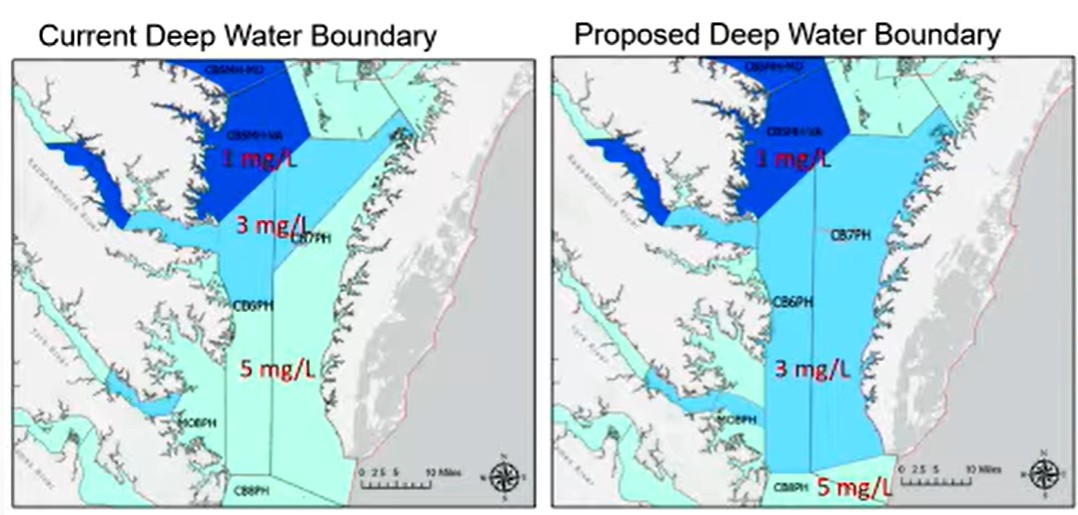
As can be seen in the map above titled "Proposed Deep Water Boundary," the board proposes to substantially expand the portion of the bay where the less stringent criteria applies during the warmer months to extend southward toward the bay's mouth. According to DEQ, when EPA established the current boundaries in 2004 there was an assumption that due to the proximity to the Atlantic Ocean there would be constant recharging of the bottom waters in the areas closest to the mouth; as a result, that the naturally occurring DO levels would not deviate substantially at different depths during the summer. DEQ staff have found that this assumption is not matching up with their monitoring data. There is some recharge and replenishment, but not enough to disturb the stratification that results in the low DO at greater depths. Thus, the board proposes to extend the area where the less stringent criteria applies from June 1 through September 30.
Dissolved Oxygen Criteria and Tenths' Placeholders. In the current regulation there are five DO criteria for the Bay and its tidal tributaries that are whole numbers. The board proposes to add ".0" after these whole numbers. For example, where there are migratory fish spawning, the current regulation requires that the instantaneous DO be at least 5 mg/L. The board proposes to amend the minimum to be 5.0 mg/L.
Assessment of Attainment of Dissolved Oxygen Criteria. The current regulation restricts the assessment of bay DO criteria to the cumulative frequency distribution method. The board proposes to allow for the use of other DEQ-approved methods.
Dissolved Oxygen Criteria for Tidal Chickahominy and Pocomoke Rivers. DEQ staff have recently determined that the water quality in the tidal Chickahominy is significantly influenced by surrounding wetlands. Wetlands have a depressing effect on DO5 and the agency has been recording low DO in this system. According to DEQ, EPA has developed a special DO criterion for situations like this. Thus, the board proposes that special less stringent DO criterion be applied to the tidal Chickahominy. DEQ staff have observed a similar situation on the Eastern Shore with the oligohaline portion of the tidal Pocomoke River, which is shared between Maryland and Virginia. It sits right on the state boundary and Maryland has adopted that special EPA DO criterion for wetland influence water bodies whereas Virginia has been using the default DO criterion of 5 milligrams per liter. Thus, the board proposes that the special DO criterion be applied to Virginia's portion of the Pocomoke River as well.
Perfluorooctanoic Acid and Perfluorooctane Sulfonate Criteria. The current regulation does not have aquatic life criteria for PFOA and PFOS. These are two chemicals in the class of chemicals known as per- and polyfluoroalkyl substances (PFAS), also known as forever chemicals. According to the EPA, peer-reviewed scientific studies have shown that exposure to certain levels of PFAS may lead to:6
- Reproductive effects such as decreased fertility or increased high blood pressure in pregnant women;
- Developmental effects or delays in children, including low birth weight, accelerated puberty, bone variations, or behavioral changes;
- Increased risk of some cancers, including prostate, kidney, and testicular cancers;
- Reduced ability of the body's immune system to fight infections, including reduced vaccine response;
- Interference with the body's natural hormones; and
- Increased cholesterol levels and/or risk of obesity.
The federal agency points out that eating fish and other seafood and drinking water that contain PFAS are among the ways people may be exposed to PFAS. Aquatic organisms are also negatively affected by PFAS.7 To address these negative effects, the board proposes to set EPA's aquatic life criteria for PFOA and PFOS, which are designed to safeguard aquatic life by reducing exposure to these contaminants.
Copper Biotic Ligand Model. Both the current and proposed regulations allow for the use of either the standard hardness-based freshwater copper criteria or the alternative BLM copper criteria. Under the current regulation, BLM-derived criteria for each specific site would have to be promulgated through the regulatory process, which can take two or more years. Consequently, BLM has not been used in practice. Under the proposed regulation, the regulatory process would not be needed to effectively implement the BLM criteria. The proposed regulation also makes clear that the BLM criteria would be used instead of the hardness-based criteria if both are available.
Estimated Benefits and Costs. Expanding the Deep Water Aquatic Life Designated Use Area in the Virginia Portion of the Chesapeake Bay. The proposed expansion in the Bay of where the less stringent DO criteria applies from June 1 through September 30 could potentially affect facilities with a dissolved oxygen permit limit that discharge in the newly less stringent area. Such facilities could potentially benefit by saving on costs or increasing production with a more permissive TMDL or effluent limitations. In practice, DEQ does not expect substantial changes in point source permitting.
Dissolved Oxygen Criteria and Tenths' Placeholders. According to DEQ, where the criteria are whole numbers, the data is rounded up. For example, for the migratory fish spawning areas an instantaneous DO reading of 4.6 mg/L would be rounded up to 5 and would be assessed as meeting the minimum of 5 mg/L. Under the board proposed minimum of 5.0 mg/L, the reading 4.6 mg/L would not be assessed as meeting the minimum of 5.0 mg/L. Though it is possible that this could cause a permittee to take action where there would be no need under the current regulation, DEQ believes that this would be unlikely in practice.
Assessment of Attainment of Dissolved Oxygen Criteria. According to DEQ, the cumulative frequency distribution method does not allow for the assessment of all bay DO criteria using all existing data sets. The proposal to allow for the use of other DEQ approved methods would enable DEQ to conduct more complete assessments of the DO criteria, improving accuracy.
Dissolved Oxygen Criteria for Tidal Chickahominy and Pocomoke Rivers. Similar to the proposed expansion in the bay of where the less stringent DO criteria applies, the proposed reduction in stringency of DO criteria for the tidal Chickahominy and Pocomoke Rivers could potentially affect facilities with a dissolved oxygen permit limit that discharge in these tidal rivers. Such facilities could potentially benefit by saving on costs or increasing production with a more permissive TMDL or effluent limitations. In practice though, DEQ does not expect substantial changes in point source permitting.
Perfluorooctanoic Acid and Perfluorooctane Sulfonate Criteria. Facilities that are found to discharge PFOS and PFOA contaminants at levels that exceed the proposed aquatic life criteria may incur costs. Such facilities may need to increase monitoring and conduct treatment activities or reduce discharge. To the extent that the proposed aquatic life criteria result in reduced discharge of PFOS and PFOA into the bay, there may be some reduction in the occurrences of the negative health outcomes described above for people as well as aquatic life. In practice, DEQ expects that a few facilities may be required to do increased monitoring but believe it is unlikely that any facilities will have to take any other action to maintain their permit. If there are some facilities that need to take action beyond monitoring, they would be given a compliance schedule (up to five years) to meet the criteria.
Copper Biotic Ligand Model. The proposal allows the use of the BLM copper criteria without promulgating each individual BLM-derived copper criterion. This would save staff time for both DEQ and the facility owner applying for a permit. It could also enable the facility to operate sooner.
Businesses and Other Entities Affected. Entities that operate facilities subject to VPDES permitting may potentially be affected by the proposed amendments as related to discharge permits. In particular, DEQ estimates that there are 268 industrial dischargers that may be subject to additional monitoring requirements due to the potential for manufacturing sources of PFAS. Additionally, permittees that discharge into the tidal Chickahominy and Pocomoke Rivers and the portion of the Bay where the less stringent DO criteria would newly apply during warmer months may also be particularly affected. According to the agency, 146 permittees currently have copper limits and may be affected by the modified language for the copper BLM. Municipally-owned wastewater treatment plants comprise 36 percent of these permittees, while industrial facilities make up the rest. There are other permittees that currently do not have copper limits but may be required to have them when their permits are renewed. The Code of Virginia requires DPB to assess whether an adverse impact may result from the proposed regulation.8 An adverse impact is indicated if there is any increase in net cost or reduction in net benefit for any entity, even if the benefits exceed the costs for all entities combined.9 As noted above, some industrial dischargers may encounter additional costs through the proposed PFAS criteria. Thus, an adverse impact is indicated.
Small Businesses10 Affected.11
Types and Estimated Number of Small Businesses Affected. The proposal to incorporate PFAS criteria may moderately increase costs for manufacturers that discharge PFAS. DEQ does not have an estimate of the number that qualify as small businesses.
Costs and Other Effects. The costs would most likely occur from increased monitoring.
Alternative Method that Minimizes Adverse Impact. There are no clear alternative methods that both reduce adverse impact and meet the intended policy goals.
Localities12 Affected.13 Localities throughout the Commonwealth may be affected, but localities adjacent to the Chesapeake Bay or the Chickahominy and Pocomoke Rivers may be particularly affected. The proposed amendments are unlikely to introduce costs for local governments.
Projected Impact on Employment. The proposed amendments are unlikely to substantively affect total employment.
Effects on the Use and Value of Private Property. As discussed above, for the most part DEQ does not expect that the proposed amendments would require substantive new actions or reductions in actions. The proposed PFAS criteria would likely require some additional monitoring, which would impose a small new cost, but would not likely substantively affect the value of firms required to do such additional monitoring. The proposed amendments are unlikely to substantively affect real estate development costs.
_____________________________
1 Section 2.2-4007.04 of the Code of Virginia requires that such economic impact analyses determine the public benefits and costs of the proposed amendments. Further the analysis should include but not be limited to: (1) the projected number of businesses or other entities to whom the proposed regulatory action would apply, (2) the identity of any localities and types of businesses or other entities particularly affected, (3) the projected number of persons and employment positions to be affected, (4) the projected costs to affected businesses or entities to implement or comply with the regulation, and (5) the impact on the use and value of private property.
2 More specifically: (a) 30-day mean ≥ 5.5 mg/l (tidal habitats with 0-0.5 ppt salinity), (b) 30-day mean ≥ 5.0 mg/l (tidal habitats with > 0.5 ppt salinity), (c) 7-day mean ≥ 4.0 mg/l, (d) instantaneous minimum ≥ 3.2 mg/l at temperatures < 29°C, and (e) instantaneous minimum ≥ 4.3 mg/l at temperatures ≥ 29°C.
3 More specifically: (a) 30-day mean ≥ 3 mg/l, (b) 1-day mean ≥ 2.3 mg/l, and (c) instantaneous minimum ≥ 1.7 mg/l.
4 The maps are courtesy of the Department of Environmental Quality.
5 Source: DEQ.
6 See https://www.epa.gov/pfas/our-current-understanding-human-health-and-environmental-risks-pfas.
7 See https://www.sciencedirect.com/science/article/abs/pii/S0025326X25001535.
8 Pursuant to § 2.2-4007.04 D: In the event this economic impact analysis reveals that the proposed regulation would have an adverse economic impact on businesses or would impose a significant adverse economic impact on a locality, business, or entity particularly affected, the Department of Planning and Budget shall advise the Joint Commission on Administrative Rules, the House Committee on Appropriations, and the Senate Committee on Finance. Statute does not define "adverse impact," state whether only Virginia entities should be considered, nor indicate whether an adverse impact results from regulatory requirements mandated by legislation.
9 Statute does not define "adverse impact," state whether only Virginia entities should be considered, nor indicate whether an adverse impact results from regulatory requirements mandated by legislation. As a result, DPB has adopted a definition of adverse impact that assesses changes in net costs and benefits for each affected Virginia entity that directly results from discretionary changes to the regulation.
10 Pursuant to § 2.2-4007.04, small business is defined as "a business entity, including its affiliates, that (i) is independently owned and operated and (ii) employs fewer than 500 full-time employees or has gross annual sales of less than $6 million."
11 If the proposed regulatory action may have an adverse effect on small businesses, § 2.2-4007.04 requires that such economic impact analyses include: (1) an identification and estimate of the number of small businesses subject to the proposed regulation, (2) the projected reporting, recordkeeping, and other administrative costs required for small businesses to comply with the proposed regulation, including the type of professional skills necessary for preparing required reports and other documents, (3) a statement of the probable effect of the proposed regulation on affected small businesses, and (4) a description of any less intrusive or less costly alternative methods of achieving the purpose of the proposed regulation. Additionally, pursuant to § 2.2-4007.1 of the Code of Virginia, if there is a finding that a proposed regulation may have an adverse impact on small business, the Joint Commission on Administrative Rules shall be notified.
12 "Locality" can refer to either local governments or the locations in the Commonwealth where the activities relevant to the regulatory change are most likely to occur.
13 Section 2.2-4007.04 defines "particularly affected" as bearing disproportionate material impact.
Agency Response to Economic Impact Analysis: The State Water Control Board has reviewed the economic impact analysis prepared by the Department of Planning and Budget and has no comment.
Summary:
The proposed amendments update numerical and narrative criteria, use designations, and other requirements based on current scientific information. The changes include (i) expanding the Virginia portion of the Chesapeake Bay that is designated for Deep Water Aquatic Life Designated Use; (ii) adding the U.S. Environmental Protection Agency's (EPA) aquatic life criteria for perfluorooctanoic acid (PFOA) and perfluorooctane sulfonate (PFOS); (iii) updating the Biotic Ligand Model option for copper criteria; (iv) adding a decimal place to the five dissolved oxygen (DO) criteria that are currently whole numbers; (v) allowing use of Department of Environmental Quality-approved methods in addition to the cumulative frequency distribution to assess attainment of Chesapeake Bay DO criteria; (vi) adding special DO criteria for the tidal Chickahominy and Pocomoke Rivers; and (vii) incorporating by reference the document, Boundary of the Deep Water Designated Use in Virginia's Chesapeake Bay Mainstem.
9VAC25-260-10. Designation of uses.
A. All state waters, including wetlands, are designated for the following uses: recreational uses, e.g., swimming and boating; the propagation and growth of a balanced, indigenous population of aquatic life, including game fish, which might reasonably be expected to inhabit them; wildlife; and the production of edible and marketable natural resources, e.g., fish and shellfish.
B. Subcategories of the propagation and growth of a balanced indigenous population of aquatic life, including game fish designated use for waters in the Chesapeake Bay and its tidal tributaries are listed in this subsection.
1. Migratory Fish Spawning and Nursery Designated Use: waters in the Chesapeake Bay and its tidal tributaries that protect the survival, growth, and propagation of the early life stages of a balanced, indigenous population of anadromous, semi-anadromous, catadromous, and tidal-fresh resident fish species inhabiting spawning and nursery grounds. This designated use extends from the end of tidal waters to the downriver end of spawning and nursery habitats that have been determined through a composite of all targeted anadromous and semi-anadromous fish species' spawning and nursery habitats (see boundaries in U.S. Environmental Protection Agency, 2004, Technical Support Document for Identification of Chesapeake Bay Designated Uses and Attainability 2004 Addendum, Chesapeake Bay Program Office, Annapolis, Maryland). This designated use extends horizontally from the shoreline of the body of water to the adjacent shoreline, and extends down through the water column to the bottom water-sediment interface. This use applies February 1 through May 31 and applies in addition to the open-water use described in this subsection.
2. Shallow-water Submerged Aquatic Vegetation Designated Use: waters in the Chesapeake Bay and its tidal tributaries that support the survival, growth, and propagation of submerged aquatic vegetation (rooted, underwater bay grasses). This use applies April 1 through October 31 in tidal-fresh, oligohaline, and mesohaline Chesapeake Bay Program segments, and March 1 through November 30 in polyhaline Chesapeake Bay Program segments and applies in addition to the open-water use described in this subsection.
3. Open Water Aquatic Life Designated Use: waters in the Chesapeake Bay and its tidal tributaries that protect the survival, growth, and propagation of a balanced, indigenous population of aquatic life inhabiting open-water habitats. This designated use applies year-round but the vertical boundaries change seasonally. October 1 through May 31, the open water aquatic life use extends horizontally from the shoreline at mean low water, to the adjacent shoreline, and extending through the water column to the bottom water-sediment interface. June 1 through September 30, if a pycnocline is present and, in combination with bottom bathymetry and water column circulation patterns, presents a barrier to oxygen replenishment of deeper waters, this designated use extends down into the water column only as far as the upper boundary of the pycnocline. June 1 through September 30, if a pycnocline is present but other physical circulation patterns (such as influx of oxygen rich oceanic bottom waters) provide for oxygen replenishment of deeper waters, the open-water aquatic life designated use extends down into the bottom water-sediment interface (see boundaries in U.S. Environmental Protection Agency, 2004 Technical Support Document for Identification of Chesapeake Bay Designated Uses and Attainability 2004 Addendum, Chesapeake Bay Program Office, Annapolis, Maryland). This designated use includes the migratory fish spawning and nursery and shallow-water submerged aquatic vegetation uses.
4. Deep Water Aquatic Life Designated Use: waters in the Chesapeake Bay and its tidal tributaries that protect the survival and growth of a balanced, indigenous population of aquatic life inhabiting deep-water habitats. This designated use extends to the tidally influenced waters located between the upper and lower boundaries of the pycnocline where, in combination with bottom bathymetry and water circulation patterns, a pycnocline is present and presents a barrier to oxygen replenishment of deeper waters. In some areas, the deep-water designated use extends from the upper boundary of the pycnocline down to the bottom water-sediment interface (see boundaries in U.S. Environmental Protection Agency, 2004 Technical Support Document for Identification of Chesapeake Bay Designated Uses and Attainability 2004 Addendum, Chesapeake Bay Program Office, Annapolis, Maryland) and the updated boundaries in the Chesapeake Bay mainstem and Mobjack Bay as described in the DEQ 2025 technical support document titled "Boundary of the Deep Water Designated Use in Virginia's Chesapeake Bay Mainstem." This use applies June 1 through September 30.
5. Deep Channel Seasonal Refuge Designated Use: waters in the Chesapeake Bay and its tidal tributaries that protect the survival of a balanced, indigenous population of benthic infauna and epifauna inhabiting deep-channel habitats. This designated use extends to the tidally influenced waters at depths greater than the lower boundary of the pycnocline in areas where, in combination with bottom bathymetry and water circulation patterns, the pycnocline presents a barrier to oxygen replenishment of deeper waters (see boundaries in U.S. Environmental Protection Agency, 2004 Technical Support Document for Identification of Chesapeake Bay Designated Uses and Attainability 2004 Addendum, Chesapeake Bay Program Office, Annapolis, Maryland). This use applies June 1 through September 30.
C. In designating uses of a water body and the appropriate criteria for those uses, the board shall take into consideration the water quality standards of downstream waters and shall ensure that its water quality standards provide for the attainment and maintenance of the water quality standards of downstream waters.
D. The board may adopt subcategories of a use and set the appropriate criteria to reflect varying needs of such subcategories of uses, for instance, to differentiate between cold water (trout streams) and warm water fisheries.
E. At a minimum, uses are deemed attainable if they can be achieved by the imposition of effluent limits required under §§ 301(b)(1)(A) and (B) and 306 of the Clean Water Act and cost-effective and reasonable best management practices for nonpoint source control.
F. Prior to adding or removing any use, or establishing subcategories of a use, the board shall provide notice and an opportunity for a public hearing under the Administrative Process Act (§ 2.2-4000 et seq. of the Code of Virginia).
G. The board may adopt seasonal uses as an alternative to reclassifying a water body or segment thereof to uses requiring less stringent water quality criteria. If seasonal uses are adopted, water quality criteria should be adjusted to reflect the seasonal uses; however, such criteria shall not preclude the attainment and maintenance of a more protective use in another season.
H. The board may remove a designated use which that is not an existing use, or establish subcategories of a use, if the board can demonstrate that attaining the designated use is not feasible because:
1. Naturally occurring pollutant concentrations prevent the attainment of the use;
2. Natural, ephemeral, intermittent, or low flow conditions or water levels prevent the attainment of the use unless these conditions may be compensated for by the discharge of sufficient volume of effluent discharges without violating state water conservation requirements to enable uses to be met;
3. Human caused conditions or sources of pollution prevent the attainment of the use and cannot be remedied or would cause more environmental damage to correct than to leave in place;
4. Dams, diversions, or other types of hydrologic modifications preclude the attainment of the use, and it is not feasible to restore the water body to its original condition or to operate such modification in a way that would result in the attainment of the use;
5. Physical conditions related to the natural features of the water body, such as the lack of a proper substrate, cover, flow, depth, pools, riffles, and the like, unrelated to water quality, preclude attainment of aquatic life protection uses; or
6. Controls more stringent than those required by §§ 301(b) and 306 of the Clean Water Act would result in substantial and widespread economic and social impact.
I. The board may not remove designated uses if:
1. They The designated uses are existing uses, unless a use requiring more stringent criteria is added; or
2. Such uses will be attained by implementing effluent limits required under §§ 301(b)(1)(A) and (B) and 306 of the Clean Water Act and by implementing cost-effective and reasonable best management practices for nonpoint source control.
J. Where existing water quality standards specify designated uses less than those which that are presently being attained, the board shall revise its standards to reflect the uses actually being attained.
K. The board must conduct a use attainability analysis whenever:
1. The board designates or has designated uses that do not include the uses specified in § 101(a)(2) of the Clean Water Act; or
2. The board wishes to remove a designated use that is specified in § 101(a)(2) of the Clean Water Act or to adopt subcategories of uses specified in § 101(a)(2) of the Clean Water Act which require less stringent criteria.
L. The board is not required to conduct a use attainability analysis under this chapter whenever designating uses which that include those specified in subsection A of this section.
9VAC25-260-140. Criteria for surface water.
A. Instream water quality conditions shall not be acutely1 or chronically2 toxic except as allowed in 9VAC25-260-20 B (mixing zones). The following are definitions of acute and chronic toxicity conditions:
"Acute toxicity" means an adverse effect that usually occurs shortly after exposure to a pollutant. Lethality to an organism is the usual measure of acute toxicity. Where death is not easily detected, immobilization is considered equivalent to death.
"Chronic toxicity" means an adverse effect that is irreversible or progressive or occurs because the rate of injury is greater than the rate of repair during prolonged exposure to a pollutant. This includes low level, long-term effects such as reduction in growth or reproduction.
B. The following table is a list of numerical water quality criteria for specific parameters.
|
Table of Parameters6, 7
|
|
PARAMETER
CAS Number
|
USE DESIGNATION
|
|
AQUATIC LIFE
|
HUMAN HEALTH
|
|
FRESHWATER
|
SALTWATER
|
Public Water Supply3
|
All Other Surface Waters4
|
|
Acute1
|
Chronic2
|
Acute1
|
Chronic2
|
|
EDITOR'S NOTE: Rows Acenapthene through Pentachlorophenol of 9VAC25-260-140 B are not amended; therefore, the text of those rows is not set out.
|
|
Perfluorooctanoic acid (PFOA) (µg/l)
45285516; 335671; 3825261
|
3,100
|
100
See footnote 9 for tissue values
|
|
|
|
|
|
Perfluorooctane sulfonate (PFOS) (µg/l)
45298906; 1763231; 2795393; 56773423; 4021470; 29457725
|
71
|
0.25
See footnote 10 for tissue values
|
|
|
|
|
|
EDITOR'S NOTE: Rows pH through Toxaphene of 9VAC25-260-140 B are not amended; therefore, the text of those rows is not set out.
|
|
Tributyltin (µg/l)
E1790678 E1790679
|
0.46
|
0.072
|
0.42
|
0.0074
|
|
|
|
EDITOR'S NOTE: Rows 1, 2, 4 Trichlorobenzene through Zinc of 9VAC25-260-140 B are not amended; therefore, the text of those rows is not set out.
|
|
1One hour average concentration not to be exceeded more than once every 3 three years on the average, unless otherwise noted.
2Four-day average concentration not to be exceeded more than once every 3 three years on the average, unless otherwise noted.
3Criteria have been calculated to protect human health from toxic effects through drinking water and fish consumption, unless otherwise noted and apply in segments designated as PWS in 9VAC25-260-390 through 9VAC25-260-540. Human health criteria are based on the assumption of average amount of exposure on a long-term basis.
4Criteria have been calculated to protect human health from toxic effects through fish consumption, unless otherwise noted and apply in all other surface waters not designated as PWS in 9VAC25-260-390 through 9VAC25-260-540. Human health criteria are based on the assumption of average amount of exposure on a long-term basis.
5Acute and chronic saltwater and freshwater aquatic life criteria apply to the biologically available form of the metal and apply as a function of the pollutant's water effect ratio (WER) as defined in 9VAC25-260-140 F (WER X criterion). Metals measured as dissolved shall be considered to be biologically available, or, because local receiving water characteristics may otherwise affect the biological availability of the metal, the biologically available equivalent measurement of the metal can be further defined by determining a water effect ratio (WER) and multiplying the numerical value shown in 9VAC25-260-140 B by the WER. Refer to 9VAC25-260-140 F. Values displayed above in the table are examples and correspond to a WER of 1.0. Metals criteria have been adjusted to convert the total recoverable fraction to dissolved fraction using a conversion factor. Criteria that change with hardness have the conversion factor listed in the table above Table of Parameters6, 7.
6The flows listed below in the Aquatic Life table are default design flows for calculating steady state wasteload allocations unless statistically valid methods are employed which that demonstrate compliance with the duration and return frequency of the water quality criteria.
|
Aquatic Life:
|
|
Acute criteria
|
1Q10
|
|
Chronic criteria
|
7Q10
|
|
Chronic criteria (ammonia)
|
30Q10
|
|
Human Health:
|
|
Noncarcinogens
|
30Q5
|
|
Carcinogens
|
Harmonic mean
|
The following are defined for this section:
"1Q10" means the lowest flow averaged over a period of 1 one day which on a statistical basis can be expected to occur once every 10 climatic years.
"7Q10" means the lowest flow averaged over a period of 7 seven consecutive days that can be statistically expected to occur once every 10 climatic years.
"30Q5" means the lowest flow averaged over a period of 30 consecutive days that can be statistically expected to occur once every 5 five climatic years.
"30Q10" means the lowest flow averaged over a period of 30 consecutive days that can be statistically expected to occur once every 10 climatic years.
"Averaged" means an arithmetic mean.
"Climatic year" means a year beginning on April 1 and ending on March 31.
7The criteria listed in this table are two significant digits with the exception of criteria values for the animal tissue concentrations for perfluorooctanoic acid (PFOA) and perfluorooctane sulfonate (PFOS). In footnote 8, all digits for these criteria values are significant. For other criteria that are referenced to other sections of this regulation in this table, all numbers listed as criteria values are significant.
8The fish tissue criterion for methylmercury applies to a concentration of 0.30 mg/kg as wet weight in edible tissue for species of fish and shellfish resident in a waterbody that are commonly eaten in the area and have commercial, recreational, or subsistence value.
9 Perfluorooctanoic acid (PFOA) - Duration for invertebrate/fish tissue is instantaneous and not to be exceeded.
1.18 mg/kg wet weight in invertebrate whole-body tissue.
6.49 mg/kg wet weight fish whole-body tissue.
0.133 mg/kg wet weight fish muscle tissue.
10 Perfluorooctane sulfonate (PFOS) - Duration for invertebrate/fish tissue is instantaneous and not to be exceeded.
0.028 mg/kg wet weight in invertebrate whole-body tissue.
0.201 mg/kg wet weight fish whole-body tissue.
0.087 mg/kg wet weight fish muscle tissue.
|
C. Application of freshwater and saltwater numerical criteria. The numerical water quality criteria listed in subsection B of this section (excluding dissolved oxygen, pH, temperature) shall be applied according to the following classes of waters (see 9VAC25-260-50) and boundary designations:
|
CLASS OF WATERS
|
NUMERICAL CRITERIA
|
|
I and II (Estuarine Waters)
|
Saltwater criteria apply
|
|
II (Transition Zone)
|
More stringent of either the freshwater or saltwater criteria apply
|
|
II (Tidal Freshwater), III, IV, V, VI and VII
|
Freshwater criteria apply
|
The following describes the boundary designations for Class II, (estuarine, transition zone, and tidal freshwater waters) by river basin:
1. Rappahannock Basin. Tidal freshwater is from the fall line of the Rappahannock River to the upstream boundary of the transition zone including all tidal tributaries that enter the tidal freshwater Rappahannock River.
Transition zone upstream boundary – N38° 4' 56.59"/W76° 58' 47.93" (430 feet east of Hutchinson Swamp) to N38° 5' 23.33"/W76° 58' 24.39" (0.7 miles upstream of Peedee Creek).
Transition zone downstream boundary – N37° 58' 45.80"/W76° 55' 28.75" (1,000 feet downstream of Jenkins Landing) to N37° 59' 20.07/W76° 53' 45.09" (0.33 miles upstream of Mulberry Point). All tidal waters that enter the transition zone are themselves transition zone waters.
Estuarine waters are from the downstream boundary of the transition zone to the mouth of the Rappahannock River (Buoy 6), including all tidal tributaries that enter the estuarine waters of the Rappahannock River.
2. York Basin. Tidal freshwater is from the fall line of the Mattaponi River at N37° 47' 20.03"/W77° 6' 15.16" (800 feet upstream of the Route 360 bridge in Aylett) to the upstream boundary of the Mattaponi River transition zone, and from the fall line of the Pamunkey River at N37° 41' 22.64"/W77° 12' 50.83" (2,000 feet upstream of Totopotomy Creek) to the upstream boundary of the Pamunkey River transition zone, including all tidal tributaries that enter the tidal freshwaters of the Mattaponi and Pamunkey Rivers.
Mattaponi River transition zone upstream boundary – N37° 39' 29.65"/W76° 52' 53.29" (1,000 feet upstream of Mitchell Hill Creek) to N37° 39' 24.20"/W76° 52' 55.87" (across from Courthouse Landing).
Mattaponi River transition zone downstream boundary – N37° 32' 19.76"/W76° 47' 29.41" (old Lord Delaware Bridge, west side) to N37° 32' 13.25"/W76° 47' 10.30" (old Lord Delaware Bridge, east side).
Pamunkey River transition zone upstream boundary – N37° 32' 36.63"/W76° 58' 29.88" (Cohoke Marsh, 0.9 miles upstream of Turkey Creek) to N37° 32' 36.51"/W76° 58' 36.48" (0.75 miles upstream of creek at Cook Landing).
Pamunkey River transition zone downstream boundary – N37° 31' 57.90"/W76° 48' 38.22" (old Eltham Bridge, west side) to N37° 32' 6.25"/W76° 48' 18.82" (old Eltham Bridge, east side).
All tidal tributaries that enter the transition zones of the Mattaponi and Pamunkey Rivers are themselves in the transition zone.
Estuarine waters are from the downstream boundary of the transition zones of the Mattaponi and Pamunkey Rivers to the mouth of the York River (Tue Marsh Light) including all tidal tributaries that enter the estuarine waters of the York River.
3. James Basin. Tidal freshwater is from the fall line of the James River in the City of Richmond upstream of Mayo Bridge to the upstream boundary of the transition zone, including all tidal tributaries that enter the tidal freshwater James River.
James River transition zone upstream boundary – N37° 14' 28.25"/W76° 56' 44.47" (at Tettington) to N37° 13' 38.56"/W76° 56' 47.13" (0.3 miles downstream of Sloop Point).
Chickahominy River transition zone upstream boundary – N37° 25' 44.79"/W77° 1' 41.76" (Holly Landing) N37° 24' 25"/W76° 56' 16" (Walker's Dam).
Transition zone downstream boundary – N37° 12' 7.23"/W76° 37' 34.70" (near Carters Grove Home, 1.25 miles downstream of Grove Creek) to N37° 9' 17.23"/W76° 40' 13.45" (0.7 miles upstream of Hunnicutt Creek). All tidal waters that enter the transition zone are themselves transition zone waters.
Estuarine waters are from the downstream transition zone boundary to the mouth of the James River (Buoy 25) including all tidal tributaries that enter the estuarine waters of the James River.
4. Potomac Basin. Tidal freshwater includes all tidal tributaries that enter the Potomac River from its fall line at the Chain Bridge (N38° 55' 46.28"/W77° 6' 59.23") to the upstream transition zone boundary near Quantico, Virginia.
Transition zone includes all tidal tributaries that enter the Potomac River from N38° 31' 27.05"/W77° 17' 7.06" (midway between Shipping Point and Quantico Pier) to N38° 23' 22.78"/W77° 1' 45.50" (one mile southeast of Mathias Point).
Estuarine waters includes all tidal tributaries that enter the Potomac River from the downstream transition zone boundary to the mouth of the Potomac River (Buoy 44B).
5. Chesapeake Bay, Atlantic Ocean, and small coastal basins. Estuarine waters include the Atlantic Ocean tidal tributaries, and the Chesapeake Bay and its small coastal basins from the Virginia state line to the mouth of the bay (a line from Cape Henry drawn through Buoys 3 and 8 to Fishermans Island), and its tidal tributaries, excluding the Potomac tributaries and those tributaries listed in subdivisions 1 through 4 of this subsection.
6. Chowan River Basin. Tidal freshwater includes the Northwest River and its tidal tributaries from the Virginia-North Carolina state line to the free flowing portion, the Blackwater River and its tidal tributaries from the Virginia-North Carolina state line to the end of tidal waters at approximately state route 611 at river mile 20.90, the Nottoway River and its tidal tributaries from the Virginia-North Carolina state line to the end of tidal waters at approximately Route 674, and the North Landing River and its tidal tributaries from the Virginia-North Carolina state line to the Great Bridge Lock.
Transition zone includes Back Bay and its tributaries in the City of Virginia Beach to the Virginia-North Carolina state line.
D. Site-specific modifications to numerical water quality criteria.
1. The board may consider site-specific modifications to numerical water quality criteria in subsection B of this section where the applicant or permittee demonstrates that the alternate numerical water quality criteria are sufficient to protect all designated uses (see 9VAC25-260-10) of that particular surface water segment or body.
2. Any demonstration for site-specific human health criteria shall be restricted to a reevaluation of the bioconcentration or bioaccumulation properties of the pollutant. The exceptions to this restriction are for site-specific criteria for taste, odor, and aesthetic compounds noted by double asterisks in subsection B of this section and nitrates.
3. Procedures for promulgation and review of site-specific modifications to numerical water quality criteria resulting from subdivisions 1 and 2 of this subsection.
a. Proposals describing the details of the site-specific study shall be submitted to the board's staff for approval prior to commencing the study.
b. Any site-specific modification shall be promulgated as a regulation in accordance with the Administrative Process Act (§ 2.2-4000 et seq. of the Code of Virginia). All site-specific modifications shall be listed in 9VAC25-260-310 (Special standards and requirements).
E. Variances to water quality standards.
1. A variance from numeric criteria may be granted to a discharger if it can be demonstrated that one or more of the conditions in 9VAC25-260-10 H limit the attainment of one or more specific designated uses.
a. Variances shall apply only to the discharger to whom they the variances are granted and shall be reevaluated and either continued, modified, or revoked at the time of permit issuance. At that time the permittee shall make a showing that the conditions for granting the variance still apply.
b. Variances shall be described in the public notice published for the permit. The decision to approve a variance shall be subject to the public participation requirements of the Virginia Pollutant Discharge Elimination System (VPDES) Permit Regulation, 9VAC25-31.
c. Variances shall not prevent the maintenance and protection of existing uses or exempt the discharger or regulated activity from compliance with other appropriate technology or water quality-based limits or best management practices.
d. Variances granted under this section shall not apply to new discharges.
e. Variances shall be submitted by the department's Division of Scientific Research or its successors to the U.S. Environmental Protection Agency for review and approval or disapproval.
f. A list of variances granted shall be maintained by the department's Division of Scientific Research or its successors.
2. None of the variances in this subsection shall apply to the halogen ban section (9VAC25-260-110) or temperature criteria in 9VAC25-260-50 if superseded by § 316(a) of the Clean Water Act requirements. No variances in this subsection shall apply to the criteria that are designed to protect human health from carcinogenic and noncarcinogenic toxic effects (subsection B of this section) with the exception of the metals, and the taste, odor, and aesthetic compounds noted by double asterisks and nitrates, listed in subsection B of this section.
F. Water effect ratio.
1. A water effects ratio (WER) shall be determined by measuring the effect of receiving water (as it is or will be affected by any discharges) on the bioavailability or toxicity of a metal by using standard test organisms and a metal to conduct toxicity tests simultaneously in receiving water and laboratory water. The ratio of toxicities of the metals in the two waters is the WER (toxicity in receiving water divided by toxicity in laboratory water equals WER). Once an acceptable WER for a metal is established, the numerical value for the metal in subsection B of this section is multiplied by the WER to produce an instream concentration that will protect designated uses. This instream concentration shall be utilized in permitting decisions.
2. The WER shall be assigned a value of 1.0 unless the applicant or permittee demonstrates to the department's satisfaction in a permit proceeding that another value is appropriate, or unless available data allow the department to compute a WER for the receiving waters. The applicant or permittee is responsible for proposing and conducting the study to develop a WER. The study may require multiple testing over several seasons. The applicant or permittee shall obtain the department's Division of Scientific Research or its successor approval of the study protocol and the final WER.
3. 9VAC25-31-230 C requires that permit limits for metals be expressed as total recoverable measurements. To that end, the study used to establish the WER may be based on total recoverable measurements of the metals.
4. The WER is established in a permit proceeding, shall be described in the public notice associated with the permit proceeding, and applies only to the applicant or permittee in that proceeding. The department's action to approve or disapprove a WER is a case decision, not an amendment to the present regulation.
The decision to approve or disapprove a WER shall be subject to the public participation requirements of Virginia Pollutant Discharge Elimination System (VPDES) Regulation, Part IV (9VAC25-31-260 et seq.). A list of final WERs will be maintained by the department's Division of Scientific Research or its successor.
5. A WER shall not be used for the freshwater and saltwater chronic mercury criteria or the freshwater acute and chronic selenium criteria.
G. Biotic Ligand Model for copper. On a case-by-case basis, EPA's 2007 The copper criteria (EPA-822-F-07-001) biotic ligand model Biotic Ligand Model (BLM) for copper may be used as an alternative to determine alternate the hardness-based freshwater copper criteria in 9VAC25-260-140 B. The copper BLM is described in the document "Aquatic Life Ambient Freshwater Quality Criteria for Copper" (EPA-822-R-07-001). Site-specific BLM-derived criteria, where established, will supersede hardness-based criteria for freshwater sites copper. The BLM is a bioavailability model that uses receiving water characteristics to develop site-specific criteria.
1. Site-specific data for 10 parameters are needed to use the BLM. These parameters are temperature, pH, dissolved organic carbon, calcium, magnesium, sodium, potassium, sulfate, chloride, and alkalinity.
If sufficient 2. Any data for these parameters are available, the BLM can be set used to calculate alternate develop BLM-based criteria values for the copper criteria shall be collected in accordance with a study plan approved by DEQ. The BLM criteria would be used instead of the hardness-based criteria and takes take the place of the hardness adjustment and the WER. A WER will not be applicable with the BLM.
9VAC25-260-185. Criteria to protect designated uses from the impacts of nutrients and suspended sediment in the Chesapeake Bay and its tidal tributaries.
A. Dissolved oxygen. The dissolved oxygen criteria in the following table apply to all Chesapeake Bay waters according to their specified designated use and supersede the dissolved oxygen criteria in 9VAC25-260-50.
|
Designated Use
|
Criteria Concentration/Duration
|
Temporal Application
|
|
Migratory fish spawning and nursery
|
7-day mean ≥ 6 greater than or equal to 6.0 mg/l (tidal habitats with 0-0.5 ppt salinity)
|
February 1 - May 31
|
|
Instantaneous minimum ≥ 5 greater than or equal to 5.0 mg/l
|
|
Open water1
|
30-day mean ≥ greater than or equal to 5.5 mg/l (tidal habitats with 0-0.5 ppt salinity)
|
year-round2
|
|
30-day mean ≥ 5 greater than or equal to 5.0 mg/l (tidal habitats with > greater than 0.5 ppt salinity)
|
|
7-day mean ≥ 4 greater than or equal to 4.0 mg/l
|
|
Instantaneous minimum ≥ greater than or equal to 3.2 mg/l at temperatures < less than 29°C
Instantaneous minimum ≥ greater than or equal to 4.3 mg/l at temperatures ≥ greater than or equal to 29°C
|
|
Deep water
|
30-day mean ≥ 3 greater than or equal to 3.0 mg/l
|
June 1 - September 30
|
|
1-day mean ≥ greater than or equal to 2.3 mg/l
|
|
Instantaneous minimum ≥ greater than or equal to 1.7 mg/l
|
|
Deep channel
|
Instantaneous minimum ≥ greater than or equal to 1 mg/l
|
June 1 - September 30
|
|
1In applying this open water instantaneous criterion to the Chesapeake Bay and its tidal tributaries where the existing water quality for dissolved oxygen exceeds an instantaneous minimum of 3.2 mg/l, that higher water quality for dissolved oxygen shall be provided antidegradation protection in accordance with 9VAC25-260-30 A 2.
2Open-water dissolved oxygen criteria attainment is assessed separately over two time periods: summer (June 1- September 30) and nonsummer (October 1-May 31) months.
|
EDITOR'S NOTE: Subsections B and C of 9VAC25-260-185 are not amended; therefore, the text of those subsections is not set out.
D. Implementation.
EDITOR'S NOTE: Subdivisions D 1 and D 2 of 9VAC25-260-185 are not amended; therefore, the text of those subsections is not set out.
3. Attainment of these criteria shall be assessed through comparison of the generated The cumulative frequency distribution of the monitoring data to the method, where applicable criteria reference curve for each designated use. If the monitoring data cumulative frequency curve is completely contained inside the reference curve, then the segment is in attainment of the designated use. The reference curves, and procedures to be followed are other published in methods approved by DEQ, shall be used to assess attainment of these criteria. These methods include procedures described in the USEPA, Ambient Water Quality Criteria for Dissolved Oxygen, Water Clarity and Chlorophyll a for the Chesapeake Bay and Its Tidal Tributaries, EPA 903-R-03-002, April 2003 and the 2004 (EPA 903-R-03-002 October 2004), 2007 (CBP/TRS 285/07, EPA 903-R-07-003), 2007 (CBP/TRS 288/07, EPA 903-R-07-005), 2008 (CBP/TRS 290-08, EPA 903-R-08-001), 2010 (CBP/TRS 301-10, EPA 903-R-10-002), and 2017 (CBP/TRS 320-17, EPA 903-R-17-002) addenda. An exception to this requirement is in measuring attainment of the SAV and water clarity acres, which are compared directly to the criteria.
9VAC25-260-187. Criteria for man-made lakes and reservoirs to protect aquatic life and recreational designated uses from the impacts of nutrients.
A. The criteria in subsection B of this section apply to the man-made lakes and reservoirs listed in this section. Additional man-made lakes and reservoirs may be added as new reservoirs are constructed or monitoring data become available from outside groups or future agency monitoring.
B. Whether or not algicide treatments are used, the chlorophyll a criteria apply to all waters on the list. The total phosphorus criteria apply only if a specific man-made lake or reservoir received algicide treatment during the monitoring and assessment period of April 1 through October 31.
The 90th percentile of the chlorophyll a data collected at one meter or less within the lacustrine portion of the man-made lake or reservoir between April 1 and October 31 shall not exceed the chlorophyll a criterion for that waterbody in each of the two most recent monitoring years that chlorophyll a data are available. For a waterbody that received algicide treatment, the median of the total phosphorus data collected at one meter or less within the lacustrine portion of the man-made lake or reservoir between April 1 and October 31 shall not exceed the total phosphorus criterion in each of the two most recent monitoring years that total phosphorus data are available.
Monitoring data used for assessment shall be from sampling locations within the lacustrine portion where observations are evenly distributed over the seven months from April 1 through October 31 and are in locations that are representative, either individually or collectively, of the condition of the man-made lake or reservoir.
|
Man-made Lake or Reservoir Name
|
Location
|
Chlorophyll a (μg/L)
|
Total Phosphorus (μg/L)
|
|
EDITOR'S NOTE: Rows Able Lake through Lake Connor of 9VAC25-260-187 B are not amended; therefore, the text of those rows is not set out.
|
|
Lake Culpeper
|
Culpeper County
|
35
|
40
|
|
EDITOR'S NOTE: Rows Lake Frederick through Lake Orange of 9VAC25-260-187 B are not amended; therefore, the text of those rows is not set out.
|
|
Lake Pelham
|
Culpeper County
|
35
|
40
|
|
EDITOR'S NOTE: Rows Lake Prince through Wise Reservoir of 9VAC25-260-187 B are not amended; therefore, the text of those rows is not set out.
|
C. When the board determines that the applicable criteria in subsection B of this section for a specific man-made lake or reservoir are exceeded, the board shall consult with the Department of Wildlife Resources regarding the status of the fishery in determining whether or not the designated use for that waterbody is being attained. If the designated use of the subject waterbody is not being attained, the board shall assess the waterbody as impaired in accordance with § 62.1-44.19:5 of the Code of Virginia. If the designated use is being attained, the board shall assess the waterbody as impaired in accordance with § 62.1-44.19:5 of the Code of Virginia until site-specific criteria are adopted and become effective for that waterbody.
D. If the nutrient criteria specified for a man-made lake or reservoir in subsection B of this section do not provide for the attainment and maintenance of the water quality standards of downstream waters as required in 9VAC25-260-10 C, the nutrient criteria herein may be modified on a site-specific basis to protect the water quality standards of downstream waters.
9VAC25-260-280. Analytical procedures.
Analytical testing should be done in accordance with accepted procedures in 40 CFR 136, as amended published in the 40 CFR July 1, 2024, update or other board/EPA recognized department or U.S. Environmental Protection Agency-recognized and approved methods.
9VAC25-260-310. Special standards and requirements.
The special standards are shown in small letters to correspond to lettering in the basin tables. The special standards are as follows:
a. Shellfish waters. In all open ocean or estuarine waters capable of propagating shellfish or in specific areas where public or leased private shellfish beds are present, including those waters on which condemnation classifications are established by the Virginia Department of Health, the following criteria for fecal coliform bacteria will apply:
The geometric mean fecal coliform value for a sampling station shall not exceed an MPN (most probable number) or MF (membrane filtration using mTEC culture media) of 14 per 100 milliliters (ml) of sample and the estimated 90th percentile shall not exceed an MPN of 43 per 100 ml for a 5-tube decimal dilution test or an MPN of 49 per 100 ml for a 3-tube decimal dilution test or MF test of 31 CFU (colony forming units) per 100 ml.
The shellfish area is not to be so contaminated by radionuclides, pesticides, herbicides, or fecal material that the consumption of shellfish might be hazardous.
b. Policy for the Potomac Embayments. At its meeting on September 12, 1996, the board adopted a policy (9VAC25-415., Policy for the Potomac Embayments) to control point source discharges of conventional pollutants into the Virginia embayment waters of the Potomac River, and their tributaries, from the fall line at Chain Bridge in Arlington County to the Route 301 bridge in King George County. The policy sets effluent limits for BOD5, total suspended solids, phosphorus, and ammonia, to protect the water quality of these high profile waterbodies.
c. Canceled.
d. Canceled.
e. Canceled.
f. Canceled.
g. Occoquan watershed policy. At its meeting on July 26, 1971 (Minute 10), the board adopted a comprehensive pollution abatement and water quality management policy for the Occoquan watershed. The policy set stringent treatment and discharge requirements in order to improve and protect water quality, particularly since the waters are an important water supply for Northern Virginia. Following a public hearing on November 20, 1980, the board, at its December 10-12, 1980, meeting, adopted as of February 1, 1981, revisions to this policy (Minute 20). These revisions became effective March 4, 1981. Additional amendments were made following a public hearing on August 22, 1990, and adopted by the board at its September 24, 1990, meeting (Minute 24) and became effective on December 5, 1990. Copies are available upon request from the Department of Environmental Quality.
h. Canceled.
i. Canceled.
j. Canceled.
k. Canceled.
l. Canceled.
m. The following effluent limitations apply to wastewater treatment facilities treating an organic nutrient source in the entire Chickahominy watershed above Walker's Dam (this excludes discharges consisting solely of stormwater):
|
CONSTITUENT
|
CONCENTRATION
|
|
1. Biochemical oxygen demand 5-day
|
6 mg/l monthly average, with not more than 5% 5.0% of individual samples to exceed 8 mg/l.
|
|
2. Settleable solids
|
Not to exceed 0.1 ml/l monthly average.
|
|
3. Suspended solids
|
5.0 mg/l monthly average, with not more than 5% 5.0% of individual samples to exceed 7.5 mg/l.
|
|
4. Ammonia nitrogen
|
Not to exceed 2.0 mg/l monthly average as N.
|
|
5. Total phosphorus
|
Not to exceed 0.10 mg/l monthly average for all discharges with the exception of Tyson Foods, Inc., which shall meet 0.30 mg/l monthly average and 0.50 mg/l daily maximum.
|
|
6. Other physical and chemical constituents
|
Other physical or chemical constituents not specifically mentioned will be covered by additional specifications as conditions detrimental to the stream arise. The specific mention of items 1 through 5 does not necessarily mean that the addition of other physical or chemical constituents will be condoned.
|
n. No sewage discharges, regardless of degree of treatment, should be allowed into the James River between Bosher and Williams Island Dams.
o. The concentration and total amount of impurities in Tuckahoe Creek and its tributaries of sewage origin shall be limited to those amounts from sewage, industrial wastes, and other wastes that are now present in the stream from natural sources and from existing discharges in the watershed.
p. Canceled.
q. Canceled.
r. Canceled.
s. Canceled.
t. Canceled.
u. Maximum temperature for the New River Basin from the Virginia-West Virginia state line upstream to the Giles-Montgomery County line:
The maximum temperature shall be 27°C (81°F) unless caused by natural conditions; the maximum rise above natural temperatures shall not exceed 2.8°C (5°F).
This maximum temperature limit of 81°F was established in the 1970 water quality standards amendments so that Virginia temperature criteria for the New River would be consistent with those of West Virginia, since the stream flows into that state.
v. The maximum temperature of the New River and its tributaries (except trout waters) from the Montgomery-Giles County line upstream to the Virginia-North Carolina state line shall be 29°C (84°F).
w. Canceled.
x. Clinch River from the confluence of Dumps Creek at river mile 268 at Carbo downstream to river mile 255.4. The special water quality criteria for copper (measured as total recoverable) in this section of the Clinch River are 12.4 μg/l for protection from chronic effects and 19.5 μg/l for protection from acute effects. These site-specific criteria are needed to provide protection to several endangered species of freshwater mussels.
y. Canceled.
z. A site specific dissolved copper aquatic life criterion of 16.3 μg/l for protection from acute effects and 10.5 μg/l for protection from chronic effects applies in the following area:
Little Creek to the Route 60 (Shore Drive) bridge including Little Channel, Desert Cove, Fishermans Cove, and Little Creek Cove.
Hampton Roads Harbor including the waters within the boundary lines formed by I-664 (Monitor-Merrimac Memorial Bridge Tunnel) and I-64 (Hampton Roads Bridge Tunnel), Willoughby Bay, and the Elizabeth River and its tidal tributaries.
This criterion reflects the acute and chronic copper aquatic life criterion for saltwater in 9VAC25-260-140 B X a water effect ratio. The water effect ratio was derived in accordance with 9VAC25-260-140 F.
aa. The following site-specific dissolved oxygen criteria apply to the tidal Mattaponi and Pamunkey Rivers and their tidal tributaries because of seasonal lower dissolved oxygen concentration due to the natural oxygen depleting processes present in the extensive surrounding tidal wetlands. These criteria apply June 1 through September 30 to Chesapeake Bay segments MPNTF, MPNOH, PMKTF, PMKOH and are implemented in accordance with subsection D of 9VAC25-260-185 D. These criteria supersede the open water criteria listed in subsection A of 9VAC25-260-185 A.
|
Designated use
|
Criteria Concentration/Duration
|
Temporal Application
|
|
Open water
|
30 day mean is greater than or equal to 4.0 mg/l
|
June 1 - September 30
|
|
Instantaneous minimum is greater than or equal to 3.2 mg/l at temperatures less than 29°C
Instantaneous minimum is greater than or equal to 4.3 mg/l at temperatures greater than or equal to 29°C
|
A site-specific pH criterion of 5.0-8.0 applies to the tidal freshwater Mattaponi Chesapeake Bay segment MPNTF to reflect natural conditions.
bb. The following site-specific seasonal mean criteria should not be exceeded in the specified tidal James River segment more than twice in six years. Should consecutive exceedances of the same seasonal mean criterion occur in a waterbody segment after the effective date, January 9, 2020, of these chlorophyll a criteria, the department will examine additional lines of evidence, including the occurrence of harmful algae blooms, physicochemical monitoring and phytoplankton datasets, and fish kill reports in the evaluation of the appropriate assessment category for the waterbody segment. The department will develop guidance for inclusion in the Water Quality Assessment Guidance Manual to address evaluating the appropriate assessment category when consecutive exceedances of the same seasonal mean criterion occur. The department will determine if additional monitoring for harmful algal blooms is warranted.
|
Designated Use
|
Chlorophyll a µ/l
|
Chesapeake Bay Program Segment
|
Temporal Application
|
|
Open water
|
8
|
JMSTF2
|
March 1 - May 31
(spring)
|
|
10
|
JMSTF1
|
|
13
|
JMSOH
|
|
7
|
JMSMH
|
|
8
|
JMSPH
|
|
21
|
JMSTF2
|
July 1 - September 30
(summer)
|
|
24
|
JMSTF1
|
|
11
|
JMSOH
|
|
7
|
JMSMH
|
|
7
|
JMSPH
|
The following site-specific chlorophyll a concentrations at the specified duration should not be exceeded more than 10% of the time over six summer seasons in the specified area of the tidal James River. These criteria protect against aquatic life effects due to harmful algal blooms. Such effects have not been documented in the upper portion of JMSTF2 or in JMSOH.
|
Chlorophyll a µg/l
|
Chesapeake Bay Program Segment
|
Spatial Application
|
Duration
|
|
--
|
JMSTF2
|
Upstream boundary of JMSTF2 to river mile 95
|
--
|
|
52
|
JMSTF2
|
River mile 95 to downstream boundary of JMSTF2
|
1-month median
|
|
52
|
JMSTF1
|
Upstream boundary of JMSTF1 to river mile 67
|
1-month median
|
|
34
|
JMSTF1
|
River mile 67 to downstream boundary of JMSTF1
|
1-month median
|
|
--
|
JMSOH
|
Entire segment
|
--
|
|
59
|
JMSMH
|
Entire segment
|
1-day median
|
|
20
|
JMSPH
|
Entire segment
|
1-day median
|
(1) The site-specific numerical chlorophyll a criteria apply to the tidal James River segments (excludes tributaries) JMSTF2, JMSTF1, JMSOH, JMSMH, and JMSPH, the boundaries of which are described in EPA 903-R-05-004.
(2) For segments JMSOH, JMSMH, and JMSPH, the median of same-day samples collected one meter or less in a segment should be calculated to represent the chlorophyll a expression of a segment over that day, and the median of same-month chlorophyll a values should be calculated to represent the chlorophyll a expression of a segment over that month. The seasonal geometric mean shall be calculated from the monthly chlorophyll a values for a segment.
(3) For segment JMSTF2, chlorophyll a data collected in the "upper zone" (from the upstream boundary at the fall line to approximately river mile 95 (N37° 23' 15.27" / W77° 18' 45.05" to N37° 23' 19.31" / W77° 18' 54.03")) should be pooled, in the manner described in subdivision bb (2) of this section, separately from chlorophyll a data collected in the "lower zone" (from river mile 95 to the downstream boundary of JMSTF2). The seasonal geometric mean for each of these zones should be calculated from their respective monthly chlorophyll a values. To calculate the seasonal segment-wide geometric mean, an area-weighted average of the zonal geometric means should be calculated using the following equation:
Upper Zone Geometric Mean x 0.41 + Lower Zone Geometric Mean x 0.59
(4) For segment JMSTF1, chlorophyll a data collected in the "upper zone" (from the upstream boundary of JMSTF1 to approximately river mile 67 (N37° 17' 46.21" / W77° 7' 9.55" to N37° 18' 58.94" / W77° 6' 57.14")) should be pooled, in the manner described in subdivision bb (2) of this section, separately from chlorophyll a data collected in the "lower zone" (between river mile 67 to the downstream boundary of JMSTF1). The seasonal geometric mean for each of these zones should be calculated from their respective monthly chlorophyll a values. To calculate the seasonal segment-wide geometric mean, an area-weighted average of the zonal geometric means should be calculated using the following equation:
Upper Zone Geometric Mean x 0.49 + Lower Zone Geometric Mean x 0.51
cc. For Mountain Lake in Giles County, chlorophyll a shall not exceed 6 µg/L at a depth of six meters and orthophosphate-P shall not exceed 8 µg/L at a depth of one meter or less.
dd. For Lake Drummond, located within the boundaries of Chesapeake and Suffolk in the Great Dismal Swamp, chlorophyll a shall not exceed 35 µg/L and total phosphorus shall not exceed 40 µg/L at a depth of one meter or less.
ee. Maximum temperature for these seasonally stockable trout waters is 26°C and applies May 1 through October 31.
ff. Maximum temperature for these seasonally stockable trout waters is 28°C and applies May 1 through October 31.
gg. Little Calfpasture River from the Goshen Dam to 0.76 miles above its confluence with the Calfpasture River has a stream condition index (A Stream Condition Index for Virginia Non-Coastal Streams, September 2003, Tetra Tech, Inc.) of at least 20.5 to protect the subcategory of aquatic life that exists in this river section as a result of the hydrologic modification. From 0.76 miles to 0.02 miles above its confluence with the Calfpasture River, aquatic life conditions are expected to gradually recover and meet the general aquatic life uses at 0.02 miles above its confluence with the Calfpasture River.
hh. Maximum temperature for these seasonally stockable trout waters is 31°C and applies May 1 through October 31.
ii. In the wadeable portions of the mainstem sections of the Shenandoah River, North Fork Shenandoah River, and South Fork Shenandoah River listed in the table in this subdivision, a determination of persistent nuisance filamentous algae impeding the recreation use should be made when exceedances of either of the specified benthic chlorophyll-a concentration thresholds occur in more than one recreation season (May 1 to October 31) in three years. "Wadeable" constitutes a stream that can be crossed and sampled safely during a given sampling event occurring within the recreation season.
|
Segment
|
Two-Month Median (mg/m2)
|
Seasonal Median (mg/m2)
|
|
Shenandoah River from its confluence of the North Fork and South Fork Shenandoah Rivers downstream to the Virginia-West Virginia state line
|
150
|
100
|
|
North Fork Shenandoah River from its confluence with Fort Run downstream to its confluence with the South Fork Shenandoah River
|
150
|
100
|
|
South Fork Shenandoah River from its confluence with the North and South Rivers downstream to its confluence with the North Fork Shenandoah River
|
150
|
100
|
jj. The selenium chronic criteria for the protection of freshwater aquatic life apply in the following waters:
Knox Creek watershed in Buchanan County:
(1) Race Fork and tributaries.
(2) Pounding Mill Creek and tributaries.
(3) Right Fork of Lester Fork and tributaries.
(4) Abners Fork and tributaries.
|
Media Type
|
Fish Tissue1
|
Water Column4
|
|
Criterion Element
|
Egg-ovary2
|
Fish Whole-body or Muscle3
|
Monthly Average Exposure
|
Intermittent Exposure5
|
|
Magnitude
|
15.1 mg/kg dw
|
8.5 mg/kg dw whole-body
or
11.3 mg/kg dw muscle (skinless, boneless filet)
|
1.5 µg/L in lentic aquatic systems
3.1 µg/L in lotic aquatic systems
|
WQCint = (WQC30-day - Cbkgrnd(1-fint))/ fint
|
|
Duration
|
Instantaneous measurement6
|
Instantaneous measurement6
|
30 days
|
Number of days/month with an elevated concentration
|
|
Frequency
|
Not to be exceeded
|
Not to be
exceeded
|
Not more than once in three years on average
|
Not more than once in three years on average
|
|
mg/kg dw = milligrams per kilogram dry weight
|
|
1. Fish tissue elements are expressed as steady state.
2. Egg-ovary supersedes any whole-body, muscle, or water column element when fish egg-ovary concentrations are measured , except as noted in footnote 4.
3. Fish whole-body or muscle tissue supersedes water column element when both fish tissue and water concentrations are measured , except as noted in footnote 4.
4. Water column values are based on dissolved total selenium in water and are derived from fish tissue values via bioaccumulation modeling. When selenium inputs are increasing, water column values are the applicable criterion element in the absence of steady-state condition fish tissue data. In fishless waters, compliance may be assessed using methods consistent with Aquatic Life Ambient Water Quality Criterion for Selenium – Freshwater, EPA-822-R-21-006.
5. Where WQC30-day is the water column monthly element for either lentic (still) or lotic (flowing) waters; Cbkgrnd is the average background selenium concentration; and fint is the fraction of any 30-day period during which elevated selenium concentrations occur, with fint assigned a value greater than or equal to 0.033 (corresponding to one day).
6. Fish tissue data provide instantaneous point measurements that reflect integrative accumulation of selenium over time and space in fish populations at a given site.
|
kk. The following site-specific dissolved oxygen criteria apply to the tidal Chickahominy River and its tidal tributaries because of seasonal lower dissolved oxygen concentration due to the natural oxygen-depleting processes present in the extensive surrounding tidal wetlands. These criteria apply June 1 through September 30 to Chesapeake Bay segment CHKOH and are implemented in accordance with 9VAC25-260-185 D. These criteria supersede the open water criteria listed in 9VAC25-260-185 A.
|
Designated use
|
Criteria Concentration/Duration
|
Temporal Application
|
|
Open water
|
30 day mean is greater than or equal to 4.0 mg/l
|
June 1 - September 30
|
|
Instantaneous minimum is greater than or equal to 3.2 mg/l at temperatures less than 29°C
Instantaneous minimum is greater than or equal to 4.3 mg/l at temperatures greater than or equal to 29°C
|
ll. The following site-specific dissolved oxygen criteria apply to the tidal Pocomoke River because of seasonal lower dissolved oxygen concentration due to the natural oxygen-depleting processes present in the extensive surrounding tidal wetlands. These criteria apply June 1 through September 30 to Chesapeake Bay segment POCOH and are implemented in accordance with 9VAC25-260-185 D. These criteria supersede the open water criteria listed in 9VAC25-260-185 A.
|
Designated use
|
Criteria Concentration/Duration
|
Temporal Application
|
|
Open water
|
30 day mean is greater than or equal to 4.0 mg/l
|
June 1 - September 30
|
|
Instantaneous minimum is greater than or equal to 3.2 mg/l at temperatures less than 29°C
Instantaneous minimum is greater than or equal to 4.3 mg/l at temperatures greater than or equal to 29°C
|
9VAC25-260-370. Classification column.
A. DO, pH, and temperature criteria. The classification column defines the class of waters to which the basin section belongs in accordance with the class descriptions given in 9VAC25-260-50. 9VAC25-260-50 defines the state's seven classes (I through VII) and the dissolved oxygen (DO), pH, and maximum temperature that apply to each class. By finding the class of waters for a basin section in the classification column and referring to 9VAC25-260-50, the DO, pH, and maximum temperature criteria can be found for each basin section.
B. DGIF DWR trout waters. The Department of Game and Inland Fisheries (DGIF) Wildlife Resources (DWR) has established a classification system for trout waters based on aesthetics, productivity, resident fish population, and stream structure. Classes i through iv rate wild trout habitat; Classes v through viii rate cold water habitat not suitable for wild trout but adequate for year-round hold-over of stocked trout. The DGIF DWR classification system is included in this publication chapter with the board's trout water classes (Class V—Stockable trout waters and Class VI—Natural trout waters) in the class column of the River Basin Section Tables 9VAC25-260-390 et seq.
DGIF DWR trout water classifications which that are not consistent with board classifications for stockable trout waters or natural trout waters are shown with a double asterisk (**) in the class column of the River Basin Section Tables 9VAC25-260-390 et seq. These trout waters have been identified for reevaluation by the DGIF DWR. Those trout waters which that have no DGIF DWR classification are shown with a triple asterisk (***). The DGIF DWR classes are described below in this section. Inclusion of these DGIF DWR classes provides additional information about specific streams for permit writers and other interested persons. Trout waters classified as classes class i or ii by the DGIF DWR are also recognized in 9VAC25-260-110.
DGIF DWR STREAM CLASS DESCRIPTIONS.
Wild natural trout streams.
Class i. Stream of outstanding natural beauty possessing wilderness or at least remote characteristics, an abundance of large deep pools, and excellent fish cover. Substrate is variable with an abundance of coarse gravel and rubble. Stream contains a good population of wild trout or has the potential for such. Would be considered an exceptional wild trout stream.
Class ii. Stream contains a good wild trout population or the potential for one but is lacking in aesthetic quality, productivity, and/or or in some structural characteristic. Stream maintains good water quality and temperature, maintains at least a fair summer flow, and adjacent land is not extensively developed. Stream would be considered a good wild trout stream and would represent a major portion of Virginia's wild trout waters.
Class iii. Stream which contains a fair population of wild trout with carrying capacity depressed by natural factors or more commonly man-related landuse practices. Land use activities may result in heavy siltation of the stream, destruction of banks and fish cover, water quality degradation, increased water temperature, etc. Most streams would be considered to be in the active state of degradation or recovery from degradation. Alteration in landuse practices would generally improve carrying capacity of the stream.
Class iv. Stream which contains an adequately reproducing wild trout population but has severely reduced summer flow characteristics. Fish are trapped in isolated pools where they are highly susceptible to predators and fishermen. Such streams could quickly be over-exploited and, therefore, provide difficult management problems.
Stockable trout streams.
Class v. Stream does not contain an adequately reproducing wild trout population nor does it have the potential for such. However, water quality is adequate, water temperature is good, and invertebrate productivity is exceptional. Pools are abundant with good size and depth and fish cover is excellent. Stream would be good for stocked trout but may offer more potential for a fingerling stocking program.
Class vi. Stream does not contain a significant number of trout nor a significant population of warmwater gamefish. Water quality is adequate and water temperature good for summer carryover of stocked trout. Summer flow remains fair and adjacent land is not extensively developed. All streams in this class would be considered good trout stocking water.
Class vii. Stream does not contain a significant number of trout nor a significant population of warmwater gamefish. Water quality and temperature are adequate for trout survival but productivity is marginal as are structural characteristics. Streams in this class could be included in a stocking program but they the streams would be considered marginal and generally would not be recommended for stocking.
Class viii. Stream does not contain a significant number of trout nor a significant population of warmwater gamefish. Water quality and temperature are adequate for trout but summer flows are very poor (less than 30% of channel). Streams in this class can provide good trout fishing during spring and early summer but would not be recommended for summer or fall stocking.
Other. Remaining streams would be considered unsuitable for any type of trout fishery. Streams would be considered unsuitable under any of the following conditions:
(a) summer Summer temperatures unsuitable for trout survival;
(b) stream Stream contains a significant population of warmwater gamefish;
(c) insufficient Insufficient flow; or
(d) intolerable Intolerable water quality.
9VAC25-260-390. Potomac River Basin (Potomac River Subbasin).
Potomac River Subbasin
|
SEC.
|
CLASS
|
SP. STDS.
|
SECTION DESCRIPTION
|
|
EDITOR'S NOTE: Sections 1 through 7f of 9VAC25-260-390 are not amended; therefore, the text of those rows is not set out.
|
|
7g
|
III
|
PWS,g
|
The proposed impounded waters of Licking Run above the multiple purpose impoundment structure in and its tributaries from the Germantown Lake dam on Licking Run near Midland (Fauquier County) upstream to points 5 miles above the proposed impoundment.
|
|
EDITOR'S NOTE: Sections 7h through 10b of 9VAC25-260-390 are not amended; therefore, the text of those rows is not set out.
|
|
11
|
IV
|
pH-6.5-9.5
|
Tributaries of the Potomac River in Frederick and Clarke Counties, Virginia, unless otherwise designated in this chapter.
|
|
V
|
|
Stockable Trout Waters in Section 11
|
|
***
|
pH-6.5-9.5
|
Back Creek (upper) from Rock Enon 4 miles upstream.
|
|
***
|
pH-6.5-9.5
|
Back Creek (lower) from Route 600 to the mouth of Hogue Creek - 2 miles.
|
|
***
|
hh
|
Hogue Creek from Route 679 upstream 6 miles to the Forks below Route 612.
|
|
vi
|
pH-6.5-9.5
|
Opequon Creek (in Frederick County) from its confluence with Hoge Run upstream to the point at which Route 620 first crosses the stream.
|
|
vi
|
pH-6.5-9.6 9.5
|
Turkey Run (Frederick County) from its confluence with Opequon Creek 3.6 miles upstream.
|
|
VI
|
|
Natural Trout Waters in Section 11
|
|
ii
|
pH-6.5-9.5
|
Bear Garden Run from its confluence with Sleepy Creek 3.1 miles upstream.
|
|
iii
|
pH-6.5-9.5
|
Redbud Run from its confluence with Opequon Creek 4.4 miles upstream.
|
|
EDITOR'S NOTE: Sections 11a through 12 of 9VAC25-260-390 are not amended; therefore, the text of those rows is not set out.
|
9VAC25-260-400. Potomac River Basin (Shenandoah River Subbasin).
Shenandoah River Subbasin
|
SEC.
|
CLASS
|
SP. STDS.
|
SECTION DESCRIPTION
|
|
EDITOR'S NOTE: Sections 1 through 2a of 9VAC25-260-400 are not amended; therefore, the text of those rows is not set out.
|
|
2b
|
IV
|
PWS, ii
|
The South Fork Shenandoah River and its tributaries from the Town of Front Royal's raw water intake (at the State Route 619 bridge at Luray Avenue in Front Royal) to points 5 miles upstream.
|
|
EDITOR'S NOTE: Sections 2c through 6i of 9VAC25-260-400 are not amended; therefore, the text of those rows is not set out.
|
9VAC25-260-410. James River Basin (Lower).
|
SEC.
|
CLASS
|
SP. STDS.
|
SECTION DESCRIPTION
|
|
1
|
II
|
a, z, bb, kk, ESW-11
|
James River and its tidal tributaries from Old Point Comfort - Fort Wool to the end of tidal waters (fall line, Mayo's Bridge, 14th Street, Richmond), except prohibited or spoil areas, unless otherwise designated in this chapter.
|
|
EDITOR'S NOTE: Sections 1a through 4a of 9VAC25-260-410 are not amended; therefore, the text of those rows is not set out.
|
9VAC25-260-450. Roanoke River Basin.
|
SEC.
|
CLASS
|
SP. STDS.
|
SECTION DESCRIPTION
|
|
EDITOR'S NOTE: Sections 1 through 7a of 9VAC25-260-450 are not amended; therefore, the text of those rows is not set out.
|
|
7b
|
IV
|
PWS pH-6.5-9.5
|
Roanoke River and its tributaries from the Spring Hollow Reservoir intake upstream to points 5 miles upstream.
|
|
|
V
|
PWS
|
Stockable Trout Waters in Section 7b
|
|
|
***
|
pH-6.5-9.5, ff
|
Roanoke River from the Spring Hollow Reservoir intake to the South Fork Roanoke River at the confluence of Bottom and Goose creeks near the Floyd-Montgomery County line.
|
|
|
vi
|
pH-6.5-9.5
|
South Fork Roanoke River from its confluence with the Roanoke River to 5 miles above the Spring Hollow Reservoir intake.
|
9VAC25-260-520. Chesapeake Bay, Atlantic Ocean and small coastal basins.
|
SEC.
|
CLASS
|
SP. STDS.
|
SECTION DESCRIPTION
|
|
EDITOR'S NOTE: Sections 1 through 1b of 9VAC25-260-520 are not amended; therefore, the text of those rows is not set out.
|
|
2
|
II
|
a, ll
|
Chesapeake Bay and its tidal tributaries from Old Point Comfort Tower (Latitude 37°00'00" North; Longitude 76°18'08" West) to Thimble Shoal Light (Latitude 37°00'09" North; Longitude 76°14'04" West) to and along the south side of Thimble Shoal Channel to its eastern end (Latitude 36°57'03" North; Longitude 76°02'03" West) to Smith Island (Latitude 37°07'04" North; Longitude 75°54'04" West) north to the Virginia-Maryland state line following the east-west divide boundary on the Eastern Shore of Virginia, west along the Virginia-Maryland state line, to the Virginia Coast, (Latitude 37°53'23" North; Longitude 76°14'25" West) and south following the Virginia Coast to Old Point Comfort Tower (previously described), unless otherwise designated in this chapter.
|
|
EDITOR'S NOTE: Sections 2a through 3g of 9VAC25-260-520 are not amended; therefore, the text of those rows is not set out.
|
9VAC25-260-540. New River Basin.
|
SEC.
|
CLASS
|
SP. STDS
|
SECTION DESCRIPTION
|
|
EDITOR'S NOTE: Sections 1 through 2 - Big Run of 9VAC25-260-540 are not amended; therefore, the text of those rows is not set out.
|
|
|
|
|
Big Wilson Creek from its confluence with the New River upstream including all named and unnamed tributaries.
|
|
|
***
|
|
Big Wilson Creek from its confluence with the New River 8.8 miles upstream.
|
|
|
ii
|
|
Big Wilson Creek from 8.8 miles above its confluence with the New River 6.6 miles upstream.
|
| EDITOR'S NOTE: Sections 2 - Blue Spring Creek through 2 - Brannon Branch of 9VAC25-260-540 are not amended; therefore, the text of those rows is not set out. |
|
|
ii
|
|
Brier Run from its confluence with Big Wilson Creek upstream including all named and unnamed tributaries.
|
| EDITOR'S NOTE: Sections 2 - Buffalo Branch through 2 - Pipestem Branch of 9VAC25-260-540 are not amended; therefore, the text of those rows is not set out. |
|
|
i
|
|
Quebec Branch from its confluence with Big Wilson Creek upstream including all named and unnamed tributaries.
|
| EDITOR'S NOTE: Sections 2 - Raccoon Branch through 2 - Whitetop Creek of 9VAC25-260-540 are not amended; therefore, the text of those rows is not set out. |
|
|
i
|
|
Wilburn Branch from its confluence with Big Wilson Creek upstream including all named and unnamed tributaries.
|
|
|
|
|
Wilson Creek from its confluence with the New River upstream, including all named and unnamed tributaries.
|
|
|
***
|
|
Wilson Creek from its confluence with the New River 8.8 miles upstream.
|
|
|
ii
|
|
Wilson Creek from 8.8 miles above its confluence with the New River 6.6 miles upstream.
|
|
EDITOR'S NOTE: Sections 2a through 2n of 9VAC25-260-540 are not amended; therefore, the text of those rows is not set out.
|
DOCUMENTS INCORPORATED BY REFERENCE (9VAC25-260)
Chesapeake Bay Program Analytical Segmentation Scheme - Revisions, Decisions and Rationales 1983-2003, EPA 903-R-04-008, CBP/TRS 268/04, October 2004, US EPA Region III Chesapeake Bay Office
Chesapeake Bay Program Analytical Segmentation Scheme - Revisions, Decisions and Rationales 1983-2003, EPA 903-R-05-004, CBP/TRS 278-06, 2005 Addendum, December 2005, US EPA Region III Chesapeake Bay Office
Ambient Water Quality Criteria for Dissolved Oxygen, Water Clarity and Chlorophyll a for the Chesapeake Bay and Its Tidal Tributaries, EPA 903-R-03-002, April 2003 and 2004 Addendum, October 2004, US EPA Region III Chesapeake Bay Office
Ambient Water Quality Criteria for Dissolved Oxygen, Water Clarity and Chlorophyll a for the Chesapeake Bay and Its Tidal Tributaries, EPA 903-R-07-003, CBP/TRS 285/07 2007 Addendum, July 2007, US EPA Region III Chesapeake Bay Office
Technical Support Document for Identification of Chesapeake Bay Designated Uses and Attainability, EPA 903-R-03-004, October 2003 and 2004 Addendum, October 2004, US EPA Region III Chesapeake Bay Office
Ambient Water Quality Criteria for Dissolved Oxygen, Water Clarity and Chlorophyll a for the Chesapeake Bay and its Tidal Tributaries - 2007 Chlorophyll Criteria Addendum, EPA 903-R-07-005, CBP/TRS 288/07, November 2007, U.S. EPA Region III Chesapeake Bay Office
Ambient Water Quality Criteria for Dissolved Oxygen, Water Clarity and Chlorophyll a for the Chesapeake Bay and its Tidal Tributaries - 2008 Technical Support for Criteria Assessment Protocols Addendum, EPA 903-R-08-001, CBP/TRS 290-08, September 2008, U.S. EPA Region III Chesapeake Bay Office
Ambient Water Quality Criteria for Dissolved Oxygen, Water Clarity and Chlorophyll a for the Chesapeake Bay and its Tidal Tributaries - 2010 Technical Support for Criteria Assessment Protocols Addendum, EPA 903-R-10-002, CBP/TRS 301-10, May 2010, U.S. EPA Region III Chesapeake Bay Office
Ambient Water Quality Criteria for Dissolved Oxygen, Water Clarity and Chlorophyll a for the Chesapeake Bay and Its Tidal Tributaries - 2017 Technical Addendum, EPA 903-R-17-002, CBP/TRS 320-17, November 2017, U.S. EPA Region III Chesapeake Bay Office
Aquatic Life Ambient Freshwater Quality Criteria-Copper, EPA-822-R-07-001, U.S. EPA, Office of Water, February 2007 Revision
Final Aquatic Life Ambient Water Quality Criteria for Aluminum, EPA-822-R-18-001, U.S. EPA, Office of Water, December 2018
Boundary of the Deep Water Designated Use in Virginia's Chesapeake Bay Mainstem, Virginia Department of Environmental Quality, October 2025
VA.R. Doc. No. R25-8198; Filed June 18, 2026
TITLE 13. HOUSING
VIRGINIA HOUSING DEVELOPMENT AUTHORITY
Proposed
TITLE 13. HOUSING
VIRGINIA HOUSING DEVELOPMENT AUTHORITY
Proposed Regulation
REGISTRAR'S NOTICE: The Virginia Housing Development Authority is claiming an exemption from the Administrative Process Act (§ 2.2-4000 et seq. of the Code of Virginia) pursuant to § 2.2-4002 A 4 of the Code of Virginia.
Titles of Regulations: 13VAC10-180. Rules and Regulations for Allocation of Low-Income Housing Tax Credits (repealing 13VAC10-180-10 through 13VAC10-180-110).
13VAC10-181. Rules and Regulations for Allocation of Low-Income Housing Tax Credits (adding 13VAC10-181-10 through 13VAC10-181-110).
Statutory Authority: § 36-55.30:3 of the Code of Virginia.
Public Hearing Information:
October 12, 2026 - 10 a.m. - Virginia Housing Development Authority, 601 South Belvidere Street, Richmond, VA 23220.
Public Comment Deadline: October 12, 2026.
Agency Contact: Fred Bryant, Chief Counsel, Virginia Housing Development Authority, 601 South Belvidere Street, Richmond, VA 23220, telephone (804) 343-5837, or email fred.bryant@virginiahousing.com.
Summary:
The proposed amendments repeal Rules and Regulations for Allocation of Low-Income Housing Tax Credits (13VAC10-180) and replace it with a new chapter, Rules and Regulations for Allocation of Low-Income Housing Tax Credits (13VAC10-181), which governs the allocation of low-income housing tax credits. The proposed new chapter streamlines the text, removes outdated and duplicative provisions, and helps facilitate more efficient program administration, reduce development costs, and decrease the time necessary to deliver housing units to the market. Specifically, the revisions (i) add an incentive to provide age-restricted housing; (ii) add a requirement that all applicants make the average income election outlined in § 42(g)(1) of the Internal Revenue Code as the applicable minimum set-aside; (iii) revise incentives for brick and other durable construction materials, developments with census tracts with high poverty, deeper income and rent target commitments, efficient use of resources, and green certification; (iv) reduce the point value for the Northern Virginia project-based voucher incentive and revise the incentive to include local project-based assistance; (v) expand the target population referral process; (vi) simplify certain documentation requirements; (vii) remove incentives for veteran-owned small business developments with fewer than 100 units, combination developments seeking both 9.0% and 4.0% credits, new construction in areas with increasing rent-burdened populations, developments located in areas possessing medium-level or high-level economic development activity, and the provision of certain amenities; and (viii) eliminate the flat developer's fee cap and developer's fee boost while maintaining the sliding scale to determine the maximum allowable fee.
Chapter 181
Rules and Regulations for Allocation of Low-Income Housing Tax Credits
13VAC10-181-10. Definitions.
The following words and terms when used in this chapter shall have the following meanings unless the context clearly indicates otherwise:
"Applicant" means an applicant for credits under this chapter and also means the owner of the development to whom the credits are allocated.
"Authority" means the Virginia Housing Development Authority.
"Compliance period" has the same meaning as described in § 42(i)(1) of the IRC.
"Credits" means the low-income housing tax credits as described in § 42 of the IRC.
"Credit ceiling" has the same meaning as "state housing credit ceiling" as described in § 42(h)(3)(C) of the IRC.
"Elderly housing" means any development intended to provide housing for older persons pursuant to an exemption to the provisions regarding familial status under the United States Fair Housing Act (42 USC § 3601).
"Extended use agreement" means the extended low-income housing commitment as required by and described in § 42 of the IRC and as drafted and executed by the authority.
"Extended use period" has the same meaning as described in § 42(h)(6)(D) of the IRC.
"Guidance documentation" means the application form, Housing Tax Credit Manual, instructions, and other guidance communications made available to the public by the authority.
"IRC" means the Internal Revenue Code of 1986, as amended, and the rules, regulations, notices, and other official pronouncements promulgated thereunder.
"IRS" means the Internal Revenue Service.
"Low-income housing unit" means those units that are defined as a "low-income unit" under § 42 of the IRC.
"Low-income jurisdiction" means any city or county in the Commonwealth with an area median family income at or below the Virginia nonmetro area median family income established by the U.S. Department of Housing and Urban Development (HUD).
"Qualified nonprofit" means "qualified nonprofit organization" as defined in § 42(h)(5)(C) of the IRC.
"QAP" means qualified allocation plan, consisting of the provisions of this chapter governing the distribution, reservation, and allocation by the authority of federal low-income housing tax credits available under § 42 of the IRC for housing developments located throughout the Commonwealth for occupancy by low-income persons and families, all in accordance with the requirements of the IRC.
"Principal" means any individual or any public or private entity that owns or participates in the ownership of a proposed development or, in the context of an existing or prior multifamily rental project, that has at any time owned or participated in the ownership of such existing or prior project; provided, however, that ownership of less than a 25% interest in an entity directly owned by 25 or more individuals or entities, or a beneficial interest of less than 25% in the assets of a trust, by itself does not make an individual or entity a principal. For the purposes of this definition, "participates in the ownership of" includes, without limitation, serving directly or indirectly in any managerial, governance, fiduciary, or controlling role with respect to such entity or project, or having the power to direct or influence the project's ownership, management, or affairs.
"Qualified application" means a written request for tax credits that is submitted on a form prescribed or approved by the authority together with all documents required by the authority for submission and meets all minimum scoring requirements.
"Qualified low-income buildings" or "qualified low-income development" means the buildings or development that meet the applicable requirements to qualify for an allocation of credits under § 42 of the IRC.
13VAC10-181-20. Purpose and general authority.
The authority is designated as the housing credit agency for the Commonwealth and is responsible for administering and allocating credits in accordance with § 42 of the IRC.
This chapter contains the authority's QAP required by § 42 of the IRC and sets forth the general processing requirements governing the reservation and allocation of credits. In administering the QAP and this chapter, the authority (i) shall adopt supplemental policies, rules, requirements, and guidelines; (ii) may waive or modify any provision of this chapter for good cause to promote the goals and interests of the Commonwealth; and (iii) may take other such actions it deems necessary or appropriate, consistent with § 42 of the IRC. The authority may charge and collect fees in amounts and at times it determines necessary to administer the provisions of this chapter, subject to the requirements of the IRC.
No determination made by the authority in connection with the reservation or allocation of credits shall be construed as a representation or warranty of the feasibility or viability of any project.
The authority can be an applicant, and the authority may consider and approve, in accordance with this chapter, both the reservation and the allocation of credits to buildings or developments that the authority may own or may intend to acquire, construct, or rehabilitate.
13VAC10-181-30. Locality notification information (LNI).
A. As a prerequisite to application and by the applicable deadline established by the authority, each applicant must initiate the locality notification process by submitting, on a form prescribed by the authority (LNI form), the information necessary to notify the chief executive officer (or equivalent) of each locality where the proposed development will be located. Upon receipt of this submission, the authority will contact such officers and provide the locality a reasonable opportunity to comment on the proposed development.
B. Any principal intending to submit LNI forms for more than five proposed developments must first schedule a meeting with authority staff. The authority may, in its sole discretion, require any principal to provide evidence of site control, satisfactory to the authority, before sending the notification described in subsection A for any respective proposed development.
C. Applicants will receive negative points toward their applications for:
1. Failure to submit the form and any required attachments by the prescribed deadline. (minus 50 points)
2. Receipt by the authority of a response from the chief executive officer of the locality where the proposed development is to be located opposing the allocation of credits for the development. Any such letter of opposition must (i) certify that the proposed development is inconsistent with current zoning or other applicable land use regulations and (ii) be accompanied by a legal opinion from the locality's attorney confirming that the jurisdiction's opposition does not have a discriminatory intent or a discriminatory effect that is unsupported by a legally sufficient justification in violation of the Fair Housing Act (Title VIII of the Civil Rights Act of 1968, as amended). (Minus 25 points)
13VAC10-181-40. Actions to protect long-term affordability.
To promote long-term affordability at tax credit developments, the authority may, in its discretion, take any of the actions listed in this section as the authority reasonably determines necessary or appropriate to achieve the goals of the QAP.
1. Debar principals who have made misrepresentations to the authority or who have demonstrated a history of conduct detrimental to long-term compliance with extended use agreements, whether in Virginia or another state;
2. Reject any application submitted by an applicant containing a debarred principal or a principal that, on or after January 1, 2019, either (i) requested a qualified contract in the Commonwealth, regardless of whether the extended use agreement was terminated through such process, or (ii) participated, in the authority's determination, in a foreclosure or instrument in lieu of foreclosure arranged for the primary purpose of terminating an extended use agreement issued by the authority;
3. Reject any application from an applicant with a principal the authority determines (i) is a principal in a project currently in substantial noncompliance with the requirements of the IRC or (ii) had an ownership or participation interest in a development at the time the authority reported such development to the IRS as failing to comply with the requirements of the federal low-income housing tax credit program;
4. Reject any application from an applicant whose principals the authority has determined lack the experience, financial capacity, or predisposition to regulatory compliance necessary to carry out the responsibilities for the acquisition, construction, ownership, operation, marketing, maintenance, or management of the proposed development or the ability to fully perform all the duties and obligations relating to the proposed development.
5. Require any applicant to enter into a right of first refusal on a form designated by the authority;
6. Require applicants to include within their organizational documents provisions limiting transfers of partnership or member interests or other actions the authority deems detrimental to the continued provision of affordable housing; and
7. Include in its extended use agreements and guidance documentation any requirements the authority considers necessary or appropriate to carry out or enforce the IRC, this chapter, and any future changes to them, as well as all current and future federal or state laws, administrative guidance, and judicial decrees.
13VAC10-181-50. Mandatory application requirements.
A. Applications for reservation of credits shall be submitted on forms and in the manner prescribed by the authority and must include all documentation, certifications, and information required by guidance documentation and this chapter, satisfactory to the authority. The authority may modify the application, other guidance documentation, and requirements at any time to ensure compliance with the IRC and this chapter and to facilitate reservations and allocations consistent with the QAP.
The authority shall prescribe submission deadlines as necessary to promote administrative efficiency and incentivize deal readiness. The authority may reject any application it deems, in its sole discretion, materially incomplete or submitted in bad faith.
After the application deadline, unless solicited by the authority pursuant to this chapter, no oral, written, or electronic communications made on behalf of a tax credit applicant or in support of or in opposition to any application will be accepted or considered prior to the announcement of final reservation awards.
B. The application shall require, at a minimum and as applicable, the following information and written documentation:
1. A market study prepared by a housing market analyst meeting the authority's qualification requirements, demonstrating adequate demand for the proposed development;
2. A breakdown of sources and uses with sufficient detail to identify project costs and the complete financing structure, including subsidies and anticipated syndication or placement proceeds;
3. Pro forma financial statements setting forth the anticipated cash flows during the credit period as defined in the IRC;
4. For rehabilitation projects, evidence that construction costs for existing units exceed $15,000 per unit or $10,000 per unit for developments financed with tax-exempt bonds;
5. Legal opinion regarding compliance of the proposed development with the IRC along with any additional assurances the authority may require;
6. Plans and specifications;
7. Evidence of site control;
8. Evidence of proper zoning or that no zoning or special use permit is required;
9. Certification by the applicant as to the full extent of all federal, state, and local subsidies that apply or that the applicant expects to apply with respect to each building or development;
10. Certifications, in forms required by the authority, and other such information specified and deemed necessary by the authority to evidence previous participation;
11. Certification, in a form required by the authority, that the design of the proposed development meets all of the authority's amenity and design requirements applicable to the type of housing to be provided by the proposed development; and
12. Such additional information as the authority may require as necessary to fully evaluate the application for compliance with the QAP and § 42 of the IRC, including a physical needs assessment and environmental site assessment, as permitted by the IRC and this chapter.
C. Acceptable evidence of site control is limited to the following, which must prohibit the owner from continuing to market the property:
1. Sole fee simple ownership of the site by the applicant;
2. A lease of the site to the applicant for a term extending beyond the total period of affordability represented in the application; or
3. A valid and binding written option or contract, extending at least four months beyond the applicable application deadline, to acquire or lease the site, provided that such option or contract contains no conditions within the discretion or control of the fee simple owner.
A contract for the acquisition of a site with existing residential property may not require vacancy of any buildings as a condition of such contract, unless relocation assistance is provided to displaced households, if any, at a level required by the authority.
In the case of acquisition and rehabilitation of developments funded by Rural Development of the U.S. Department of Agriculture (Rural Development), any site control document subject to approval of the partners of the seller does not need to be approved by all partners of the seller if the general partner of the seller executing the site control document provides (i) an attorney's opinion that such general partner has the authority to enter into the site control document and such document is binding on the seller or (ii) a letter from the existing syndicator indicating a willingness to secure the necessary partner approvals upon the reservation of credits.
D. The authority shall establish maximum development cost limits at least annually. Cost limits may vary by geographic area, development type, or other factors identified by the authority in its guidance documentation. The authority may reject any application that exceeds applicable cost limits. After project completion but prior to issuing IRS Form 8609, the authority shall evaluate compliance with the applicable cost limit, which shall be the higher of (i) the cost limit in effect at the time the application was submitted or (ii) the cost limit in effect when the authority issues IRS Form 8609.
E. The authority shall include any maximum developer fee calculations within its guidance documentation, but no developer fee may exceed 15% of the development's total development cost, as determined by the authority.
F. The authority shall reject any application for a development seeking an additional credit reservation. Any applicant seeking such an increase must instead cancel the existing reservation and submit a new application for the total combined credit amount.
G. Each applicant shall commit in the application to the following requirements:
1. Resident protections.
a. Provide relocation assistance to displaced households, if any, at such level required by the authority.
b. Not impose an annual minimum income requirement upon tenants that exceeds the greater of $3,600 or 2.5 times the portion of rent that tenants receiving rental assistance must pay directly.
c. Provide tenants a written acknowledgment form approved by the authority, disclosing (i) the availability of renter education from the authority, (ii) that tenants may only be evicted for good cause, and (iii) any additional disclosures designated by the authority.
2. Operational requirements.
a. Utilize a property management company certified by the authority to manage the proposed development.
b. If the proposed development contains a community room, provide free Wi-Fi access in the community room, restricted to resident-only usage.
3. Elect the average income test as the applicable minimum set-aside on IRS Form 8609.
4. Agree within the extended use agreement to waive the applicant's right to request a qualified contract as described in the IRC.
5. Unless prohibited by an applicable federal subsidy program, maintain a leasing preference in conformance with the authority's guidance documentation to individuals (i) in one or more target populations identified within the guidance documentation, (ii) having a voucher or other binding commitment for rental assistance from the Commonwealth, and (iii) referred to the development by a referring agent approved by the authority.
13VAC10-181-60. Scoring criteria.
A. The authority shall review each application, and, based on the application and other information available to the authority, shall assign points to each application as outlined within this section and the authority's guidance documentation. Any development earning fewer than 200 total points on its application (100 total points for developments financed with tax-exempt bonds) shall be ineligible for any reservation or allocation of credits.
B. Readiness. Written evidence satisfactory to the authority of unconditional approval by local authorities of the plan of development or site plan for the proposed development or that such approval is not required. (10 points)
C. Housing needs characteristics.
1. Certification, on a form and in a manner prescribed by the authority, that the proposed development is located within an area recognized as contributing to community revitalization, including areas such as qualified census tracts, federal targeted areas, opportunity zones, tribally owned lands, and certain other areas formally designated by federal, state, or local law for redevelopment, revitalization, conservation, or rehabilitation, as identified and defined by the authority within the form. (15 points)
2. Commitment to give leasing preference to individuals and families on public housing waiting lists maintained by the local housing authority or nearest section 8 administrator operating in the locality where the proposed development will be located; and to promptly notify such housing authority or administrator when units become available for lease. Developments receiving project-based rental assistance for all residential units are ineligible for points under this subdivision. (Up to 5 points)
3. Any (i) funding source, as evidenced by a binding commitment or letter of intent, that is used to reduce the credit request; (ii) commitment to donate land or buildings or tap fee waivers from the local government; or (iii) commitment to donate land, including a below market-rate land lease, from an entity that is not a principal in the applicant (the donor being the grantee of a right of first refusal or purchase option with no ownership interest in the applicant shall not make the donor a principal in the applicant). Loans must bear interest at a rate below the applicable federal rate (AFR), as published by the IRS pursuant to § 1274(d) of the IRC at the time of commitment, or be cash-flow only to be eligible for points under this subdivision. Financing from the authority or an entity in which any principal of the applicant has an ownership interest, and market rate permanent financing sources are ineligible to qualify for points under this subdivision. (2 points for each percentage point that the value of subsidized funding sources, as determined by the authority, represent of the total development cost of the proposed development; maximum 60 points). The authority will confirm receipt of such subsidized funding prior to the issuance of IRS Form 8609.
4. Receipt of new project-based subsidy. (1 point per project-based voucher, 8 points maximum; however, points apply only when competing in select pools as indicated within the guidance documentation). Any points awarded under this subdivision will reduce, in equal measure, the maximum 60 points awarded within subdivision C 3 of this section.
5. Any development that has received a commitment from a local governmental entity to reduce, rebate, or otherwise offset real estate taxes owed on the increase in assessed value of the development pursuant to a negotiated agreement or program, excluding any reduction in assessed value obtained pursuant to § 58.1-3295 of the Code of Virginia. (5 points)
6. Any development subject to (i) the U.S. Department of Housing and Urban Development's section 8 or section 236 program or (ii) Rural Development's 515 program at the time of application (20 points), unless the applicant is or has any common interests with the current owner, directly or indirectly. The application will only qualify for these points if the applicant waives all rights to developer's fee on acquisition and any other fees associated with the acquisition of the development, unless permitted by the authority for good cause.
7. Any proposed elderly or family development located in a census tract with a census-measured poverty rate between 0.0% and 25% (up to 20 points on a sliding scale for lower poverty rate).
8. Any proposed development identified by Rural Development as high priority for rehabilitation at the time the application is submitted to the authority. (15 points)
D. Physical development characteristics.
1. If development contains a community or meeting room with a minimum of 749 square feet, which may not be used for commercial purposes. (5 points). The owner may use the community room to conduct, or contract with a nonprofit provider to conduct, programs or classes for tenants and members of the community in compliance with use guidelines prescribed by the authority, but only if the cost of the community room is not included in eligible basis. Failure to comply with such requirements will result in a 10-point penalty on future applications submitted by principals in the owner within three years after the year in which the noncompliance occurs.
2. If at least 25% of exterior façade consists of full-depth, vented brick masonry units. (10 points)
3. If 100% of exterior façade consists of durable, low-maintenance material. (10 points)
4. If each bathroom contains only WaterSense-labeled toilets, faucets, and showerheads. (3 points; however, applicants receiving points for committing to obtain a green certification pursuant to subsection E of this section are ineligible for these points)
5. If all cooking surfaces are equipped with fire suppression features that meet the authority's requirements as indicated within the guidance documentation. (2 points)
6. If each full bathroom's bath fans are wired to the primary bathroom light with a delayed timer or are equipped with a humidistat. (3 points)
7. If dehumidification systems are permanently installed in each unit (5 points); or, for rehabilitations and adaptive reuse, if each unit is equipped with dedicated space, drain, and electrical hook-ups for permanently installed dehumidification systems. (2 points)
8. If each interior door is solid core. (3 points)
9. If construction or rehabilitation of the development includes installation of a renewable energy electric system in accordance with the manufacturer's specifications and all applicable provisions of the National Electrical Code. Qualifying installations must have either been performed by a licensed electrician or have passed a final inspection performed by a licensed electrician. (5 points)
10. If each unit (within a rehabilitation project only) is provided with the necessary infrastructure for high-speed Internet or broadband service where such infrastructure did not previously exist. (5 points)
11. The following points are available to applications electing to serve elderly tenants:
a. If all cooking ranges have front controls. (1 point)
b. If all bathrooms have an independent or supplemental heat source. (1 point)
c. If all entrance doors to each unit have two eye viewers, one at 42 inches and the other at standard height. (1 point)
E. Location and design.
1. If the structure is historic, by virtue of being listed individually in the National Register of Historic Places, or due to its location in a registered historic district and certified by the Secretary of the Interior as being of historical significance to the district, and the rehabilitation will be completed in such a manner as to be eligible for historic rehabilitation tax credits. (5 points)
2. If units and common areas within the development (i) meet the authority's accessibility standards and (ii) and are actively marketed to persons with disabilities, each as outlined within the guidance documentation. (5 points for 5.0% of total units, or 10 points for 10% of total units; 5 additional points if all accessible units include at least one roll-in or step in shower)
3. Any development located within one-half mile of an existing commuter rail, light rail, or subway station or one-quarter mile of one or more public bus stops either existing or to be built in accordance with existing proffers. (10 points, unless the development is located within the geographical area established by the authority for a pool of credits for Northern Virginia or Tidewater Metropolitan Statistical Area (MSA), in which case, the development will receive 20 points if the development is ranked against other developments in such Northern Virginia or Tidewater MSA pool, 10 points if the development is ranked against other developments in any other pool of credits established by the authority)
4. Any development whose application includes (i) a commitment to obtain, prior to the issuance of IRS Form 8609, a green building certification approved by the authority and (ii) a certification from the development's architect that the design incorporates the elements necessary to achieve such certification, each as approved by the authority. (10 points; additionally, such development shall be treated as if located in a difficult development area, provided that any resulting increase in the development's eligible basis shall not exceed 10% of the development's total eligible basis.
5. Any applicant containing a principal eligible to apply points previously awarded by the authority for participation in a development meeting Zero Energy Ready Home Requirements or Passive House Institute standards. (10 points until December 31, 2028)
6. If units are constructed to include the authority's universal design features, provided that the proposed development's architect is on the authority's list of universal design certified architects. (15 points if all the units in an elderly development meet this requirement; 15 points multiplied by the percentage of units meeting this requirement for nonelderly developments)
F. Tenant population characteristics.
1. Applicants may earn up to 30 points on a sliding scale for committing to either:
a. Maintain a leasing preference for individuals and families with children, while ensuring that at least 20% of total units within the development contain at least three bedrooms; or
b. Provide age-restricted housing and maintain at least 20% of total units within the development as one-bedroom units.
2. Applicants will be awarded 10 points for committing to build and operate the development in accordance with certain development criteria established by the Virginia Department of Behavioral Health and Developmental Services, as specified within the guidance documentation.
G. Substantial affordability covenants. Applicants may earn points for committing to any of the following:
1. Impose income or rent limits on the low-income housing units throughout the compliance period (as defined in the IRC) below those required by the IRC in order for the development to be a qualified low-income development, as such limits and associated point values are outlined within the guidance documentation. (Up to 50 points for income and rent limits; up to 25 points for rent limits only)
2. Extend the extended use period. (15 points for 10 additional years or 30 points for 20 additional years)
3. Participation by a local housing authority or qualified nonprofit and a commitment by the applicant to sell the proposed development to the local housing authority or qualified nonprofit pursuant to the authority's form right of first refusal. (30 points; plus 5 points if the local housing authority or qualified nonprofit organization submits a homeownership plan satisfactory to the authority in which the local housing authority or qualified nonprofit organization commits to provide tenants the option to purchase a unit in the development)
4. Participate in the Rental Assistance Demonstration (RAD) program or other public housing conversion program involving federal project based rental assistance, competing in the local housing authority pool. (10 points)
H. Electronic payment. Any applicant that commits in the application to submit any payments due the authority, including reservation fees and monitoring fees, by electronic payment. (5 points)
I. Efficient use of resources. The authority shall determine the maximum amount of credits allowable to each development under § 42 of the IRC. Points shall be awarded to any development for which the applicant's credit request is less than the maximum allowable amount, with a greater number of points awarded for a proportionally lower credit request. (Up to 50 points)
J. Negative Points. An applicant may receive negative points toward its application for sponsor participation, as follows:
1. If the applicant has a principal that, within the past three years, is or was a principal in a development:
a. At the time the authority determined that the owner failed to correct a life-threatening hazard in the timeframe established by the authority. (minus 50 points)
b. That either (i) at the time the authority reported such development to the IRS for noncompliance, had not corrected such noncompliance or (ii) remained out-of-compliance with the terms of its extended use agreement after notice and expiration of any cure period set by the authority. (Minus 15 points)
c. That did not build a development as represented in the application for credit. (Minus two times the number of points assigned to the items not built or minus 50 points per requirement for failing to provide a minimum building requirement, in addition to any other penalties the authority may elect to seek under its agreements with the applicant)
d. That has had a reservation of credits terminated by the authority. (Minus 10 points)
e. That includes a management company in its application that is rated unsatisfactory by the authority. (Minus 25 points)
f. For which the actual cost of construction exceeded the applicable cost limit by 5.0% or more. (Minus 50 points)
2. If it has a principal that, within the past two years, is or was a principal in a development that was issued IRS Form 8609 after making more than two requests for final inspection. (Minus 5 points)
13VAC10-181-70. Application pools and scoring.
A. Application rounds. The authority may establish one or more rounds of application review, ranking, and credit reservation within each calendar year. The authority shall designate within its guidance documentation the number of rounds to be offered and the procedures governing each round.
B. General authority. The authority shall establish and structure application pools as it deems necessary to best meet the affordable housing needs of the Commonwealth and shall assign credits to each pool in such amounts as it determines appropriate. The authority shall set forth the pool structure, including the pools to be offered, eligibility criteria for each pool, and the amount of credits available within each pool, within its guidance documentation, which shall be reviewed and updated at least annually and may be updated at any time as the authority determines necessary.
C. Required pools. The authority shall maintain at least the following pools:
1. Nonprofit pool. The authority shall maintain a nonprofit pool sufficient to meet the requirements of § 42(h)(5) of the IRC. Eligibility shall be limited to applicants whose general partnership interests are wholly owned by one or more qualified nonprofits authorized to do business in Virginia that demonstrates a history of being substantially based or active in the community of the development and a commitment to materially participate in the development and operation of the development throughout the compliance period. Credit requests within the nonprofit pool may not exceed $950,000. The authority shall establish additional eligibility criteria for the nonprofit pool within its guidance documentation.
2. Accessible and Supportive Housing (ASH) pool. The authority shall maintain an ASH pool for nonelderly developments actively marketed to people with disabilities. The authority shall establish eligibility criteria for the ASH pool within its guidance documentation as it deems necessary to best meet the accessible and supportive housing needs of the Commonwealth, including without limitation, rental assistance requirements, accessibility standards, unit marketing requirements, services commitments, and principal qualification standards.
3. Preservation pool. The authority shall maintain a preservation pool for existing low-income housing tax credit developments seeking credit resyndication. The authority shall establish eligibility criteria for the preservation pool within its guidance documentation as it deems necessary to best meet the affordable housing preservation needs of the Commonwealth, including without limitation, years of compliance under the existing extended use agreement, investor divestment requirements, and rent increase limits.
D. Financial infeasibility. The authority shall deem any development seeking more credits than are available within a credit pool in which the development competes as financially infeasible and ineligible for any reservation or allocation of credits from any pool.
E. Reassignment of developments between pools. The authority may reassign any development from one pool to another as it determines necessary or appropriate to achieve the affordable housing needs of the Commonwealth or to make the most effective use of available credits.
F. Ranking of applications. Upon assignment of points to all applications within a pool, the authority shall rank applications in descending order of points assigned. Applications assigned more points shall be ranked higher than applications assigned fewer points.
G. Set-aside adjustments to ranking. If any set-asides established by the authority cannot be satisfied after ranking applications based on points assigned, the authority may rank as many applications as necessary to meet the requirements of such set-aside, selecting the highest-ranked application or applications meeting the requirements of the set-aside, over applications with more points.
H. Tie-breaking. In the event that two or more applications within a pool receive an equal number of points and the credits available within such pool are insufficient to fund all tied applications, the authority may establish criteria, at its discretion, to determine how available credits shall be allocated among such applications.
I. Forward allocation of credits. The authority may reserve credits from the Commonwealth's annual credit ceiling for the following calendar year. Any such reservation exceeding 50% of the Commonwealth's annual credit ceiling for the following year must be authorized by the authority's board of commissioners.
J. Credit cap to related applicants.
1. The total amount of credits that may be awarded in any credit year to any applicant or to any related applicants for one or more developments shall not exceed 15% of Virginia's per capita dollar amount of credits for such credit year (credit cap) without approval from the authority's board of commissioners. The authority shall outline within its guidance documentation the criteria used to determine related party affiliations, which shall exclude limited partners or other similar investors.
2. If credits awarded to an applicant or related applicants in any credit year would collectively exceed the credit cap, the authority shall notify the applicants of the conflict and specify a date by which the applicants must designate which applications shall not proceed. If the applicants fail to make such designation by the specified date, the authority shall make that determination in the best interest of the program and notify the applicants prior to the date the authority's board of commissioners vote to finalize application rankings.
K. Independent analysis by the authority. During its review of submitted applications, the authority may conduct:
1. Its own analysis of the demand for the housing units to be produced by each applicant's proposed development. Notwithstanding any conclusion in the market study submitted with an application, if the authority determines that, based upon information from its own loan portfolio or its own market study, inadequate demand exists for the housing units to be produced by an applicant's proposed development, the authority may exclude and disregard the application for such proposed development.
2. A site visit to the applicant's proposed development. Notwithstanding any conclusion in any environmental site assessment submitted with an application, if the authority determines that the applicant's proposed development presents health or safety concerns for potential tenants of the development, the authority may exclude and disregard the application for such proposed development.
L. The authority may, in its discretion, grant an applicant the opportunity to correct minor and immaterial defects affecting mandatory items (but not points items) identified in an application by providing the applicant written notice that the applicant has two business days from the date of the notification to cure identified defects or to provide requested information. Such written notice does not constitute the authority's approval of the application or confirm that the application is free of defects (identified or unidentified within the notice) that could result in rejection of the application or the assessment of a penalty. If an applicant fails to respond or to adequately address the question asked, a negative conclusion shall be drawn.
13VAC10-181-80. Reservation, allocation, and issuance of IRS Form 8609.
A. Credit reservation.
1. The authority shall provide each applicant reasonable notice of the authority's reservation decision. Upon selecting an applicant for reservation, the authority shall issue a written binding commitment to allocate reserved credits and may also require the applicant to pay fees, submit a good faith deposit, execute contractual agreements providing for monetary or other remedies, or any combination of these requirements to ensure compliance with all applicable requirements, including conformance with all representations, commitments, and information contained in the application. The written binding commitment shall contain such provisions as the authority deems prudent or necessary to carry out the requirements of the IRC and this chapter, including provisions (i) prohibiting any direct or indirect transfer of partnership interests except for the admission of limited partners prior to the placed-in-service date; and (ii) limiting developer fees to the amounts established during application review. Any such provisions may be modified only by the authority's express written consent.
2. The authority may establish deadlines for determining an applicant's ability to qualify for an allocation of credits, in order to allow sufficient time to reserve or reallocate credits to other eligible applicants in the event of a reduction or termination of a reservation.
3. Any material changes to the development as proposed in the application shall require the prior written approval of the authority. As a condition of such approval, the authority may reduce the amount of credits reserved, impose additional terms and conditions, impose penalties, debar the applicant and its principals, or take any combination of these actions as it deems necessary or prudent to comply with the IRC, this chapter, and any contractual agreement between the authority and the applicant.
B. Credit allocation. In addition to all other applicable requirements in this QAP, the authority may establish within its guidance documentation such application procedures, deadlines, documentation requirements, and other requirements as it deems necessary or prudent to administer the allocation of credits to developments not financed with tax-exempt bonds, including certifications or documentation necessary or prudent to confirm that such developments will satisfy all applicable requirements of § 42 of the IRC.
C. Issuance of IRS Form 8609.
1. When a building or development that has received a credit reservation is placed in service or otherwise satisfies § 42(h)(1)(E) of the IRC and meets all pre-allocation requirements, the applicant shall notify the authority and request a credit allocation. The request must include, in form and substance satisfactory to the authority, CPA certifications of actual costs, a sources and uses breakdown, pro forma cash flow statements, evidence of all federal, state, and local subsidies applied or expected to apply to the project, and any other documentation the authority determines necessary to evaluate the development's financial feasibility and long-term viability as a qualified low-income housing development or to verify that the applicant has met the commitments made in its credit application.
2. The authority shall determine the amount of credits necessary for the project's financial feasibility and long-term viability in accordance with § 42 of the IRC and criteria and assumptions the authority may establish within its guidance documentation. The authority shall review all development costs for reasonableness and may reduce any costs determined to be unreasonably high. Unless a project is financed using tax-exempt bonds, credits allocated may not exceed the authority's determination by more than $100.
3. The authority reserves the right to inspect any development prior to issuing IRS Form 8609 to verify that the development conforms to the representations made in the application.
4. Prior to issuance of IRS Form 8609, the applicant shall execute and submit any forms required to authorize the IRS to release relevant tax information to the authority.
5. Prior to issuance of IRS Form 8609, the applicant shall execute and record the extended use agreement prepared by the authority containing terms required by the IRC and such additional terms as the authority deems necessary to ensure compliance with this chapter. The extended use agreement shall run with the land as a restrictive covenant binding on the applicant and all successors in interest, regardless of whether such successor directly received an allocation of credits and shall be enforceable by the beneficial parties referenced in the agreement in any court of competent jurisdiction.
D. Monitoring, enforcement, and recapture and substitution of credits.
1. The authority may require applicants to submit, at such times and in such form as the authority may require, written confirmation and documentation of the development's status and its compliance with the requirements of the IRC and any commitments made pursuant to this chapter.
2. The authority may, at any stage prior to or following allocation, exercise any one or more of the following remedies in any combination if it determines that (i) any or all buildings in the development will not become qualified low-income buildings within the time required by § 42 of the IRC or will not otherwise qualify for credits, (ii) material changes have been made to the development without the authority's written approval, or (iii) the applicant has breached any contractual agreement with the authority:
a. Terminate or reduce the reservation or allocation of credits;
b. Charge fees or draw on any good faith deposit;
c. Impose additional terms and conditions with respect to the credits;
d. Debar or penalize the applicant and its principals; or
e. Seek to enforce any remedies available to the authority under applicable law, this chapter, or the IRC.
3. An allocation may be canceled by mutual consent and the authority may re-reserve or reallocate any terminated or canceled credits in any manner permitted by the IRC.
4. The authority may permit, in its discretion, an applicant to return a prior-year credit reservation and receive an equal allocation of current or future year credits, provided the authority determines the applicant can place the development in service within the time required by the IRC. The authority shall establish applicable procedures and deadlines for such requests within its guidance documentation.
13VAC10-181-90. Compliance monitoring.
A. The owner of any development encumbered by an extended use agreement, regardless of whether such owner directly received an allocation of credits, is responsible for compliance with the requirements of § 42 of the IRC and this chapter. The authority shall establish additional requirements as it deems necessary or prudent to ensure owner compliance with § 42 of the IRC and this chapter, and may modify such requirements at any time as it deems necessary or prudent, and shall notify the IRS of any noncompliance of which it becomes aware. The authority shall not be liable for an owner's noncompliance. Failure by the authority to discover noncompliance neither excuses nor constitutes a waiver of an owner's compliance obligations.
B. The authority shall establish within its guidance documentation and update as it deems appropriate the specific recordkeeping, certification, and inspection requirements applicable to owners of low-income housing developments consistent with the requirements of the IRC and this chapter. Such requirements shall account for any difference between obligations applicable in the first year of the compliance period and those applicable in subsequent years and shall at a minimum address:
1. The records owners must maintain for each qualified low-income building until the close of the extended use period, including records relating to unit counts and sizes, rent levels, income certifications, and supporting documentation, unit vacancies, eligible basis and qualified basis, and general public use requirements;
2. The annual certifications owners must provide to the authority under penalty of perjury, including certifications relating to applicable minimum set-aside compliance, rent restrictions, tenant income certifications, unit availability, fair housing compliance, habitability, eligible basis, and the status of the extended use agreement; and
3. Retention of records described in this subsection for such periods as required by the IRC and applicable law.
C. The authority shall conduct on-site inspections and low-income certification reviews, including reviews of supporting documentation and rent records, in accordance with the requirements of the IRC. The authority shall determine which developments are subject to inspection or review in any given year and which records are examined; however, until the close of the extended use period, all developments remain subject to inspection or review at any time.
D. The authority shall provide written notice to the owner of any noncompliance or failure to certify compliance with the IRC and this chapter, specifying a correction period which the authority may extend for good cause. The authority shall report noncompliance to the IRS as necessary and appropriate to comply with the requirements of § 42 of the IRC and shall retain records of noncompliance as it determines prudent or necessary to comply with applicable laws.
E. To the extent permitted by the IRC, the authority may enter into agreements with federal agencies or applicable tax-exempt bond issuers to accept compliance information from such entities in lieu of collecting and reviewing such information directly from owners.
F. Owners shall pay such fees as the authority requires to administer compliance monitoring until the close of the extended use period.
G. Owners shall, until the close of the extended use period, execute and submit any forms the authority determines necessary to authorize the IRS to release relevant tax information to the authority.
13VAC10-181-100. Tax-exempt bonds.
In addition to all other applicable requirements in this QAP, the authority may establish within its guidance documentation such application procedures, deadlines, documentation requirements, and other requirements as it deems necessary or prudent to administer the allocation of credits to developments financed with tax-exempt bonds, including certifications or documentation necessary or prudent to confirm that such developments will satisfy all applicable requirements of § 42 of the IRC.
13VAC10-181-110. Qualified contracts.
A. Any owner seeking a qualified contract shall first contact the authority to initiate a preliminary eligibility determination and shall provide the authority with any documents and information that the authority may request to evaluate the owner's eligibility.
B. If the authority determines that the right to a qualified contract was not waived within the extended use agreement or otherwise extinguished and that owner is eligible to seek a qualified contract, the owner shall submit to the authority a complete qualified contract application on forms prescribed by the authority. The authority shall establish within its guidance documentation the information and documentation required for a complete qualified contract application, including criteria and assumptions to be used in determining the qualified contract price in accordance with § 42(h)(6)(F) of the IRC, and shall also establish the process and deadlines applicable to each stage of the qualified contract application process.
At a minimum, a complete qualified contract application shall include, in form and substance satisfactory to the authority:
1. The IRS Form 8609 for each building;
2. The owner's annual tax returns for all years of operation since the start of the credit period (all years);
3. Annual project financial statements for all years;
4. Loan documents for all secured debt during the credit period;
5. The owner's organizational documents (original, current, and all interim amendments); and
6. Accountant work papers for all years.
C. The authority may additionally require the following in form and substance satisfactory to the authority, either at the time of the submission of the qualified contract application or after confirmation of the qualified contract price, as it determines in its discretion:
1. A physical needs assessment;
2. An appraisal for the entire project;
3. A market study for the entire project;
4. A title report showing marketable title;
5. A Phase I environmental assessment;
6. A legal opinion or other assurances as to, among other things, compliance with the IRC and this chapter; and
7. A certification, together with an opinion of an independent certified public accountant or other assurances setting forth the calculation of the qualified contract amount requested in the application and certifying, among other things, that the owner is entitled to the qualified contract amount requested.
D. The authority shall charge fees, due and payable at such time as the authority shall require, that the authority determines necessary to cover third-party costs and the authority's actual costs incurred in producing a qualified contract. The fees shall not include any general costs associated with the general operations of the authority.
VA.R. Doc. No. R26-8725; Filed June 22, 2026
TITLE 13. HOUSING
VIRGINIA HOUSING DEVELOPMENT AUTHORITY
Proposed
TITLE 13. HOUSING
VIRGINIA HOUSING DEVELOPMENT AUTHORITY
Proposed Regulation
REGISTRAR'S NOTICE: The Virginia Housing Development Authority is claiming an exemption from the Administrative Process Act (§ 2.2-4000 et seq. of the Code of Virginia) pursuant to § 2.2-4002 A 4 of the Code of Virginia.
Titles of Regulations: 13VAC10-180. Rules and Regulations for Allocation of Low-Income Housing Tax Credits (repealing 13VAC10-180-10 through 13VAC10-180-110).
13VAC10-181. Rules and Regulations for Allocation of Low-Income Housing Tax Credits (adding 13VAC10-181-10 through 13VAC10-181-110).
Statutory Authority: § 36-55.30:3 of the Code of Virginia.
Public Hearing Information:
October 12, 2026 - 10 a.m. - Virginia Housing Development Authority, 601 South Belvidere Street, Richmond, VA 23220.
Public Comment Deadline: October 12, 2026.
Agency Contact: Fred Bryant, Chief Counsel, Virginia Housing Development Authority, 601 South Belvidere Street, Richmond, VA 23220, telephone (804) 343-5837, or email fred.bryant@virginiahousing.com.
Summary:
The proposed amendments repeal Rules and Regulations for Allocation of Low-Income Housing Tax Credits (13VAC10-180) and replace it with a new chapter, Rules and Regulations for Allocation of Low-Income Housing Tax Credits (13VAC10-181), which governs the allocation of low-income housing tax credits. The proposed new chapter streamlines the text, removes outdated and duplicative provisions, and helps facilitate more efficient program administration, reduce development costs, and decrease the time necessary to deliver housing units to the market. Specifically, the revisions (i) add an incentive to provide age-restricted housing; (ii) add a requirement that all applicants make the average income election outlined in § 42(g)(1) of the Internal Revenue Code as the applicable minimum set-aside; (iii) revise incentives for brick and other durable construction materials, developments with census tracts with high poverty, deeper income and rent target commitments, efficient use of resources, and green certification; (iv) reduce the point value for the Northern Virginia project-based voucher incentive and revise the incentive to include local project-based assistance; (v) expand the target population referral process; (vi) simplify certain documentation requirements; (vii) remove incentives for veteran-owned small business developments with fewer than 100 units, combination developments seeking both 9.0% and 4.0% credits, new construction in areas with increasing rent-burdened populations, developments located in areas possessing medium-level or high-level economic development activity, and the provision of certain amenities; and (viii) eliminate the flat developer's fee cap and developer's fee boost while maintaining the sliding scale to determine the maximum allowable fee.
Chapter 181
Rules and Regulations for Allocation of Low-Income Housing Tax Credits
13VAC10-181-10. Definitions.
The following words and terms when used in this chapter shall have the following meanings unless the context clearly indicates otherwise:
"Applicant" means an applicant for credits under this chapter and also means the owner of the development to whom the credits are allocated.
"Authority" means the Virginia Housing Development Authority.
"Compliance period" has the same meaning as described in § 42(i)(1) of the IRC.
"Credits" means the low-income housing tax credits as described in § 42 of the IRC.
"Credit ceiling" has the same meaning as "state housing credit ceiling" as described in § 42(h)(3)(C) of the IRC.
"Elderly housing" means any development intended to provide housing for older persons pursuant to an exemption to the provisions regarding familial status under the United States Fair Housing Act (42 USC § 3601).
"Extended use agreement" means the extended low-income housing commitment as required by and described in § 42 of the IRC and as drafted and executed by the authority.
"Extended use period" has the same meaning as described in § 42(h)(6)(D) of the IRC.
"Guidance documentation" means the application form, Housing Tax Credit Manual, instructions, and other guidance communications made available to the public by the authority.
"IRC" means the Internal Revenue Code of 1986, as amended, and the rules, regulations, notices, and other official pronouncements promulgated thereunder.
"IRS" means the Internal Revenue Service.
"Low-income housing unit" means those units that are defined as a "low-income unit" under § 42 of the IRC.
"Low-income jurisdiction" means any city or county in the Commonwealth with an area median family income at or below the Virginia nonmetro area median family income established by the U.S. Department of Housing and Urban Development (HUD).
"Qualified nonprofit" means "qualified nonprofit organization" as defined in § 42(h)(5)(C) of the IRC.
"QAP" means qualified allocation plan, consisting of the provisions of this chapter governing the distribution, reservation, and allocation by the authority of federal low-income housing tax credits available under § 42 of the IRC for housing developments located throughout the Commonwealth for occupancy by low-income persons and families, all in accordance with the requirements of the IRC.
"Principal" means any individual or any public or private entity that owns or participates in the ownership of a proposed development or, in the context of an existing or prior multifamily rental project, that has at any time owned or participated in the ownership of such existing or prior project; provided, however, that ownership of less than a 25% interest in an entity directly owned by 25 or more individuals or entities, or a beneficial interest of less than 25% in the assets of a trust, by itself does not make an individual or entity a principal. For the purposes of this definition, "participates in the ownership of" includes, without limitation, serving directly or indirectly in any managerial, governance, fiduciary, or controlling role with respect to such entity or project, or having the power to direct or influence the project's ownership, management, or affairs.
"Qualified application" means a written request for tax credits that is submitted on a form prescribed or approved by the authority together with all documents required by the authority for submission and meets all minimum scoring requirements.
"Qualified low-income buildings" or "qualified low-income development" means the buildings or development that meet the applicable requirements to qualify for an allocation of credits under § 42 of the IRC.
13VAC10-181-20. Purpose and general authority.
The authority is designated as the housing credit agency for the Commonwealth and is responsible for administering and allocating credits in accordance with § 42 of the IRC.
This chapter contains the authority's QAP required by § 42 of the IRC and sets forth the general processing requirements governing the reservation and allocation of credits. In administering the QAP and this chapter, the authority (i) shall adopt supplemental policies, rules, requirements, and guidelines; (ii) may waive or modify any provision of this chapter for good cause to promote the goals and interests of the Commonwealth; and (iii) may take other such actions it deems necessary or appropriate, consistent with § 42 of the IRC. The authority may charge and collect fees in amounts and at times it determines necessary to administer the provisions of this chapter, subject to the requirements of the IRC.
No determination made by the authority in connection with the reservation or allocation of credits shall be construed as a representation or warranty of the feasibility or viability of any project.
The authority can be an applicant, and the authority may consider and approve, in accordance with this chapter, both the reservation and the allocation of credits to buildings or developments that the authority may own or may intend to acquire, construct, or rehabilitate.
13VAC10-181-30. Locality notification information (LNI).
A. As a prerequisite to application and by the applicable deadline established by the authority, each applicant must initiate the locality notification process by submitting, on a form prescribed by the authority (LNI form), the information necessary to notify the chief executive officer (or equivalent) of each locality where the proposed development will be located. Upon receipt of this submission, the authority will contact such officers and provide the locality a reasonable opportunity to comment on the proposed development.
B. Any principal intending to submit LNI forms for more than five proposed developments must first schedule a meeting with authority staff. The authority may, in its sole discretion, require any principal to provide evidence of site control, satisfactory to the authority, before sending the notification described in subsection A for any respective proposed development.
C. Applicants will receive negative points toward their applications for:
1. Failure to submit the form and any required attachments by the prescribed deadline. (minus 50 points)
2. Receipt by the authority of a response from the chief executive officer of the locality where the proposed development is to be located opposing the allocation of credits for the development. Any such letter of opposition must (i) certify that the proposed development is inconsistent with current zoning or other applicable land use regulations and (ii) be accompanied by a legal opinion from the locality's attorney confirming that the jurisdiction's opposition does not have a discriminatory intent or a discriminatory effect that is unsupported by a legally sufficient justification in violation of the Fair Housing Act (Title VIII of the Civil Rights Act of 1968, as amended). (Minus 25 points)
13VAC10-181-40. Actions to protect long-term affordability.
To promote long-term affordability at tax credit developments, the authority may, in its discretion, take any of the actions listed in this section as the authority reasonably determines necessary or appropriate to achieve the goals of the QAP.
1. Debar principals who have made misrepresentations to the authority or who have demonstrated a history of conduct detrimental to long-term compliance with extended use agreements, whether in Virginia or another state;
2. Reject any application submitted by an applicant containing a debarred principal or a principal that, on or after January 1, 2019, either (i) requested a qualified contract in the Commonwealth, regardless of whether the extended use agreement was terminated through such process, or (ii) participated, in the authority's determination, in a foreclosure or instrument in lieu of foreclosure arranged for the primary purpose of terminating an extended use agreement issued by the authority;
3. Reject any application from an applicant with a principal the authority determines (i) is a principal in a project currently in substantial noncompliance with the requirements of the IRC or (ii) had an ownership or participation interest in a development at the time the authority reported such development to the IRS as failing to comply with the requirements of the federal low-income housing tax credit program;
4. Reject any application from an applicant whose principals the authority has determined lack the experience, financial capacity, or predisposition to regulatory compliance necessary to carry out the responsibilities for the acquisition, construction, ownership, operation, marketing, maintenance, or management of the proposed development or the ability to fully perform all the duties and obligations relating to the proposed development.
5. Require any applicant to enter into a right of first refusal on a form designated by the authority;
6. Require applicants to include within their organizational documents provisions limiting transfers of partnership or member interests or other actions the authority deems detrimental to the continued provision of affordable housing; and
7. Include in its extended use agreements and guidance documentation any requirements the authority considers necessary or appropriate to carry out or enforce the IRC, this chapter, and any future changes to them, as well as all current and future federal or state laws, administrative guidance, and judicial decrees.
13VAC10-181-50. Mandatory application requirements.
A. Applications for reservation of credits shall be submitted on forms and in the manner prescribed by the authority and must include all documentation, certifications, and information required by guidance documentation and this chapter, satisfactory to the authority. The authority may modify the application, other guidance documentation, and requirements at any time to ensure compliance with the IRC and this chapter and to facilitate reservations and allocations consistent with the QAP.
The authority shall prescribe submission deadlines as necessary to promote administrative efficiency and incentivize deal readiness. The authority may reject any application it deems, in its sole discretion, materially incomplete or submitted in bad faith.
After the application deadline, unless solicited by the authority pursuant to this chapter, no oral, written, or electronic communications made on behalf of a tax credit applicant or in support of or in opposition to any application will be accepted or considered prior to the announcement of final reservation awards.
B. The application shall require, at a minimum and as applicable, the following information and written documentation:
1. A market study prepared by a housing market analyst meeting the authority's qualification requirements, demonstrating adequate demand for the proposed development;
2. A breakdown of sources and uses with sufficient detail to identify project costs and the complete financing structure, including subsidies and anticipated syndication or placement proceeds;
3. Pro forma financial statements setting forth the anticipated cash flows during the credit period as defined in the IRC;
4. For rehabilitation projects, evidence that construction costs for existing units exceed $15,000 per unit or $10,000 per unit for developments financed with tax-exempt bonds;
5. Legal opinion regarding compliance of the proposed development with the IRC along with any additional assurances the authority may require;
6. Plans and specifications;
7. Evidence of site control;
8. Evidence of proper zoning or that no zoning or special use permit is required;
9. Certification by the applicant as to the full extent of all federal, state, and local subsidies that apply or that the applicant expects to apply with respect to each building or development;
10. Certifications, in forms required by the authority, and other such information specified and deemed necessary by the authority to evidence previous participation;
11. Certification, in a form required by the authority, that the design of the proposed development meets all of the authority's amenity and design requirements applicable to the type of housing to be provided by the proposed development; and
12. Such additional information as the authority may require as necessary to fully evaluate the application for compliance with the QAP and § 42 of the IRC, including a physical needs assessment and environmental site assessment, as permitted by the IRC and this chapter.
C. Acceptable evidence of site control is limited to the following, which must prohibit the owner from continuing to market the property:
1. Sole fee simple ownership of the site by the applicant;
2. A lease of the site to the applicant for a term extending beyond the total period of affordability represented in the application; or
3. A valid and binding written option or contract, extending at least four months beyond the applicable application deadline, to acquire or lease the site, provided that such option or contract contains no conditions within the discretion or control of the fee simple owner.
A contract for the acquisition of a site with existing residential property may not require vacancy of any buildings as a condition of such contract, unless relocation assistance is provided to displaced households, if any, at a level required by the authority.
In the case of acquisition and rehabilitation of developments funded by Rural Development of the U.S. Department of Agriculture (Rural Development), any site control document subject to approval of the partners of the seller does not need to be approved by all partners of the seller if the general partner of the seller executing the site control document provides (i) an attorney's opinion that such general partner has the authority to enter into the site control document and such document is binding on the seller or (ii) a letter from the existing syndicator indicating a willingness to secure the necessary partner approvals upon the reservation of credits.
D. The authority shall establish maximum development cost limits at least annually. Cost limits may vary by geographic area, development type, or other factors identified by the authority in its guidance documentation. The authority may reject any application that exceeds applicable cost limits. After project completion but prior to issuing IRS Form 8609, the authority shall evaluate compliance with the applicable cost limit, which shall be the higher of (i) the cost limit in effect at the time the application was submitted or (ii) the cost limit in effect when the authority issues IRS Form 8609.
E. The authority shall include any maximum developer fee calculations within its guidance documentation, but no developer fee may exceed 15% of the development's total development cost, as determined by the authority.
F. The authority shall reject any application for a development seeking an additional credit reservation. Any applicant seeking such an increase must instead cancel the existing reservation and submit a new application for the total combined credit amount.
G. Each applicant shall commit in the application to the following requirements:
1. Resident protections.
a. Provide relocation assistance to displaced households, if any, at such level required by the authority.
b. Not impose an annual minimum income requirement upon tenants that exceeds the greater of $3,600 or 2.5 times the portion of rent that tenants receiving rental assistance must pay directly.
c. Provide tenants a written acknowledgment form approved by the authority, disclosing (i) the availability of renter education from the authority, (ii) that tenants may only be evicted for good cause, and (iii) any additional disclosures designated by the authority.
2. Operational requirements.
a. Utilize a property management company certified by the authority to manage the proposed development.
b. If the proposed development contains a community room, provide free Wi-Fi access in the community room, restricted to resident-only usage.
3. Elect the average income test as the applicable minimum set-aside on IRS Form 8609.
4. Agree within the extended use agreement to waive the applicant's right to request a qualified contract as described in the IRC.
5. Unless prohibited by an applicable federal subsidy program, maintain a leasing preference in conformance with the authority's guidance documentation to individuals (i) in one or more target populations identified within the guidance documentation, (ii) having a voucher or other binding commitment for rental assistance from the Commonwealth, and (iii) referred to the development by a referring agent approved by the authority.
13VAC10-181-60. Scoring criteria.
A. The authority shall review each application, and, based on the application and other information available to the authority, shall assign points to each application as outlined within this section and the authority's guidance documentation. Any development earning fewer than 200 total points on its application (100 total points for developments financed with tax-exempt bonds) shall be ineligible for any reservation or allocation of credits.
B. Readiness. Written evidence satisfactory to the authority of unconditional approval by local authorities of the plan of development or site plan for the proposed development or that such approval is not required. (10 points)
C. Housing needs characteristics.
1. Certification, on a form and in a manner prescribed by the authority, that the proposed development is located within an area recognized as contributing to community revitalization, including areas such as qualified census tracts, federal targeted areas, opportunity zones, tribally owned lands, and certain other areas formally designated by federal, state, or local law for redevelopment, revitalization, conservation, or rehabilitation, as identified and defined by the authority within the form. (15 points)
2. Commitment to give leasing preference to individuals and families on public housing waiting lists maintained by the local housing authority or nearest section 8 administrator operating in the locality where the proposed development will be located; and to promptly notify such housing authority or administrator when units become available for lease. Developments receiving project-based rental assistance for all residential units are ineligible for points under this subdivision. (Up to 5 points)
3. Any (i) funding source, as evidenced by a binding commitment or letter of intent, that is used to reduce the credit request; (ii) commitment to donate land or buildings or tap fee waivers from the local government; or (iii) commitment to donate land, including a below market-rate land lease, from an entity that is not a principal in the applicant (the donor being the grantee of a right of first refusal or purchase option with no ownership interest in the applicant shall not make the donor a principal in the applicant). Loans must bear interest at a rate below the applicable federal rate (AFR), as published by the IRS pursuant to § 1274(d) of the IRC at the time of commitment, or be cash-flow only to be eligible for points under this subdivision. Financing from the authority or an entity in which any principal of the applicant has an ownership interest, and market rate permanent financing sources are ineligible to qualify for points under this subdivision. (2 points for each percentage point that the value of subsidized funding sources, as determined by the authority, represent of the total development cost of the proposed development; maximum 60 points). The authority will confirm receipt of such subsidized funding prior to the issuance of IRS Form 8609.
4. Receipt of new project-based subsidy. (1 point per project-based voucher, 8 points maximum; however, points apply only when competing in select pools as indicated within the guidance documentation). Any points awarded under this subdivision will reduce, in equal measure, the maximum 60 points awarded within subdivision C 3 of this section.
5. Any development that has received a commitment from a local governmental entity to reduce, rebate, or otherwise offset real estate taxes owed on the increase in assessed value of the development pursuant to a negotiated agreement or program, excluding any reduction in assessed value obtained pursuant to § 58.1-3295 of the Code of Virginia. (5 points)
6. Any development subject to (i) the U.S. Department of Housing and Urban Development's section 8 or section 236 program or (ii) Rural Development's 515 program at the time of application (20 points), unless the applicant is or has any common interests with the current owner, directly or indirectly. The application will only qualify for these points if the applicant waives all rights to developer's fee on acquisition and any other fees associated with the acquisition of the development, unless permitted by the authority for good cause.
7. Any proposed elderly or family development located in a census tract with a census-measured poverty rate between 0.0% and 25% (up to 20 points on a sliding scale for lower poverty rate).
8. Any proposed development identified by Rural Development as high priority for rehabilitation at the time the application is submitted to the authority. (15 points)
D. Physical development characteristics.
1. If development contains a community or meeting room with a minimum of 749 square feet, which may not be used for commercial purposes. (5 points). The owner may use the community room to conduct, or contract with a nonprofit provider to conduct, programs or classes for tenants and members of the community in compliance with use guidelines prescribed by the authority, but only if the cost of the community room is not included in eligible basis. Failure to comply with such requirements will result in a 10-point penalty on future applications submitted by principals in the owner within three years after the year in which the noncompliance occurs.
2. If at least 25% of exterior façade consists of full-depth, vented brick masonry units. (10 points)
3. If 100% of exterior façade consists of durable, low-maintenance material. (10 points)
4. If each bathroom contains only WaterSense-labeled toilets, faucets, and showerheads. (3 points; however, applicants receiving points for committing to obtain a green certification pursuant to subsection E of this section are ineligible for these points)
5. If all cooking surfaces are equipped with fire suppression features that meet the authority's requirements as indicated within the guidance documentation. (2 points)
6. If each full bathroom's bath fans are wired to the primary bathroom light with a delayed timer or are equipped with a humidistat. (3 points)
7. If dehumidification systems are permanently installed in each unit (5 points); or, for rehabilitations and adaptive reuse, if each unit is equipped with dedicated space, drain, and electrical hook-ups for permanently installed dehumidification systems. (2 points)
8. If each interior door is solid core. (3 points)
9. If construction or rehabilitation of the development includes installation of a renewable energy electric system in accordance with the manufacturer's specifications and all applicable provisions of the National Electrical Code. Qualifying installations must have either been performed by a licensed electrician or have passed a final inspection performed by a licensed electrician. (5 points)
10. If each unit (within a rehabilitation project only) is provided with the necessary infrastructure for high-speed Internet or broadband service where such infrastructure did not previously exist. (5 points)
11. The following points are available to applications electing to serve elderly tenants:
a. If all cooking ranges have front controls. (1 point)
b. If all bathrooms have an independent or supplemental heat source. (1 point)
c. If all entrance doors to each unit have two eye viewers, one at 42 inches and the other at standard height. (1 point)
E. Location and design.
1. If the structure is historic, by virtue of being listed individually in the National Register of Historic Places, or due to its location in a registered historic district and certified by the Secretary of the Interior as being of historical significance to the district, and the rehabilitation will be completed in such a manner as to be eligible for historic rehabilitation tax credits. (5 points)
2. If units and common areas within the development (i) meet the authority's accessibility standards and (ii) and are actively marketed to persons with disabilities, each as outlined within the guidance documentation. (5 points for 5.0% of total units, or 10 points for 10% of total units; 5 additional points if all accessible units include at least one roll-in or step in shower)
3. Any development located within one-half mile of an existing commuter rail, light rail, or subway station or one-quarter mile of one or more public bus stops either existing or to be built in accordance with existing proffers. (10 points, unless the development is located within the geographical area established by the authority for a pool of credits for Northern Virginia or Tidewater Metropolitan Statistical Area (MSA), in which case, the development will receive 20 points if the development is ranked against other developments in such Northern Virginia or Tidewater MSA pool, 10 points if the development is ranked against other developments in any other pool of credits established by the authority)
4. Any development whose application includes (i) a commitment to obtain, prior to the issuance of IRS Form 8609, a green building certification approved by the authority and (ii) a certification from the development's architect that the design incorporates the elements necessary to achieve such certification, each as approved by the authority. (10 points; additionally, such development shall be treated as if located in a difficult development area, provided that any resulting increase in the development's eligible basis shall not exceed 10% of the development's total eligible basis.
5. Any applicant containing a principal eligible to apply points previously awarded by the authority for participation in a development meeting Zero Energy Ready Home Requirements or Passive House Institute standards. (10 points until December 31, 2028)
6. If units are constructed to include the authority's universal design features, provided that the proposed development's architect is on the authority's list of universal design certified architects. (15 points if all the units in an elderly development meet this requirement; 15 points multiplied by the percentage of units meeting this requirement for nonelderly developments)
F. Tenant population characteristics.
1. Applicants may earn up to 30 points on a sliding scale for committing to either:
a. Maintain a leasing preference for individuals and families with children, while ensuring that at least 20% of total units within the development contain at least three bedrooms; or
b. Provide age-restricted housing and maintain at least 20% of total units within the development as one-bedroom units.
2. Applicants will be awarded 10 points for committing to build and operate the development in accordance with certain development criteria established by the Virginia Department of Behavioral Health and Developmental Services, as specified within the guidance documentation.
G. Substantial affordability covenants. Applicants may earn points for committing to any of the following:
1. Impose income or rent limits on the low-income housing units throughout the compliance period (as defined in the IRC) below those required by the IRC in order for the development to be a qualified low-income development, as such limits and associated point values are outlined within the guidance documentation. (Up to 50 points for income and rent limits; up to 25 points for rent limits only)
2. Extend the extended use period. (15 points for 10 additional years or 30 points for 20 additional years)
3. Participation by a local housing authority or qualified nonprofit and a commitment by the applicant to sell the proposed development to the local housing authority or qualified nonprofit pursuant to the authority's form right of first refusal. (30 points; plus 5 points if the local housing authority or qualified nonprofit organization submits a homeownership plan satisfactory to the authority in which the local housing authority or qualified nonprofit organization commits to provide tenants the option to purchase a unit in the development)
4. Participate in the Rental Assistance Demonstration (RAD) program or other public housing conversion program involving federal project based rental assistance, competing in the local housing authority pool. (10 points)
H. Electronic payment. Any applicant that commits in the application to submit any payments due the authority, including reservation fees and monitoring fees, by electronic payment. (5 points)
I. Efficient use of resources. The authority shall determine the maximum amount of credits allowable to each development under § 42 of the IRC. Points shall be awarded to any development for which the applicant's credit request is less than the maximum allowable amount, with a greater number of points awarded for a proportionally lower credit request. (Up to 50 points)
J. Negative Points. An applicant may receive negative points toward its application for sponsor participation, as follows:
1. If the applicant has a principal that, within the past three years, is or was a principal in a development:
a. At the time the authority determined that the owner failed to correct a life-threatening hazard in the timeframe established by the authority. (minus 50 points)
b. That either (i) at the time the authority reported such development to the IRS for noncompliance, had not corrected such noncompliance or (ii) remained out-of-compliance with the terms of its extended use agreement after notice and expiration of any cure period set by the authority. (Minus 15 points)
c. That did not build a development as represented in the application for credit. (Minus two times the number of points assigned to the items not built or minus 50 points per requirement for failing to provide a minimum building requirement, in addition to any other penalties the authority may elect to seek under its agreements with the applicant)
d. That has had a reservation of credits terminated by the authority. (Minus 10 points)
e. That includes a management company in its application that is rated unsatisfactory by the authority. (Minus 25 points)
f. For which the actual cost of construction exceeded the applicable cost limit by 5.0% or more. (Minus 50 points)
2. If it has a principal that, within the past two years, is or was a principal in a development that was issued IRS Form 8609 after making more than two requests for final inspection. (Minus 5 points)
13VAC10-181-70. Application pools and scoring.
A. Application rounds. The authority may establish one or more rounds of application review, ranking, and credit reservation within each calendar year. The authority shall designate within its guidance documentation the number of rounds to be offered and the procedures governing each round.
B. General authority. The authority shall establish and structure application pools as it deems necessary to best meet the affordable housing needs of the Commonwealth and shall assign credits to each pool in such amounts as it determines appropriate. The authority shall set forth the pool structure, including the pools to be offered, eligibility criteria for each pool, and the amount of credits available within each pool, within its guidance documentation, which shall be reviewed and updated at least annually and may be updated at any time as the authority determines necessary.
C. Required pools. The authority shall maintain at least the following pools:
1. Nonprofit pool. The authority shall maintain a nonprofit pool sufficient to meet the requirements of § 42(h)(5) of the IRC. Eligibility shall be limited to applicants whose general partnership interests are wholly owned by one or more qualified nonprofits authorized to do business in Virginia that demonstrates a history of being substantially based or active in the community of the development and a commitment to materially participate in the development and operation of the development throughout the compliance period. Credit requests within the nonprofit pool may not exceed $950,000. The authority shall establish additional eligibility criteria for the nonprofit pool within its guidance documentation.
2. Accessible and Supportive Housing (ASH) pool. The authority shall maintain an ASH pool for nonelderly developments actively marketed to people with disabilities. The authority shall establish eligibility criteria for the ASH pool within its guidance documentation as it deems necessary to best meet the accessible and supportive housing needs of the Commonwealth, including without limitation, rental assistance requirements, accessibility standards, unit marketing requirements, services commitments, and principal qualification standards.
3. Preservation pool. The authority shall maintain a preservation pool for existing low-income housing tax credit developments seeking credit resyndication. The authority shall establish eligibility criteria for the preservation pool within its guidance documentation as it deems necessary to best meet the affordable housing preservation needs of the Commonwealth, including without limitation, years of compliance under the existing extended use agreement, investor divestment requirements, and rent increase limits.
D. Financial infeasibility. The authority shall deem any development seeking more credits than are available within a credit pool in which the development competes as financially infeasible and ineligible for any reservation or allocation of credits from any pool.
E. Reassignment of developments between pools. The authority may reassign any development from one pool to another as it determines necessary or appropriate to achieve the affordable housing needs of the Commonwealth or to make the most effective use of available credits.
F. Ranking of applications. Upon assignment of points to all applications within a pool, the authority shall rank applications in descending order of points assigned. Applications assigned more points shall be ranked higher than applications assigned fewer points.
G. Set-aside adjustments to ranking. If any set-asides established by the authority cannot be satisfied after ranking applications based on points assigned, the authority may rank as many applications as necessary to meet the requirements of such set-aside, selecting the highest-ranked application or applications meeting the requirements of the set-aside, over applications with more points.
H. Tie-breaking. In the event that two or more applications within a pool receive an equal number of points and the credits available within such pool are insufficient to fund all tied applications, the authority may establish criteria, at its discretion, to determine how available credits shall be allocated among such applications.
I. Forward allocation of credits. The authority may reserve credits from the Commonwealth's annual credit ceiling for the following calendar year. Any such reservation exceeding 50% of the Commonwealth's annual credit ceiling for the following year must be authorized by the authority's board of commissioners.
J. Credit cap to related applicants.
1. The total amount of credits that may be awarded in any credit year to any applicant or to any related applicants for one or more developments shall not exceed 15% of Virginia's per capita dollar amount of credits for such credit year (credit cap) without approval from the authority's board of commissioners. The authority shall outline within its guidance documentation the criteria used to determine related party affiliations, which shall exclude limited partners or other similar investors.
2. If credits awarded to an applicant or related applicants in any credit year would collectively exceed the credit cap, the authority shall notify the applicants of the conflict and specify a date by which the applicants must designate which applications shall not proceed. If the applicants fail to make such designation by the specified date, the authority shall make that determination in the best interest of the program and notify the applicants prior to the date the authority's board of commissioners vote to finalize application rankings.
K. Independent analysis by the authority. During its review of submitted applications, the authority may conduct:
1. Its own analysis of the demand for the housing units to be produced by each applicant's proposed development. Notwithstanding any conclusion in the market study submitted with an application, if the authority determines that, based upon information from its own loan portfolio or its own market study, inadequate demand exists for the housing units to be produced by an applicant's proposed development, the authority may exclude and disregard the application for such proposed development.
2. A site visit to the applicant's proposed development. Notwithstanding any conclusion in any environmental site assessment submitted with an application, if the authority determines that the applicant's proposed development presents health or safety concerns for potential tenants of the development, the authority may exclude and disregard the application for such proposed development.
L. The authority may, in its discretion, grant an applicant the opportunity to correct minor and immaterial defects affecting mandatory items (but not points items) identified in an application by providing the applicant written notice that the applicant has two business days from the date of the notification to cure identified defects or to provide requested information. Such written notice does not constitute the authority's approval of the application or confirm that the application is free of defects (identified or unidentified within the notice) that could result in rejection of the application or the assessment of a penalty. If an applicant fails to respond or to adequately address the question asked, a negative conclusion shall be drawn.
13VAC10-181-80. Reservation, allocation, and issuance of IRS Form 8609.
A. Credit reservation.
1. The authority shall provide each applicant reasonable notice of the authority's reservation decision. Upon selecting an applicant for reservation, the authority shall issue a written binding commitment to allocate reserved credits and may also require the applicant to pay fees, submit a good faith deposit, execute contractual agreements providing for monetary or other remedies, or any combination of these requirements to ensure compliance with all applicable requirements, including conformance with all representations, commitments, and information contained in the application. The written binding commitment shall contain such provisions as the authority deems prudent or necessary to carry out the requirements of the IRC and this chapter, including provisions (i) prohibiting any direct or indirect transfer of partnership interests except for the admission of limited partners prior to the placed-in-service date; and (ii) limiting developer fees to the amounts established during application review. Any such provisions may be modified only by the authority's express written consent.
2. The authority may establish deadlines for determining an applicant's ability to qualify for an allocation of credits, in order to allow sufficient time to reserve or reallocate credits to other eligible applicants in the event of a reduction or termination of a reservation.
3. Any material changes to the development as proposed in the application shall require the prior written approval of the authority. As a condition of such approval, the authority may reduce the amount of credits reserved, impose additional terms and conditions, impose penalties, debar the applicant and its principals, or take any combination of these actions as it deems necessary or prudent to comply with the IRC, this chapter, and any contractual agreement between the authority and the applicant.
B. Credit allocation. In addition to all other applicable requirements in this QAP, the authority may establish within its guidance documentation such application procedures, deadlines, documentation requirements, and other requirements as it deems necessary or prudent to administer the allocation of credits to developments not financed with tax-exempt bonds, including certifications or documentation necessary or prudent to confirm that such developments will satisfy all applicable requirements of § 42 of the IRC.
C. Issuance of IRS Form 8609.
1. When a building or development that has received a credit reservation is placed in service or otherwise satisfies § 42(h)(1)(E) of the IRC and meets all pre-allocation requirements, the applicant shall notify the authority and request a credit allocation. The request must include, in form and substance satisfactory to the authority, CPA certifications of actual costs, a sources and uses breakdown, pro forma cash flow statements, evidence of all federal, state, and local subsidies applied or expected to apply to the project, and any other documentation the authority determines necessary to evaluate the development's financial feasibility and long-term viability as a qualified low-income housing development or to verify that the applicant has met the commitments made in its credit application.
2. The authority shall determine the amount of credits necessary for the project's financial feasibility and long-term viability in accordance with § 42 of the IRC and criteria and assumptions the authority may establish within its guidance documentation. The authority shall review all development costs for reasonableness and may reduce any costs determined to be unreasonably high. Unless a project is financed using tax-exempt bonds, credits allocated may not exceed the authority's determination by more than $100.
3. The authority reserves the right to inspect any development prior to issuing IRS Form 8609 to verify that the development conforms to the representations made in the application.
4. Prior to issuance of IRS Form 8609, the applicant shall execute and submit any forms required to authorize the IRS to release relevant tax information to the authority.
5. Prior to issuance of IRS Form 8609, the applicant shall execute and record the extended use agreement prepared by the authority containing terms required by the IRC and such additional terms as the authority deems necessary to ensure compliance with this chapter. The extended use agreement shall run with the land as a restrictive covenant binding on the applicant and all successors in interest, regardless of whether such successor directly received an allocation of credits and shall be enforceable by the beneficial parties referenced in the agreement in any court of competent jurisdiction.
D. Monitoring, enforcement, and recapture and substitution of credits.
1. The authority may require applicants to submit, at such times and in such form as the authority may require, written confirmation and documentation of the development's status and its compliance with the requirements of the IRC and any commitments made pursuant to this chapter.
2. The authority may, at any stage prior to or following allocation, exercise any one or more of the following remedies in any combination if it determines that (i) any or all buildings in the development will not become qualified low-income buildings within the time required by § 42 of the IRC or will not otherwise qualify for credits, (ii) material changes have been made to the development without the authority's written approval, or (iii) the applicant has breached any contractual agreement with the authority:
a. Terminate or reduce the reservation or allocation of credits;
b. Charge fees or draw on any good faith deposit;
c. Impose additional terms and conditions with respect to the credits;
d. Debar or penalize the applicant and its principals; or
e. Seek to enforce any remedies available to the authority under applicable law, this chapter, or the IRC.
3. An allocation may be canceled by mutual consent and the authority may re-reserve or reallocate any terminated or canceled credits in any manner permitted by the IRC.
4. The authority may permit, in its discretion, an applicant to return a prior-year credit reservation and receive an equal allocation of current or future year credits, provided the authority determines the applicant can place the development in service within the time required by the IRC. The authority shall establish applicable procedures and deadlines for such requests within its guidance documentation.
13VAC10-181-90. Compliance monitoring.
A. The owner of any development encumbered by an extended use agreement, regardless of whether such owner directly received an allocation of credits, is responsible for compliance with the requirements of § 42 of the IRC and this chapter. The authority shall establish additional requirements as it deems necessary or prudent to ensure owner compliance with § 42 of the IRC and this chapter, and may modify such requirements at any time as it deems necessary or prudent, and shall notify the IRS of any noncompliance of which it becomes aware. The authority shall not be liable for an owner's noncompliance. Failure by the authority to discover noncompliance neither excuses nor constitutes a waiver of an owner's compliance obligations.
B. The authority shall establish within its guidance documentation and update as it deems appropriate the specific recordkeeping, certification, and inspection requirements applicable to owners of low-income housing developments consistent with the requirements of the IRC and this chapter. Such requirements shall account for any difference between obligations applicable in the first year of the compliance period and those applicable in subsequent years and shall at a minimum address:
1. The records owners must maintain for each qualified low-income building until the close of the extended use period, including records relating to unit counts and sizes, rent levels, income certifications, and supporting documentation, unit vacancies, eligible basis and qualified basis, and general public use requirements;
2. The annual certifications owners must provide to the authority under penalty of perjury, including certifications relating to applicable minimum set-aside compliance, rent restrictions, tenant income certifications, unit availability, fair housing compliance, habitability, eligible basis, and the status of the extended use agreement; and
3. Retention of records described in this subsection for such periods as required by the IRC and applicable law.
C. The authority shall conduct on-site inspections and low-income certification reviews, including reviews of supporting documentation and rent records, in accordance with the requirements of the IRC. The authority shall determine which developments are subject to inspection or review in any given year and which records are examined; however, until the close of the extended use period, all developments remain subject to inspection or review at any time.
D. The authority shall provide written notice to the owner of any noncompliance or failure to certify compliance with the IRC and this chapter, specifying a correction period which the authority may extend for good cause. The authority shall report noncompliance to the IRS as necessary and appropriate to comply with the requirements of § 42 of the IRC and shall retain records of noncompliance as it determines prudent or necessary to comply with applicable laws.
E. To the extent permitted by the IRC, the authority may enter into agreements with federal agencies or applicable tax-exempt bond issuers to accept compliance information from such entities in lieu of collecting and reviewing such information directly from owners.
F. Owners shall pay such fees as the authority requires to administer compliance monitoring until the close of the extended use period.
G. Owners shall, until the close of the extended use period, execute and submit any forms the authority determines necessary to authorize the IRS to release relevant tax information to the authority.
13VAC10-181-100. Tax-exempt bonds.
In addition to all other applicable requirements in this QAP, the authority may establish within its guidance documentation such application procedures, deadlines, documentation requirements, and other requirements as it deems necessary or prudent to administer the allocation of credits to developments financed with tax-exempt bonds, including certifications or documentation necessary or prudent to confirm that such developments will satisfy all applicable requirements of § 42 of the IRC.
13VAC10-181-110. Qualified contracts.
A. Any owner seeking a qualified contract shall first contact the authority to initiate a preliminary eligibility determination and shall provide the authority with any documents and information that the authority may request to evaluate the owner's eligibility.
B. If the authority determines that the right to a qualified contract was not waived within the extended use agreement or otherwise extinguished and that owner is eligible to seek a qualified contract, the owner shall submit to the authority a complete qualified contract application on forms prescribed by the authority. The authority shall establish within its guidance documentation the information and documentation required for a complete qualified contract application, including criteria and assumptions to be used in determining the qualified contract price in accordance with § 42(h)(6)(F) of the IRC, and shall also establish the process and deadlines applicable to each stage of the qualified contract application process.
At a minimum, a complete qualified contract application shall include, in form and substance satisfactory to the authority:
1. The IRS Form 8609 for each building;
2. The owner's annual tax returns for all years of operation since the start of the credit period (all years);
3. Annual project financial statements for all years;
4. Loan documents for all secured debt during the credit period;
5. The owner's organizational documents (original, current, and all interim amendments); and
6. Accountant work papers for all years.
C. The authority may additionally require the following in form and substance satisfactory to the authority, either at the time of the submission of the qualified contract application or after confirmation of the qualified contract price, as it determines in its discretion:
1. A physical needs assessment;
2. An appraisal for the entire project;
3. A market study for the entire project;
4. A title report showing marketable title;
5. A Phase I environmental assessment;
6. A legal opinion or other assurances as to, among other things, compliance with the IRC and this chapter; and
7. A certification, together with an opinion of an independent certified public accountant or other assurances setting forth the calculation of the qualified contract amount requested in the application and certifying, among other things, that the owner is entitled to the qualified contract amount requested.
D. The authority shall charge fees, due and payable at such time as the authority shall require, that the authority determines necessary to cover third-party costs and the authority's actual costs incurred in producing a qualified contract. The fees shall not include any general costs associated with the general operations of the authority.
VA.R. Doc. No. R26-8725; Filed June 22, 2026
TITLE 18. PROFESSIONAL AND OCCUPATIONAL LICENSING
BOARD OF PHARMACY
Fast-Track
TITLE 18. PROFESSIONAL AND OCCUPATIONAL LICENSING
BOARD OF PHARMACY
Fast-Track Regulation
Title of Regulation: 18VAC110-20. Regulations Governing the Practice of Pharmacy (amending 18VAC110-20-590).
Statutory Authority: §§ 54.1-2400 and 54.1-3423 of the Code of Virginia.
Public Hearing Information: No public hearing is currently scheduled.
Public Comment Deadline: August 12, 2026.
Effective Date: August 27, 2026.
Agency Contact: Caroline Juran, RPh, Executive Director, Board of Pharmacy, 9960 Mayland Drive, Suite 300, Richmond, VA 23233-1463, telephone (804) 367-4456, fax (804) 527-4472, or email caroline.juran@dhp.virginia.gov.
Basis: Section 54.1-2400 of the Code of Virginia authorizes the Board of Pharmacy to promulgate regulations that are reasonable and necessary to effectively administer the regulatory system.
Purpose: This action is essential to protect the health, safety, and welfare of citizens because it addresses the health and safety of the incarcerated population by allowing correctional facilities to maintain floor stock of long-acting injectable medication and extended-release prescription medication, facilitating faster medical care.
Rationale for Using Fast-Track Rulemaking Process: This action is expected to be noncontroversial and is appropriate for the fast-track rulemaking process because it addresses a current gap in medical care coverage for inmates and because correctional facilities using this allowance must obtain a controlled substances registration and comply with recordkeeping and security requirements.
Substance: The amendments allow correctional facilities to maintain floor stock of long-acting injectable medication and extended-release prescription medication, provided that the correctional facility obtains a controlled substance registration and complies with security and recordkeeping requirements.
Issues: The primary advantage to the public is ensuring adequate medical care for the incarcerated population. There are no disadvantages to the public. There are no advantages or disadvantages to the agency or the Commonwealth.
Department of Planning and Budget Economic Impact Analysis:
The Department of Planning and Budget (DPB) has analyzed the economic impact of this proposed regulation in accordance with § 2.2-4007.04 of the Code of Virginia and Executive Order 19. The analysis presented represents DPB's best estimate of the potential economic impacts as of the date of this analysis.1
Summary of the Proposed Amendments to Regulation. In response to 2025 legislation, the Board of Pharmacy (board) proposes to amend the section on drugs in correctional facilities to allow correctional facilities to maintain a floor stock of certain long-acting or extended-release prescription drugs for the treatment of mental illness or substance use disorder. The proposed changes would (i) require the correctional facility to obtain a controlled substance registration and (ii) include inventory reconciliation and recordkeeping requirements.
Background. Chapters 278 and 283 of the 2025 Acts of Assembly allow the board to register a correctional facility to maintain a floor stock of long-acting injectable or extended-release prescription drugs for the treatment of mental illness or substance use disorder. The legislation also requires the following: (i) such drugs must be stored in an area accessible only to persons licensed to administer such drugs, regardless of whether the prescriber is on site (ii) each correctional facility must maintain an ongoing perpetual inventory of all such drugs in Schedules II through V, and (iii) the perpetual inventory must accurately indicate the physical count of each drug on hand and be reconciled at least once per month. 18VAC110-20-590 does not currently allow correctional facilities to maintain a floor stock of such drugs, leading to inmates not receiving needed prescription medication until a prescriber is on site. Thus, the board proposes to amend this to add the allowance and requirements in the legislation. The proposed amendments would specifically require the correctional facility to obtain a controlled substance registration2 from the board and to comply with 18VAC110-20-690, 18VAC110-20-700, 18VAC110-20-710, and 18VAC110-20-720. The proposed amendments would also specify that the ongoing perpetual inventory required by statute be maintained for at least two years from the date of transaction.
Estimated Benefits and Costs. Neither the 2025 legislation nor the proposed regulatory changes would require correctional facilities to take any action. If correctional facilities choose to maintain a floor stock of long-acting injectables or extended-release prescription drugs, they would incur a $120 fee for the controlled substance registration, costs associated with the staff time required for inventory management, reconciliation, and recordkeeping, as well as the cost of the medications. The Department of Health Professions (DHP) reports that 37 entities with the word correctional in the name already have a controlled substance registration. Maintaining a floor stock of these drugs for administration to inmates would benefit the inmates who would receive their prescription medications in a consistent and timely manner, rather than having to wait until a prescriber is on site.
Businesses and Other Entities Affected. The proposed amendments would apply to correctional facilities in Virginia, which is defined in 18VAC110-20-10 to mean any prison, penitentiary, penal facility, jail, detention unit, or other facility in which persons are incarcerated by government officials. DHP reports that state prisons are more likely to avail of this allowance since their inmates typically stay for a longer period of time, whereas jails and detention units would be unlikely to stock long-acting injectable drugs. The Virginia Department of Corrections currently operates 31 correctional facilities, four work centers, and one treatment correctional facility.3 None of these facilities would be required to take any action, and several may already have controlled substance registrations. The Code of Virginia requires DPB to assess whether an adverse impact may result from the proposed regulation.4 An adverse impact is indicated if there is any increase in net cost or reduction in net benefit for any entity, even if the benefits exceed the costs for all entities combined.5 Since correctional facilities may choose whether or not to carry a floor stock of medications, any costs associated with doing so would be voluntary. Thus, an adverse impact is not indicated.
Small Businesses6 Affected.7 The proposed changes do not affect small businesses.
Localities8 Affected.9 Local governments would only incur costs if a jail, detention unit, or other facility operated by one or more localities chooses to obtain a controlled substance registration and maintain a floor stock of medications as provided by the proposed amendments. No locality would be disproportionately affected.
Projected Impact on Employment. The proposed amendments would not affect total employment.
Effects on the Use and Value of Private Property. The proposed amendments would not affect the use or value of private property. Real estate development costs would not be affected.
_____________________________
1 Section 2.2-4007.04 of the Code of Virginia requires that such economic impact analyses determine the public benefits and costs of the proposed amendments. Further the analysis should include but not be limited to: (1) the projected number of businesses or other entities to whom the proposed regulatory action would apply, (2) the identity of any localities and types of businesses or other entities particularly affected, (3) the projected number of persons and employment positions to be affected, (4) the projected costs to affected businesses or entities to implement or comply with the regulation, and (5) the impact on the use and value of private property.
2 See https://ris.dls.virginia.gov/uploads/18VAC110/forms/0220 Controlled Substance Registration Application 8-2024-20240819122354.pdf.
3 https://vadoc.virginia.gov/facilities-and-offices/.
4 Pursuant to § 2.2-4007.04 D: In the event this economic impact analysis reveals that the proposed regulation would have an adverse economic impact on businesses or would impose a significant adverse economic impact on a locality, business, or entity particularly affected, the Department of Planning and Budget shall advise the Joint Commission on Administrative Rules, the House Committee on Appropriations, and the Senate Committee on Finance. Statute does not define "adverse impact," state whether only Virginia entities should be considered, nor indicate whether an adverse impact results from regulatory requirements mandated by legislation.
5 Statute does not define "adverse impact," state whether only Virginia entities should be considered, nor indicate whether an adverse impact results from regulatory requirements mandated by legislation. As a result, DPB has adopted a definition of adverse impact that assesses changes in net costs and benefits for each affected Virginia entity that directly results from discretionary changes to the regulation.
6 Pursuant to § 2.2-4007.04, small business is defined as "a business entity, including its affiliates, that (i) is independently owned and operated and (ii) employs fewer than 500 full-time employees or has gross annual sales of less than $6 million."
7 If the proposed regulatory action may have an adverse effect on small businesses, § 2.2-4007.04 requires that such economic impact analyses include: (1) an identification and estimate of the number of small businesses subject to the proposed regulation, (2) the projected reporting, recordkeeping, and other administrative costs required for small businesses to comply with the proposed regulation, including the type of professional skills necessary for preparing required reports and other documents, (3) a statement of the probable effect of the proposed regulation on affected small businesses, and (4) a description of any less intrusive or less costly alternative methods of achieving the purpose of the proposed regulation. Additionally, pursuant to § 2.2-4007.1 of the Code of Virginia, if there is a finding that a proposed regulation may have an adverse impact on small business, the Joint Commission on Administrative Rules shall be notified.
8 "Locality" can refer to either local governments or the locations in the Commonwealth where the activities relevant to the regulatory change are most likely to occur.
9 Section 2.2-4007.04 defines "particularly affected" as bearing disproportionate material impact.
Agency Response to Economic Impact Analysis: The Board of Pharmacy concurs with the economic impact analysis prepared by the Department of Planning and Budget.
Summary:
The amendments allow registered correctional facilities to possess long-acting injectables or extended-release prescription drugs for administration to inmates.
18VAC110-20-590. Drugs in correctional facilities.
A. All prescription drugs at any correctional facility shall be subject to the following conditions:
1. Notwithstanding the allowances in subsections B, C, and D, and E of this section, prescription drugs shall be obtained only on an individual prescription basis.
2. All prepared drugs shall be maintained in a suitable locked storage area with only the person responsible for administering the drugs having access.
3. Complete and accurate records shall be maintained of all drugs received, administered, and discontinued. The administration record shall show the:
a. Patient name;
b. Drug name and strength;
c. Number of dosage units received;
d. Prescriber's name; and
e. Date, time, and signature of the person administering the individual dose of drug.
4. All unused or discontinued drugs shall be sealed and the amount in the container at the time of the sealing shall be recorded on the drug administration record. Schedule VI drugs shall be returned to the provider pharmacy or to a secondary pharmacy along with the drug administration record, a copy of the drug administration record, or other form showing substantially the same information, within 30 days of discontinuance.
a. The provider or secondary pharmacy shall conduct random audits of returned drug administration records for accountability.
b. The drug administration records shall be filed in chronological order by the provider or secondary pharmacy and maintained for a period of one year or, at the option of the facility, the records may be returned by the pharmacy to the facility.
c. Drugs may be returned to pharmacy stock in compliance with the provisions of 18VAC110-20-400.
d. Other drugs shall be disposed of or destroyed by the provider pharmacy in accordance with local, state, and federal regulations.
5. After performing the audit required by subdivision 4 a of this subsection and ensuring the proper maintenance of the administration records, drugs in Schedules II through V shall be destroyed at the site of the correctional facility using a method of destruction that renders the drug unrecoverable.
a. The destruction shall be performed by a nurse, pharmacist, or physician and witnessed by the nurse supervisor, a pharmacist, or a physician.
b. Destruction of drugs shall occur within 30 days of discontinuance.
c. A complete and accurate record of the drugs destroyed shall be made. The original of the record of destruction shall be signed and dated by the persons witnessing the destruction and maintained at the correctional facility for a period of two years. A copy of the destruction record shall be maintained at the provider pharmacy for a period of two years.
B. Emergency and stat-drug box. An emergency box and a stat-drug box may be prepared for a correctional facility served by the pharmacy pursuant to 18VAC110-20-540 and 18VAC110-20-550 provided that the facility employs one or more full-time physicians, registered nurses, licensed practical nurses, or physician assistants.
C. A correctional facility may maintain a stock of intravenous fluids, irrigation fluids, sterile water, and sterile saline to be accessed only by those persons licensed to administer drugs and shall be administered only by such persons pursuant to a valid prescription or lawful order of a prescriber. Such stock shall be limited to a listing to be determined by the provider pharmacist in consultation with the medical and nursing staff of the institution.
D. Except for drugs in an emergency box, stat-drug box, or a stock of intravenous fluids, irrigation fluids, sterile water, and sterile saline, and the drugs referenced in subsection E of this section, prescription drugs, including vaccines, may be floor-stocked only at a medical clinic or surgery center that is part of a correctional facility and that is staffed by one or more prescribers during the hours of operation, provided the clinic first obtains a controlled substances registration and complies with the requirements of 18VAC110-20-690, 18VAC110-20-700, 18VAC110-20-710, and through 18VAC110-20-720.
E. A floor stock of long-acting injectable or extended-release prescription drugs for the treatment of mental illness or substance use disorder may be maintained and stored in an area accessible only to persons who are licensed to administer such prescription drugs, regardless of whether the prescriber is on site, provided the correctional facility first obtains a controlled substances registration and complies with the requirements of 18VAC110-20-690 through 18VAC110-20-720. A perpetual inventory and reconciliation shall be performed on an ongoing basis in accordance with § 54.1-3423 of the Code of Virginia. Inventory and reconciliation records shall be maintained for a period of not less than two years from the date of transaction.
VA.R. Doc. No. R26-8481; Filed June 11, 2026